The Economics of Cleaning Lead Generation: LTV vs. Acquisition Cost
Effective digital marketing for cleaning services combines high-intent Google Search and Local Services Ads, localized SEO and Google Business Profile optimization, targeted social media awareness, and rapid automated CRM lead response to capture and convert local searchers into recurring clients. Rather than treating marketing as an isolated expense for buying one-time cleans, a balanced multi-channel system maximizes customer lifetime value (LTV) and builds sustainable route density.
Many cleaning business owners treat marketing like a leaky faucet: turn it on when the schedule looks light, and shut it off the moment crews are booked. This feast-or-famine cycle happens because owners focus on transactional jobs rather than long-term retention.
In residential cleaning, a single recurring client can be highly valuable over time because repeat visits create steadier revenue, stronger route density, and more predictable scheduling. That makes customer retention just as important as lead acquisition: the goal is not only to win a first booking, but to turn that booking into an ongoing relationship.
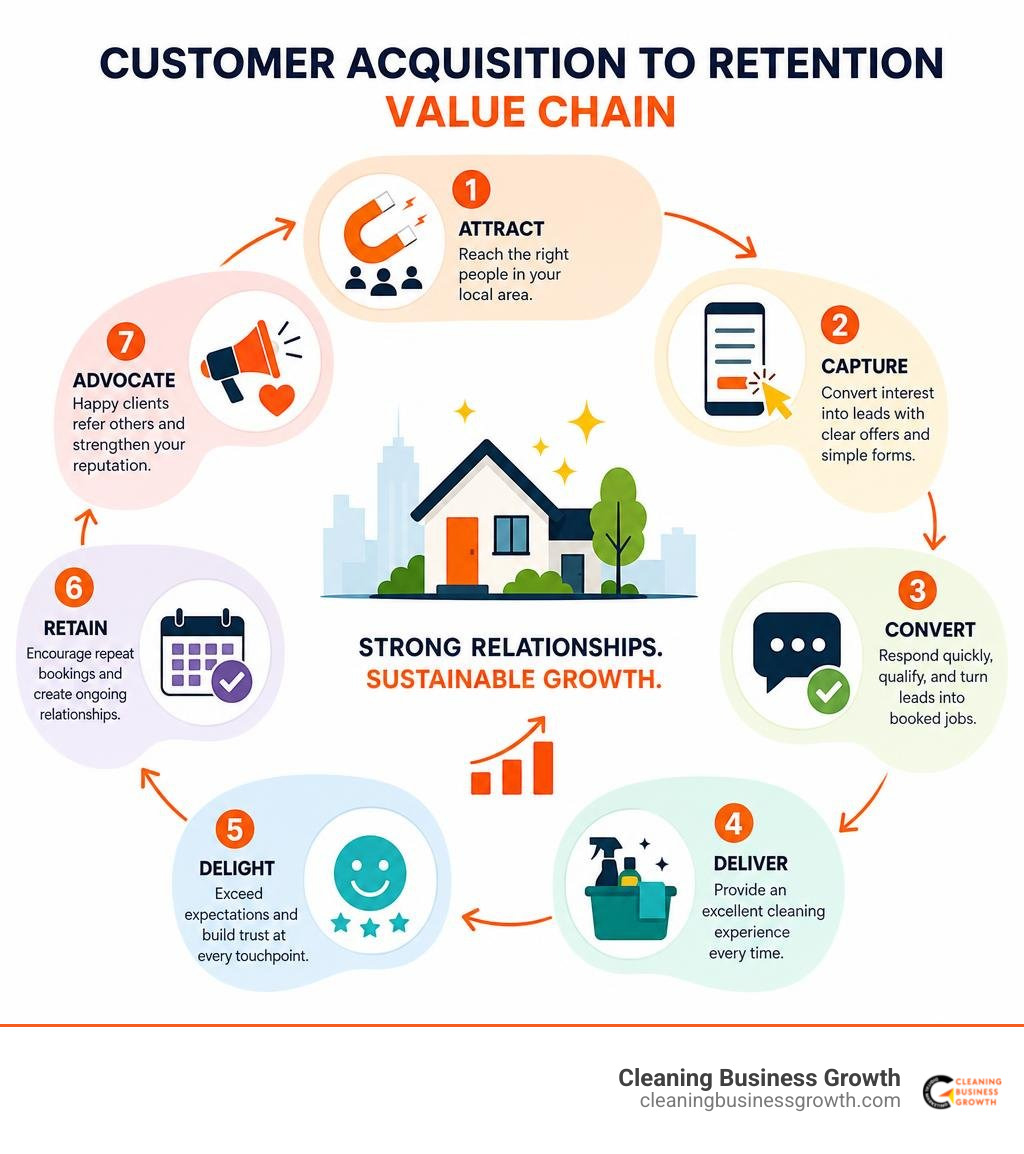
When you look at the client journey, customer retention is just as important as lead acquisition. Losing a bi-weekly client does not only create an opening in the schedule—it also weakens long-term route density, repeat bookings, and referral momentum.
| Lead Generation Channel | Buyer Intent Level | Long-Term Asset Value | Best Use Case |
|---|---|---|---|
| Google Local Services Ads (LSAs) | High (ready to book) | Low (pay-per-lead) | Immediate schedule filling with verified trust badges |
| Google Search Ads (PPC) | High (active problem) | Low (stops when ad spend stops) | Capturing urgent searches such as move-out or post-construction cleaning |
| Local SEO & Google Business Profile | Very high (local searchers) | High (compounds over time) | Dominating local Map Pack visibility for sustainable organic inquiries |
| Meta Ads (Facebook / Instagram) | Medium-low (interruption) | Medium (builds local brand equity) | Creating demand, remarketing, and visual brand awareness |
| Third-Party Aggregators (Angi/Thumbtack) | Medium-high (price shopping) | None (platform owns the user relationship) | Quick short-term volume when starting out |
Cleaning and maid services can build efficient lead generation systems when each marketing channel has a clear role. For an established business, consistent marketing helps maintain steady inquiry volume, while a more aggressive growth push may require a stronger mix of paid search, local SEO, review generation, and follow-up automation.
To explore practical systems for managing growth across these channels, explore our smart marketing playbook for ambitious cleaning business owners.
Core Pillars of Digital Marketing for Cleaning Services in 2026
Relying entirely on a single source of inquiries leaves your business vulnerable to sudden algorithm shifts or rising ad costs. A resilient cleaning business runs a balanced, multi-channel engine designed to capture existing demand, create new interest, and secure long-term organic authority.
Dominating High-Intent Search with Google Ads and Local Services Ads
When someone spills wine on a wool rug or needs a house sanitized before moving in on Friday, they do not browse social media—they turn to search engines.
Capturing these high-intent searches requires a two-pronged paid search strategy:
- Google Local Services Ads (LSAs): Operating on a pay-per-lead model, LSAs place your company at the very top of Google results with a “Google Guaranteed” badge. Because 56% of consumers check online reviews before hiring a cleaner, the prominent star ratings shown in LSAs deliver exceptional conversion rates.
- Google Search Ads (PPC): PPC allows you to bid on granular, high-value terms such as “commercial janitorial services near me” or “emergency move-out cleaning.”
To avoid wasting thousands on unoptimized search campaigns, implement strict negative keyword lists (filtering out terms like “DIY cleaning tips,” “cheap,” or “cleaning jobs”) and use click fraud prevention tools to protect your budget. You can learn more about structuring profitable campaigns in our guide to google ads ppc and see why google ads campaigns are crucial for growing your residential cleaning service.
Local SEO, Google Business Profiles, and Review Generation Engines
Organic search visibility represents the highest-margin lead source for cleaning companies. Dominating the Google Map Pack requires active optimization of your Google Business Profile (GBP):
- Complete Profile Data: Ensure your business name, address, phone number (NAP), hours, and service categories are 100% accurate.
- Visual Proof: Regularly upload geo-tagged before-and-after photos of your team’s work.
- Review Velocity: Set up automated text messages sent within 30 minutes of job completion containing a direct review link. Consistently generating fresh, detailed reviews with service keywords helps close the gap against established competitors.
- Localized Content Architecture: Create individual service pages for each distinct offering paired with your key geographic areas.
To build a rock-solid organic presence, follow our guides on seo for cleaning services, seo strategies for cleaning companies, and review local cleaning service seo keywords the blueprint for map pack rankings. For step-by-step execution, read the practical guide to cleaning company seo for more bookings and learn how to make your cleaning service rank first on google.
Brand Awareness and Social Media Lead Engines
While search captures active demand, social media creates demand by putting your work in front of local homeowners before they actively search.
Meta platforms (Facebook and Instagram) thrive on visual storytelling. High-performing creative assets include:
- Satisfying time-lapse cleaning videos (e.g., restoring a stained tile floor or an oven interior).
- Cleaners in branded uniforms showcasing friendly, background-checked staff to establish immediate trust.
- Simple, upfront promotions for first-time deep cleans.
Social channels also power website retargeting. When a prospect visits your pricing page but leaves without booking, retargeting ads keep your brand top-of-mind across Facebook and Instagram. Dive deeper into our social media services and facebook meta ads strategies. You can also review our guides on how to laser focus your facebook ad targeting for cleaning services today, get fresh advertising inspiration for growing residential and commercial cleaners, and follow the blueprint for profitable cleaning service social media campaigns.
Balancing Short-Term Wins with Long-Term Organic Authority
A common operational mistake is relying exclusively on third-party lead brokers like Angi, Thumbtack, or TaskRabbit. While aggregators can fill short-term schedule holes, they force companies to compete on price, keep lead acquisition costs high, and withhold customer relationship data.
Building sustainable route density requires investing in owned digital assets—primarily a high-converting website and dedicated local search assets.
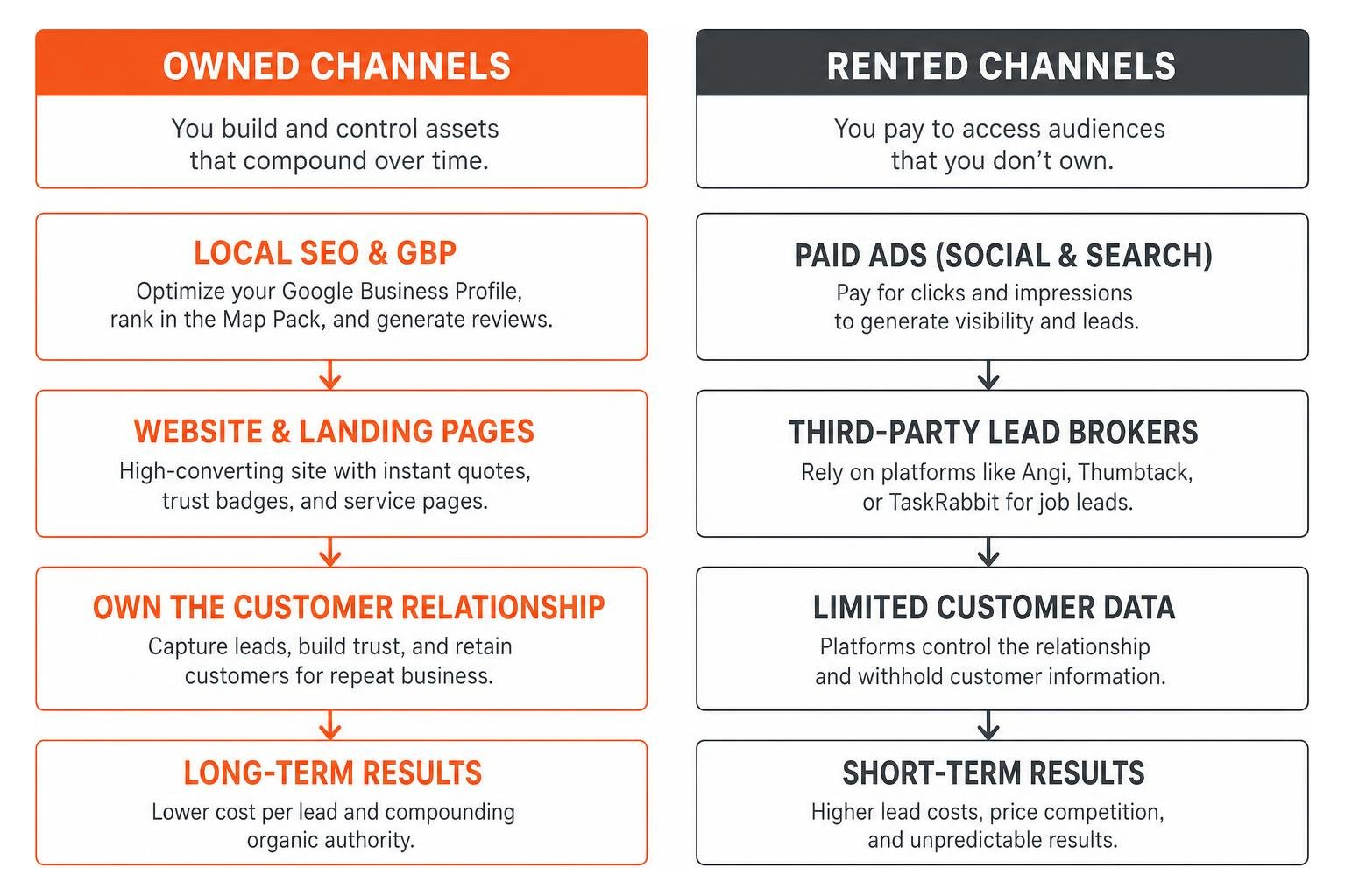
Your website must act as a 24/7 sales representative. High-performing cleaning websites feature:
- Instant online quoting or clear flat-rate pricing options (75% of residential clients prefer flat rates over hourly billing).
- Prominent badges showing insurance, bonding, and background checks.
- Dedicated landing pages for specific niches like maid service marketing and commercial janitorial accounts.
Learn how to structure your online assets with our specialized website design for cleaning services, study elements website design for cleaning services, review the anatomy of a high converting maid service landing page, and implement winning web design strategies for local house and carpet cleaners.
Integrating Organic and Paid Digital Marketing for Cleaning Services
The most profitable cleaning businesses do not choose between paid ads and SEO; they integrate them. Search ads provide immediate booking data showing which keywords convert best in your specific territory. You can then feed those high-converting terms directly into your long-term organic content strategy.
As your local SEO authority rises and your Google Map Pack visibility expands, your reliance on paid clicks decreases. This lowers your blended cost per acquisition while keeping your crews operating at maximum route density.
For a broader perspective on cross-channel planning, check out Marketing for a cleaning business in 2026: Win clients, but keep them longer and listen to The 2026 Digital Marketing Strategy That Actually Works for Cleaning Companies | James Dooley Podcast.
Generative Engine Optimization (GEO) and AI Visibility
Search behavior is evolving rapidly. Prospective residential and commercial clients increasingly use large language models and conversational search tools like ChatGPT, Perplexity, and Google AI Overviews to find local service providers.
To ensure your cleaning company is recommended by AI search engines:
- Maintain Structured Data (Schema Markup): Implement comprehensive
LocalBusinessandCleaningServiceschema across your website so AI engines can easily read your pricing, service areas, and operational hours. - Build Local Brand Authority: LLMs aggregate information from local directories, news mentions, and community forums. An active footprint on neighborhood discussion boards and local directories directly impacts whether an AI assistant cites your business.
- Monitor AI Brand Sentiment: Periodically search your brand name and core services across ChatGPT and Perplexity to see how your services are summarized relative to local competitors.
Turning One-Time Bookings into High-Retention Recurring Contracts
Winning a client’s first clean is only the starting point. Because 60% of recurring residential cleaning clients prefer a bi-weekly schedule, your sales and post-service marketing workflows should be built to convert one-off jobs into ongoing contracts.
Our proven retention strategies include:
- Tiered Packaging: Provide clear packages (e.g., Essential, Deep Clean, Premium Recurring) so clients can easily understand the benefits of recurring maintenance over irregular deep cleans.
- Service Bundling: Combine recurring maintenance with seasonal add-ons, such as adding an annual carpet shampoo or refrigerator cleaning to standard bi-weekly visits.
- Automated Feedback & Win-Back Loops: Use your CRM to trigger satisfaction surveys immediately after every clean. If an issue occurs, resolving it within 24 hours prevents cancellations and builds long-term loyalty.
- Systematized Referral Programs: Reward existing clients with service credits when they introduce neighbors on their street, naturally improving your geographic route density.
To see how these retention systems fit into an end-to-end operational blueprint, explore our clean growth framework, evaluate the stages of growth for cleaning businesses, and review our real-world marketing case studies.
Measuring ROI and Lifetime Value in Digital Marketing for Cleaning Services
Scaling your cleaning business requires tracking clear performance indicators rather than vanity metrics. Before increasing your monthly advertising spend, ensure your operational dashboard tracks:
- Lead-to-Booking Conversion Rate: The percentage of incoming calls, form submissions, and messages that turn into scheduled estimates or booked jobs.
- Contact Rate: The speed and percentage of inbound leads your team successfully reaches.
- Customer Acquisition Cost (CAC): Total sales and marketing spend divided by total new clients acquired over a given period.
- Blended Cost Per Lead (CPL): Average lead acquisition cost across all active paid and organic channels.
- Recurring Retention Rate: The percentage of clients who remain active past 3, 6, and 12 months.
Speed-to-Lead Protocols and Automated CRM Lead Nurturing
In the cleaning industry, response time directly determines conversion rates. A prospect requesting a quote online is often reaching out to two or three local companies simultaneously. Responding within 5 minutes increases booking rates dramatically compared to waiting an hour or more.
Integrating your digital marketing campaigns with an automated CRM allows you to:
- Instantly send a personalized SMS and email confirmation the moment an online quote request is submitted.
- Trigger automated booking links so prospects can self-schedule their initial estimate.
- Dispatch automated appointment reminders to reduce cancellations and no-shows.
- Re-engage past one-time deep cleaning leads with seasonal follow-up campaigns.
Frequently Asked Questions About Cleaning Business Marketing
How much does a typical cleaning service lead cost?
Across the industry, cleaning and maid service leads average approximately $47 each. Google Local Services Ads and targeted Search Ads generally range between $25 and $65 per qualified lead, while visual social media campaigns on Meta platforms often generate initial inquiries between $15 and $40. For context on cleaning-business marketing benchmarks and client value, see this 2026 cleaning business marketing guide.
What is the best strategy to get recurring cleaning clients?
The most reliable way to secure recurring clients is to make bi-weekly recurring service your default, best-value offering. Follow up immediately after an initial deep clean or move-in clean with an automated discount or credit applied toward their first recurring visit. Pairing consistent cleaning quality with flat-rate pricing makes ongoing scheduling simple for homeowners.
Are third-party lead generation platforms worth using compared to owning your lead funnel?
Third-party platforms like Angi or Thumbtack can provide fast volume for new cleaning businesses looking to build initial cash flow. However, because they foster aggressive price shopping and do not give you ownership over the customer acquisition channel, growing companies should prioritize owned assets—specifically local SEO, a high-converting website, and direct search ads.
Conclusion
Scaling a cleaning business from unpredictable revenue to sustainable profitability requires connecting front-end digital marketing directly to back-end customer retention. By combining high-intent Google search channels, targeted social awareness, active Google Business Profile management, and rapid automated lead follow-up, you build a dependable client acquisition engine.
At Cleaning Business Growth, we specialize in helping cleaning companies implement proven, no-contract digital marketing systems built around recurring revenue and route density. If you are ready to stop chasing one-off leads and start building a predictable client base, explore our full suite of digital marketing for cleaning businesses and partner with our team today.