Core Foundations of a Modern Cleaning Service Marketing Strategy
An effective cleaning service marketing strategy combines high-intent local search acquisition (Google Local Services Ads and SEO), flat-rate pricing focused on bi-weekly recurring contracts, automated review generation, and rapid lead response times. By connecting customer acquisition cost (CAC) directly to client lifetime value and route density, cleaning business owners build a predictable, scalable revenue engine rather than relying on volatile one-off bookings.
Many cleaning business owners fall into the trap of viewing marketing purely as top-of-funnel lead generation. When you treat client acquisition as a treadmill where you constantly replace departing one-off customers, marketing feels expensive, exhausting, and unpredictable.
A modern, high-growth cleaning business views marketing as an integrated revenue engine. In this framework, customer acquisition cost (CAC), pricing structures, and retention metrics are completely linked. By mastering these unit economics, you can acquire clients profitably while building a sustainable, sellable asset.
Assessing Lifetime Value and Recurring Revenue Economics
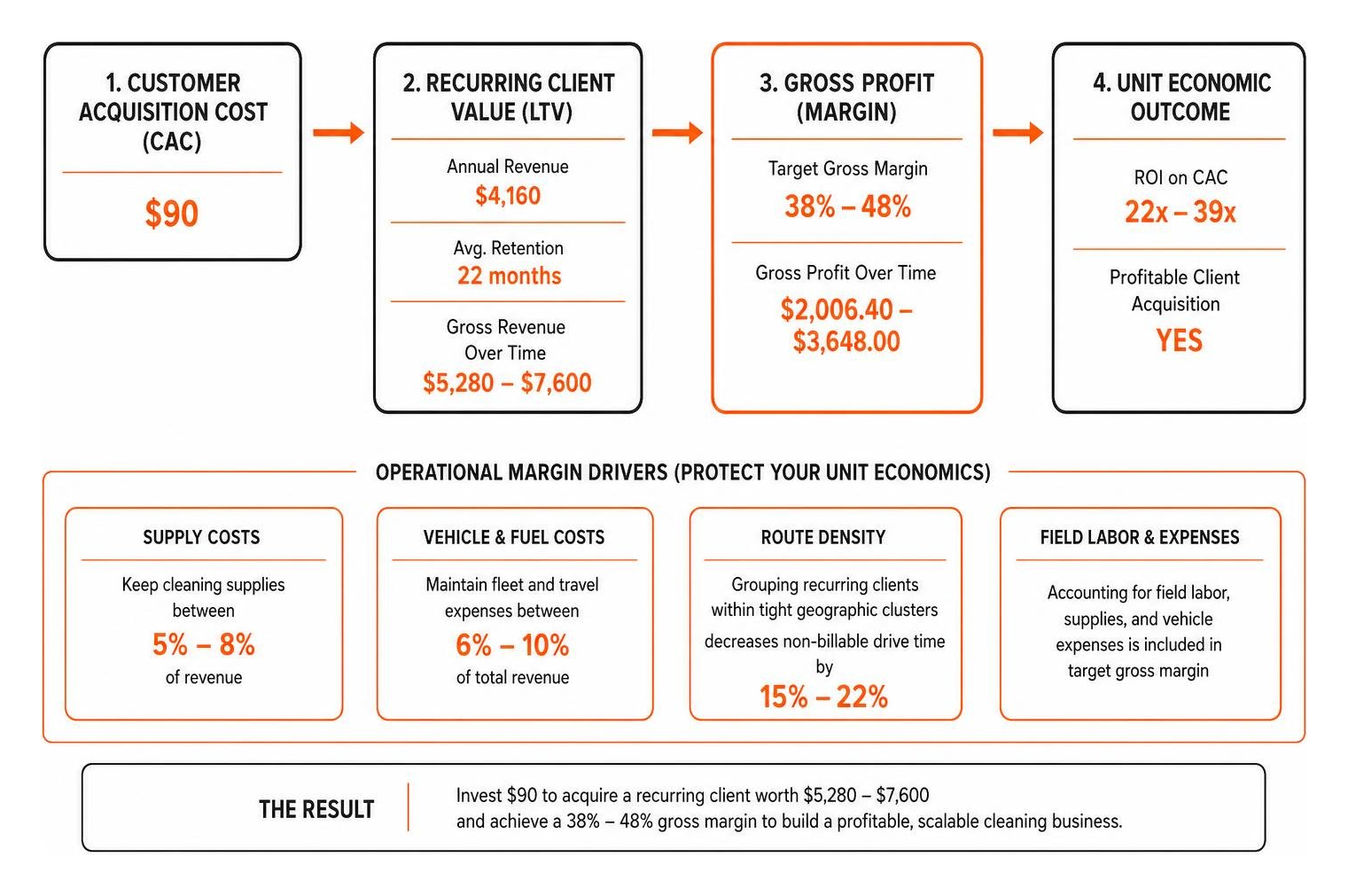
The math behind a thriving residential maid service or commercial cleaning company hinges on customer lifetime value (LTV). Industry benchmarks show that a typical bi-weekly residential cleaning customer generates approximately $160 per visit, or $4,160 annually. With an average recurring tenure of 22 months, that single client yields near $7,600 in gross revenue. Even at conservative baseline averages—$330 per month across a 16-month average retention period—a residential client is worth roughly $5,280 over time.
Compare that to a single one-off deep clean generating $300 to $400. If your customer acquisition cost is $90, spending that money to capture a one-time clean eats away at your margins. However, investing $90 to acquire a recurring client worth $5,280 to $7,600 yields an extraordinary return on investment.
To protect these unit economics, your operational margins must remain healthy:
- Target Gross Margin: Aim for 38% to 48% after accounting for field labor, supplies, and vehicle expenses.
- Supply Costs: Keep cleaning supplies between 5% and 8% of revenue.
- Vehicle & Fuel Costs: Maintain fleet and travel expenses between 6% and 10% of total revenue.
- Route Density: Grouping recurring clients within tight geographic clusters decreases non-billable drive time by 15% to 22%, expanding your team’s earning capacity.
A strong, systematic model like our Clean Growth Framework aligns your pricing structure, recurring customer acquisition, and route optimization into a predictable, scalable system.
Budget Allocation Across Business Growth Milestones
Marketing budgets should never be arbitrary. Instead, allocate resources based on your business stage, target growth velocity, and proven customer acquisition math.
Depending on your current revenue and operational maturity, allocate your gross revenue as follows:
- Established / Maintenance Mode (5% to 10% of revenue): Focused on maintaining market share, route density, and replacing natural client attrition.
- Active Growth Phase (10% to 15% of revenue): Designed to add routes, hire additional cleaning technicians, and dominate the local market.
- Aggressive Expansion / Startup Phase (15% to 20% of revenue): Necessary when launching in new territories or scaling rapidly past early milestones.
Review how your operational capabilities match your target trajectory by evaluating the Stages of Growth for Cleaning Businesses.
When deploying that budget, balance your media mix across intent-driven channels. A reliable starting allocation for scaling companies includes:
- 40% High-Intent Search Ads: Google Ads and Google Local Services Ads (LSA).
- 25% Social Advertising: Facebook and Instagram targeted campaigns for brand awareness and retargeting.
- 15% Direct Outreach & Hyperlocal Print: Targeted direct mail to high-income neighborhoods and local business networking.
- 10% SEO & Content Strategy: Ongoing local optimization, citation building, and service-area content development.
- 10% Software & Marketing Automation: CRM infrastructure, automated SMS follow-up tools, and pipeline management.
Building High-Intent Search and Local Acquisition Channels
When a homeowner discovers a messy home after a long workweek, or an office manager needs immediate janitorial support, they do not wait around for a flyer. They pick up their phone and search Google. Capturing this high-intent demand is the fastest way to generate predictable leads.
A comprehensive Digital Marketing for Cleaning Businesses strategy combines organic visibility on search engines with paid search ads to capture customers at the exact moment they are ready to book.
Dominating Local SEO and Map Pack Rankings
The Google Local 3-Pack (the map listings displayed at the top of local search results) generates the majority of organic clicks for cleaning queries. Securing a spot in this section requires an optimized Google Business Profile (GBP) and a website structured for local discovery.
To optimize your Google Business Profile:
- Complete Every Profile Field: Select primary categories such as “House Cleaning Service” or “Janitorial Service,” and include secondary categories like “Carpet Cleaning Service” or “Window Cleaning Service.”
- Add Geo-Targeted Visual Proof: Upload 20 to 30 authentic, high-resolution before-and-after photos of kitchens, bathrooms, and commercial floors. Update these weekly.
- Build Granular Service Area Pages: Rather than listing all towns on a single page, build dedicated landing pages for each municipality and neighborhood (e.g., “Maid Service in [Neighborhood]”). Include localized testimonials, pricing guidelines, and driving directions to boost relevance.
Deploying proven SEO Strategies for Cleaning Companies ensures your website ranks organically for competitive terms like “house cleaning near me” and “office cleaners in [City].”
Scaling Inbound Leads with Google Ads and Local Services Ads
While organic SEO builds sustainable long-term value, paid search delivers immediate, high-intent lead volume.
The cleaning vertical benefits from an attractive cost-per-lead landscape:
- Average Cleaning Cost Per Lead (CPL): Averages roughly $47, making it one of the most affordable home service categories (compared to $90+ for general trades and $200+ for roofing).
- Google Local Services Ads (LSA): Operates on a pay-per-qualified-lead model rather than pay-per-click. Leads typically cost $25 to $60 in standard US metros and $60 to $110 in high-cost metro areas.
- Conversion Efficiency: LSA leads close at an impressive 35% to 45%, compared to shared-lead platforms that often convert at only 8% to 15%.
Earning the green Google Guaranteed badge requires passing background checks and submitting proof of liability insurance ($1M minimum recommended). Once active, Google routes calls directly to your business.
When managing Google Ads search campaigns, implement strong negative keyword lists. Filter out non-commercial terms such as “free,” “DIY,” “jobs,” “salary,” “recipes,” and “cleaning hacks.” This prevents wasted ad spend so every click comes from an actual buyer. Understanding why Google Ads campaigns are crucial for growing your residential cleaning service will help you turn paid clicks into predictable, long-term revenue.
Mastering Client Retention and Recurring Contract Conversions
Acquiring a lead is only the first step. The true enterprise value of a cleaning company is determined by its recurring customer base. Cleaning companies with 70%+ recurring revenue sell for 3x to 5x annual revenue, whereas businesses built on one-time transactional cleans trade for only 1x to 2x annual revenue.
| Metric / Attribute | One-Off / Transactional Model | Recurring Contract Model (Weekly / Bi-Weekly) |
|---|---|---|
| Average Client Lifetime Value | $300 – $450 | $5,280 – $7,600+ |
| Customer Acquisition Cost Payback | 1 to 2 cleanings (tight margins) | Under 6 weeks (rapid ROI) |
| Schedule Predictability | High volatility, constant re-booking | Highly predictable, automated routing |
| Business Valuation Multiplier | 1x – 2x annual revenue | 3x – 5x annual revenue |
| Operational Route Efficiency | Scattered drive times across town | Dense, clustered service routes |
Optimizing Your Cleaning Service Marketing Strategy for Bi-Weekly Contracts
To convert one-off inquiries into long-term recurring revenue, make recurring service your default offering across all sales copy and checkout flows. Data indicates that 60% of recurring customers prefer a bi-weekly schedule, and 75% prefer transparent flat-rate pricing over hourly estimates.
To maximize recurring conversions:
- Price First-Time Cleans Strategically: Charge a premium for initial deep cleans ($280 to $550) to account for extra buildup and reset the home’s baseline condition.
- The 48-Hour Conversion Window: Contact the client within 24 to 48 hours after their first cleaning while satisfaction is at its peak. Offer an introductory 10% to 15% discount or a free add-on (like interior oven or refrigerator cleaning) if they lock in a bi-weekly schedule. This simple follow-up habit routinely boosts first-to-recurring conversions from 25% to over 50%.
- Offer Flexible Frequency Tiers: Package your services into Weekly, Bi-Weekly, and Monthly tiers, clearly demonstrating the per-visit cost savings of higher frequency.
For dedicated strategies on positioning residential services, study our guide on Maid Service Marketing.
Turning Social Proof and Automated Reviews into Referral Flywheels
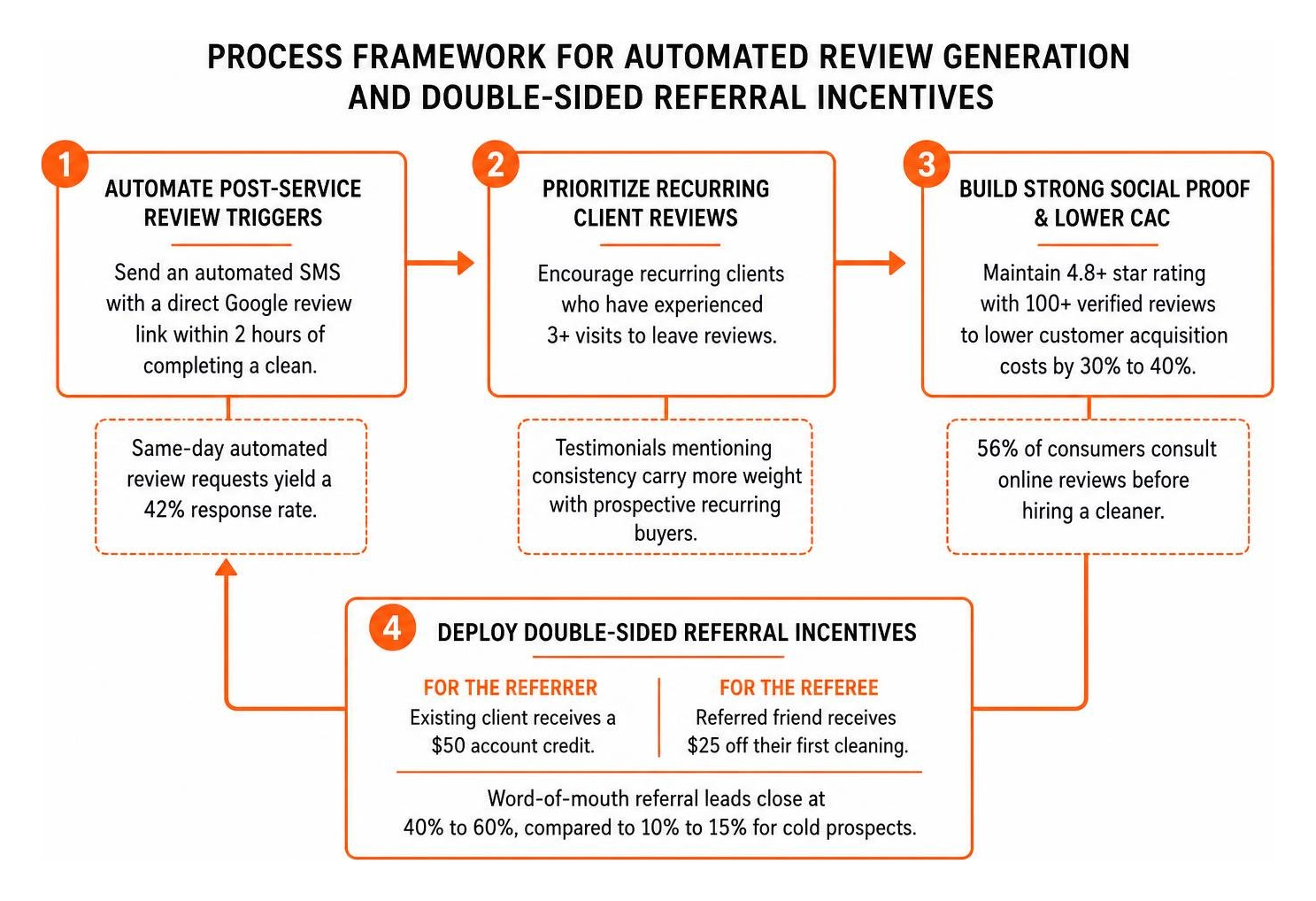
Social proof drives conversion rates across the home services industry. More than 56% of consumers consult online reviews before hiring a cleaner. Furthermore, maintaining a 4.8+ star rating with over 100 verified reviews lowers your customer acquisition costs by 30% to 40% across all paid marketing channels.
To build a continuous review and referral engine:
- Automate Post-Service Review Triggers: Send an automated SMS containing a direct Google review link within 2 hours of completing a clean. Same-day automated review requests yield a 42% response rate.
- Prioritize Recurring Client Reviews: Encourage recurring clients who have experienced 3+ visits to leave reviews. Testimonials that mention consistency (e.g., “They’ve cleaned our home every two weeks for a year!”) carry significantly more weight with prospective recurring buyers than single-visit reviews. Learn more about the importance of reviews to cleaning business growth.
- Deploy Double-Sided Referral Incentives: Provide existing clients with a $50 account credit and give their referred friend $25 off their initial cleaning. Word-of-mouth referral leads close at 40% to 60%, compared to 10% to 15% for cold prospects.
Scaling Commercial Janitorial and Property Management Accounts
While residential cleaning offers rapid sales cycles and high transaction volumes, the $19 billion U.S. commercial cleaning industry provides stability through multi-year contracts, larger monthly billings, and predictable daytime or evening schedules.

Tailoring a B2B Cleaning Service Marketing Strategy for Facility Contracts
Marketing to commercial facility managers, medical offices, and property management firms requires a different approach than direct-to-consumer advertising. B2B decision-makers prioritize reliability, comprehensive liability insurance, standardized reporting, and backup staffing over flashy discounts.
Commercial marketing channels rely on:
- Account-Based Marketing (ABM): Identify high-value commercial targets within your service territory—such as corporate offices, medical clinics, and industrial facilities. Engage property directors through multi-touch campaigns combining personalized email, professional mailers, and LinkedIn outreach.
- Property Management Partnerships: A single property manager can oversee tens or hundreds of residential and commercial units. Approach property managers with clear Service Level Agreements (SLAs), standardized damage reporting procedures, and guaranteed backup cleaner coverage.
- Educational RFP Bidding Proposals: Win competitive janitorial bids by providing transparent scope-of-work documentation, chemical safety compliance sheets, and digital inspection audit samples.
Ensure your digital presence reflects this standard of professionalism through strategic Website Design for Cleaning Services.
Differentiating Service Offerings with Video and Niche Positioning
Video content builds immediate trust, showing prospective commercial and residential clients the team and techniques behind your brand.
Ways to leverage visual storytelling:
- Before-and-After Video Walkthroughs: Film short, high-contrast clips of deep floor scrubs, grease-laden commercial kitchens, or pristine move-out turnovers for social media and landing pages.
- Team Introduction & Culture Spotlights: Feature your cleaners discussing safety standards and quality control. Humanizing your team eases security concerns for residential homeowners and corporate facility managers alike.
- Niche Specialization Positioning: Highlight high-margin specialty services like post-construction cleanup, eco-friendly green cleaning, or medical-grade terminal sanitization.
Distribute these video assets across social channels using targeted Facebook Meta Ads and local community platforms to maintain top-of-mind awareness.
Streamlining Operations, Lead Response, and Automated Systems
The most sophisticated marketing campaign will fail if operational bottlenecks prevent you from closing and retaining incoming leads. Lead conversion in the cleaning industry is heavily dependent on speed: roughly 78% to 80% of clients hire the first service provider that responds to their inquiry.

Eliminating Critical Pricing and Pipeline Mistakes
Avoid common operational pitfalls that drain marketing ROI:
- The Hourly Pricing Trap: Hourly rates penalize your fastest, most experienced cleaners while rewarding slow work. Hourly pricing also creates billing friction with clients who watch the clock. Use flat-rate pricing based on square footage, room count, and home condition.
- Ignoring the Cancellation Save Workflow: When a recurring client calls to cancel, have a structured retention offer ready. Empower your office team to offer a complimentary schedule pause (30/60/90 days), a free service upgrade, or a reassignment to a senior lead cleaner. This simple workflow saves 35% to 50% of cancellations.
- Choosing the Wrong Growth Partners: Avoid working with generalist agencies that do not understand cleaning margins, dispatch systems, or technician retention. Review the differences between Niche vs Generalist Marketing Agencies before choosing a partner.
Implementing High-Converting Booking and Communication Workflows
To capture modern consumers who prefer self-service scheduling, implement frictionless online booking flows. Research shows that websites with online booking convert 2x to 3x more visitors than static contact forms.
Key elements of an effective conversion pipeline:
- Instant Online Quoting: Provide upfront estimates based on home or facility parameters.
- 5-Minute Automated Text Responses: Use CRM automations to send an immediate SMS and email confirmation whenever a web lead arrives outside business hours.
- Automated Win-Back Campaigns: Trigger automated email and SMS check-ins to past one-time deep clean clients at 90-day intervals, offering a seasonal tune-up discount.
Ensure your digital storefront integrates these elements by reviewing the foundational principles of Elements Website Design for Cleaning Services.
Frequently Asked Questions About Cleaning Service Marketing
What is the most effective marketing channel for a cleaning business in 2026?
Google Local Services Ads (LSA) and Google Business Profile (Local SEO) generate the highest return on investment. These channels capture prospects at the exact moment they search for cleaning solutions, resulting in 35% to 45% close rates on inbound calls.
How much should a cleaning company spend on marketing each month?
Most established cleaning businesses allocate 5% to 10% of gross monthly revenue to maintain their client base. Companies pursuing active expansion should invest 10% to 15%, while new companies launching in competitive markets often spend 15% to 20% to build initial route density.
How do cleaning businesses convert one-time cleans into recurring clients?
The most reliable approach is following up by phone or SMS within 24 to 48 hours of completing the initial cleaning. Pair this check-in with an introductory discount on bi-weekly service and emphasize your flat-rate pricing packages.
Conclusion
Building a high-growth cleaning business does not require working longer hours in the field or competing in a race to the bottom on price. By combining targeted local search acquisition, automated review generation, flat-rate recurring packages, and fast lead response times, you can turn your marketing into a reliable engine for long-term growth.
At Cleaning Business Growth, we build hands-off digital marketing systems specifically designed for cleaning company owners. We combine industry-specific web design, high-converting Google and Meta ad management, local SEO, and automated CRM pipelines to help you scale your business sustainably.
Ready to build a reliable marketing and retention system for your business? Partner with our team through our proven Growth Marketing Coaching program and start scaling your cleaning company today.