Why SEO for Cleaning Companies Matters in 2026
To make your cleaning service rank first on Google, you need an integrated local SEO strategy: optimize your Google Business Profile for the Local 3-Pack, maintain strict NAP consistency across directories, build localized service landing pages, and systematically generate authentic customer reviews. Implementing strategic seo for cleaning companies transforms your digital presence into a consistent lead generation engine that secures high-margin recurring residential and commercial clients.
The global cleaning industry reached an incredible $451.63 billion in 2025 and is expanding at 7.5% annually. That growth brings tremendous opportunity, but it also means local markets are more competitive than ever. Every month, new independent cleaners and national franchises enter your service area, bidding for the exact same clients.
If you rely exclusively on paid ads, word-of-mouth, or flyer drops, your customer acquisition costs will climb while your margins shrink. Organic search engine optimization changes that dynamic entirely.
Consider how modern customers buy: 98% of consumers search online before hiring a local service business, and 46% of all Google searches carry local intent. When a homeowner needs a deep clean before hosting an event, or an office manager needs recurring janitorial work, they turn to Google.
Organic search traffic delivers unmatched value:
- Higher conversion rates: Leads generated through organic search boast a 14.6% close rate, compared to just 1.7% for outbound channels like cold outreach.
- Superior return on investment: Local service businesses experience an average 8x ROI from disciplined search marketing.
- Immediate consumer action: 76% of local mobile searchers visit or call a business within 24 hours of their initial search.
Navigating The Evolving Landscape of SEO requires shifting away from outdated tactics like keyword stuffing. Today, search engines evaluate proximity, user experience, authority, and contextual relevance. When you optimize properly, your website becomes a 24/7 sales representative that books jobs while you sleep.
How Google AI Overviews and Search Features Impact Local Cleaners
Search results look vastly different today than they did a few years ago. Over 58.5% of searches now end without a click, largely because Google answers basic queries directly inside the results page via featured snippets, map packs, and AI Overviews.
AI Overviews now appear in over 13% of total searches. When an AI Overview triggers, standard organic clicks can drop by up to 61%. Understanding how AI Changing Local SEO affects service providers is critical if you want to protect your organic pipeline.
Fortunately, local and transactional queries remain remarkably resilient. Homeowners cannot hire an AI summary to scrub their baseboards or steam clean their carpets. However, Google’s algorithms increasingly look for authoritative, clearly structured data to cite inside AI Overviews and conversational voice results.
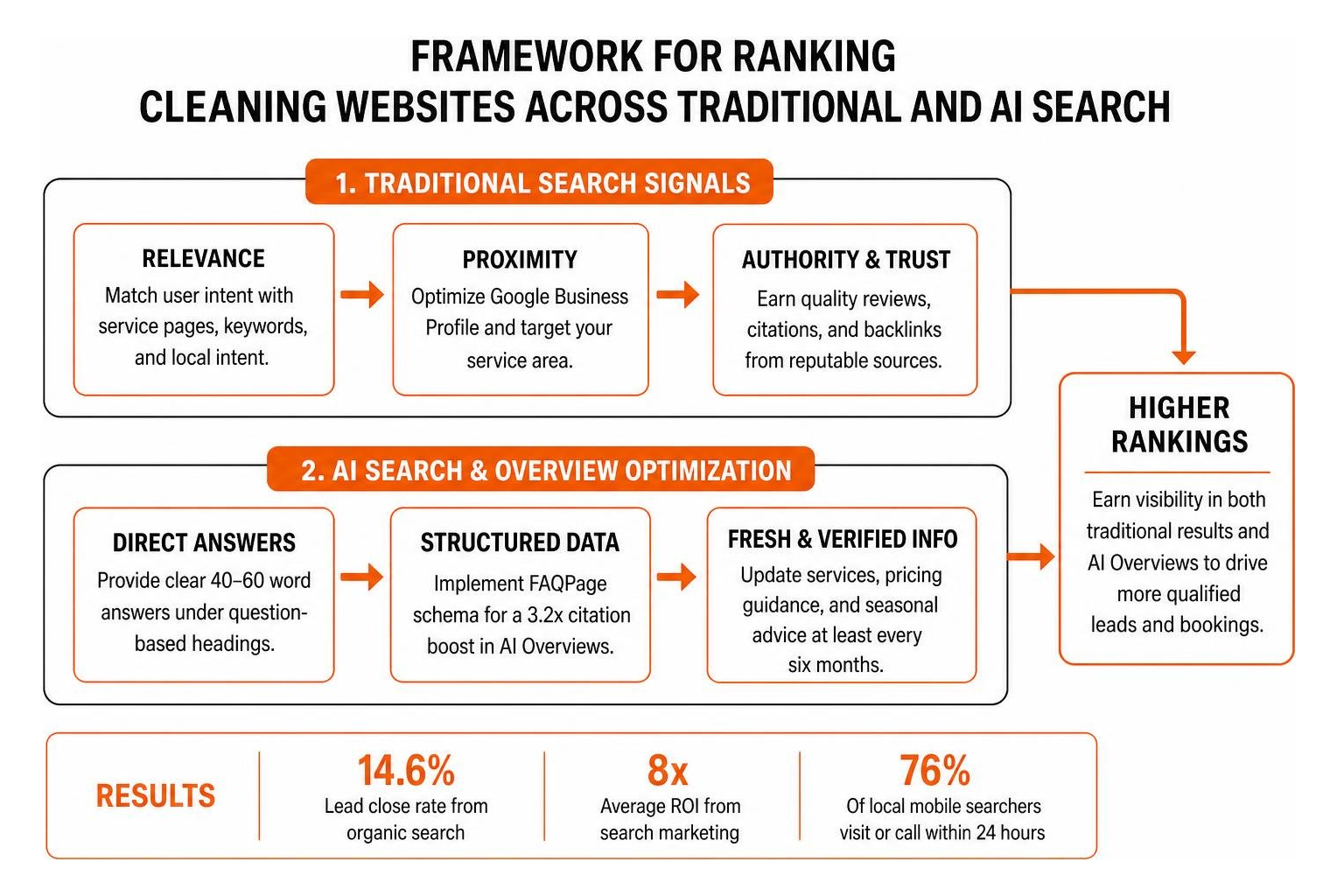
To ensure your cleaning service gets cited and ranked in this modern environment:
- Direct question answering: Structure your service content with concise 40-to-60-word answers directly beneath question-based H2 and H3 headings.
- Implement structured data: Applying
FAQPageschema gives your content a 3.2x citation boost in AI Overviews. - Maintain fresh information: Update service offerings, pricing guidance, and seasonal advice at least every six months, as search engines strongly favor recently verified local data.
Commercial vs. Residential SEO for Cleaning Companies
A common mistake cleaning business owners make is treating all cleaning keywords the same. Commercial cleaning (B2B) and residential maid services (B2C) feature entirely different search intents, decision timelines, and customer lifetime values.
| Strategic Dimension | Residential Maid Services (B2C) | Commercial & Janitorial Services (B2B) |
|---|---|---|
| Primary Target Audience | Busy homeowners, parents, tenants, short-term rental hosts | Facility managers, property management firms, office administrators |
| Search Queries & Phrasing | “house cleaning near me”, “maid service cost [city]”, “move out cleaning” | “commercial janitorial services [city]”, “office cleaning contract”, “medical clinic cleaning” |
| Search Volume & Intent | High search volume; immediate need; rapid booking decisions (same-day to 48 hours) | Lower search volume; high intent; research-heavy evaluations with multi-step RFP cycles |
| Conversion Focus | Online booking forms, clear hourly/flat rates, instant quote calculators, SMS chat | Case studies, scope-of-work specs, bonded/insured proof, request-for-proposal downloads |
| Content Strategy | Before-and-after photos, pet-friendly cleaning tips, neighborhood-specific home tips | Compliance guidelines (OSHA/HIPAA), industry certifications (ISSA/IICRC), commercial equipment specs |
| Average Client Lifetime Value | $1,500 to $4,000 annually (recurring bi-weekly/monthly) | $12,000 to $100,000+ annually (multi-year corporate service contracts) |
Residential clients want speed, transparent estimates, and immediate proof of trust. Commercial clients search with high scrutiny, evaluating risk management, specialized certifications, and operational reliability. Structuring distinct page silos for each division ensures search engines match the exact search intent of each audience.
Dominating Google Business Profile and the Local 3-Pack
Your Google Business Profile (GBP) is the single most valuable digital asset your cleaning company owns. Industry studies confirm that your GBP accounts for roughly 32% of your Local Pack ranking power. Furthermore, businesses with fully completed profiles are 2.7 times more likely to be considered trustworthy by consumers.
When a homeowner searches “cleaning services near me,” Google generates the Local 3-Pack—the three highlighted map listings displayed above standard organic results. Capturing one of these spots drives consistent phone calls and booking requests without paid ad spend.
To maximize your Google Business Profile performance:
- Select the precise primary category: Choose the category that best matches your primary revenue stream (House Cleaning Service, Commercial Cleaning Service, or Carpet Cleaning Service). Use secondary categories (Janitorial Service, Window Cleaning Service, Upholstery Cleaning Service) to capture auxiliary services.
- Define your service areas accurately: If you operate as a service-area business without a physical storefront open to the public, hide your street address and designate the exact cities, counties, and postal codes you serve within a 20-to-30-mile radius.
- Upload authentic visual proof weekly: Skip generic stock photography. Profiles showcasing 250+ genuine photos of your branded vehicles, uniformed crew members, and real before-and-after projects generate significantly more engagement and trust signals.
- Publish weekly Google updates: Treat your profile like a localized social channel. Share seasonal cleaning checklists, promotional discounts, and recent project highlights. Regular posting can increase customer interactions by up to 30%.
- Populate the complete services menu: Add detailed descriptions and starting rates for every service you offer. This helps Google connect your profile directly with long-tail conversational searches.
NAP Consistency and Local Citation Management
Search engines verify physical legitimacy by checking directory listings across the web. This core local ranking signal is known as NAP: Name, Address, and Phone Number.
Unfortunately, 41% of local businesses suffer from inconsistent NAP listings, diluting their search visibility. If your business is listed as “Sparkle Cleaners LLC, Suite 100” on Google, but appears as “Sparkle Cleaning Co., #100” on Yelp and “Sparkle Cleaners” on YellowPages, search algorithms struggle to confirm your business identity.
To establish citation authority:
- Maintain identical spelling, suite formatting, and phone numbers across all directories.
- Prioritize high-authority core platforms: Apple Maps, Bing Places, Yelp, Angi, Better Business Bureau (BBB), and Chamber of Commerce directories.
- Audit secondary aggregators (Data Axle, Neustar Localeze, Factual) to correct or suppress legacy phone numbers and old addresses.
- Businesses listed consistently across three or more trusted directories earn 70% higher trust ratings from search algorithms and prospective clients.
Generating High-Impact Reviews and Social Proof
Customer reviews account for 19.2% of local ranking factors, functioning as both an organic ranking signal and a primary conversion driver. About 86% of consumers read reviews before booking a local business, 79% trust online reviews as much as personal recommendations, and 57% will only hire a company boasting 4 or more stars.
Happy customers frequently forget to leave feedback on their own, while unhappy clients often rush to leave a negative comment. Building a systematic review engine levels the playing field:
- Timing is everything: Send automated review requests via SMS or email within 2 to 4 hours of job completion, while the sparkle of their clean home or office is fresh in their mind.
- Eliminate friction: Provide a direct, one-click short link straight to your Google review submission box.
- Prompt location and service context: Encourage clients to mention the specific service performed and their neighborhood (e.g., “We’d love it if you mentioned your neighborhood and the move-out clean our team provided!”). This naturally enriches your profile with geo-specific keywords.
- Respond to every single review: Responding to both positive and negative feedback boosts perceived customer trust by 76%. Use your responses to reinforce your service standards and mention the service area naturally.
High-Performance On-Page and Technical SEO Architecture
Your website serves as the foundation for your entire digital presence. Even the most polished Google Business Profile cannot compensate for a slow, confusing, or broken website.
Technical performance directly impacts your bottom line. With 84% of local searches happening on mobile devices, responsive mobile design is mandatory. If your site takes longer than 3 seconds to load, 88.5% of visitors will leave immediately. A mere one-second delay in mobile load times can slash your conversion rate by up to 20%.
Ensure your site meets technical performance standards:
- Core Web Vitals compliance: Keep Largest Contentful Paint (LCP) under 2.5 seconds, Cumulative Layout Shift (CLS) under 0.1, and Interaction to Next Paint (INP) under 200 milliseconds.
- Image compression: Convert all project photography to WebP format, ensuring file sizes remain under 150 KB.
- Mobile-first accessibility: Ensure click-to-call phone buttons, quote forms, and navigation menus are thumb-friendly, with tap targets measuring at least 48×48 pixels.
- Structured data markup: Pages containing rich schema markup earn up to 25% higher click-through rates. Implement
LocalBusiness,Service,AggregateRating, andFAQPageschemas via JSON-LD so search crawlers can instantly understand your pricing, operating hours, service radius, and customer ratings.
For a deeper dive into technical site optimization, explore our guide to SEO Strategies for Cleaning Companies to learn how on-page optimization strengthens your local search presence step by step.
Keyword Strategy and On-Page SEO for Cleaning Companies
Modern keyword strategy requires organizing your content into a three-layer keyword architecture rather than repeating the same phrase over and over:
When building each service page, optimize key on-page elements:
- Title tag formula: Keep your title tags under 60 characters:
[Primary Service] in [City, State] | [Brand Name]. For example: House Cleaning in Denver, CO | Mile High Maids. - Meta description: Write a compelling 150-to-160-character pitch with an explicit call to action: “Trusted, bonded house cleaning in Denver. Fast online booking, eco-friendly supplies, and 5-star crews. Call (303) 555-0123 for a free quote!”
- Header hierarchy: Use a single, descriptive H1 per page containing your core service and city. Structure your H2s to address customer questions, service checklists, and transparent pricing information.
Building Scalable Hyperlocal and Service-Specific Landing Pages
If your cleaning company serves multiple suburbs, business parks, or neighborhoods, creating a single generic “Areas We Serve” page will not get the job done. Proximity and geographic relevance drive over 55% of local ranking decisions.
To capture qualified leads across your entire market, build 10 to 15 dedicated, hyper-local neighborhood landing pages (800 to 1,200 words each).
Avoid duplicate template pages where you simply swap out the city name. Google penalizes repetitive boilerplate content. Instead, customize each neighborhood page with real local context:
- Mention distinct local housing styles (e.g., historic bungalows requiring delicate hardwood care vs. modern high-rise condos).
- Reference local community landmarks, parks, and prominent intersections.
- Embed a dynamic Google Map highlighting that specific service sector.
- Showcase authentic customer testimonials and before-and-after projects completed specifically within that neighborhood.
- Add unique, localized FAQ sections answering specific community questions (such as parking logistics, local water hardness, or pet-safe cleaning methods).
Using specialized cleaning business management tools helps you coordinate service routes and track location-specific customer histories, making localized marketing even easier.
Tracking SEO Performance and Agency vs. DIY Execution
Search engine optimization is an ongoing growth system, not a one-time setup. To understand whether your optimization efforts are translating into paying customers, track key performance indicators (KPIs) through Google Search Console, Google Analytics 4, and dynamic call tracking software.
As your cleaning business expands, you must decide whether to manage your SEO in-house or partner with an industry-specific digital marketing agency.
While handling your own SEO can save money in the early stages, managing technical schema, citation audits, link building, and content creation pulls you away from hiring cleaners, managing quality control, and serving clients.
Despite changing algorithms, industry data confirms that SEO Is Not Dead. It remains the single most reliable driver of high-margin recurring cleaning accounts when executed with consistency.
Frequently Asked Questions About Cleaning Business Search Rankings
How long does SEO take to generate leads for a cleaning business?
Most cleaning companies start seeing noticeable improvements in keyword rankings and website traffic within 3 to 6 months of disciplined optimization.
Local SEO results compound over time. During months 1 and 2, technical errors are resolved, your Google Business Profile is fully optimized, and core citations are corrected. Months 3 through 6 establish domain authority as localized reviews, dedicated neighborhood pages, and authoritative backlinks take hold. By months 6 through 12, top-ranking cleaning websites typically experience a consistent, predictable stream of inbound phone calls and quote submissions.
What is NAP consistency and why is it important for local cleaners?
NAP stands for Name, Address, and Phone number. It represents the baseline geographic identity of your company across the internet.
Maintaining identical NAP listings across directories (Google, Bing, Yelp, Facebook, Angi) is essential because search engine crawlers cross-reference these sources to confirm your physical location. Inconsistent formatting—such as mismatched suite numbers, old phone numbers, or variations in your business name—creates algorithmic doubt. Search engines hesitate to recommend businesses with conflicting data, which directly suppresses your Local 3-Pack rankings.
How can cleaning companies optimize for voice search and AI answers?
Over 1 billion voice searches are conducted every month, and 76% of them represent local “near me” inquiries. Unlike typed keywords (which are short and direct, like “maid service Denver”), voice searches are conversational (such as “Siri, find the highest-rated move-out cleaner near me”).
To capture voice search and AI Overviews:
- Frame your page subheadings (H2s and H3s) as conversational, natural-language questions.
- Provide a direct, factual answer in the first 40 to 60 words immediately following the heading.
- Implement structured
FAQPageandLocalBusinessJSON-LD schema across your service pages. - Ensure your mobile website loads under 2.5 seconds, as voice search algorithms prioritize lightning-fast pages.
Conclusion
Dominating local search results is the most reliable way to build a sustainable, highly profitable cleaning business. When you rank at the top of Google, you break free from unpredictable advertising costs and price-shopping customers, attracting clients who already want your services and trust your reputation.
Building search dominance requires a connected local strategy: an optimized Google Business Profile, flawless NAP consistency, an automated review generation engine, high-speed mobile pages, and localized neighborhood landing pages.
If you are ready to scale your recurring revenue and secure top local rankings, partner with our team at Cleaning Business Growth. We provide comprehensive, no-contract SEO for Cleaning Services tailored specifically to the residential and commercial cleaning industry. Let us help you turn organic search into your company’s most profitable asset.