Build a Cleaning Business Growth Framework Before You Buy More Leads
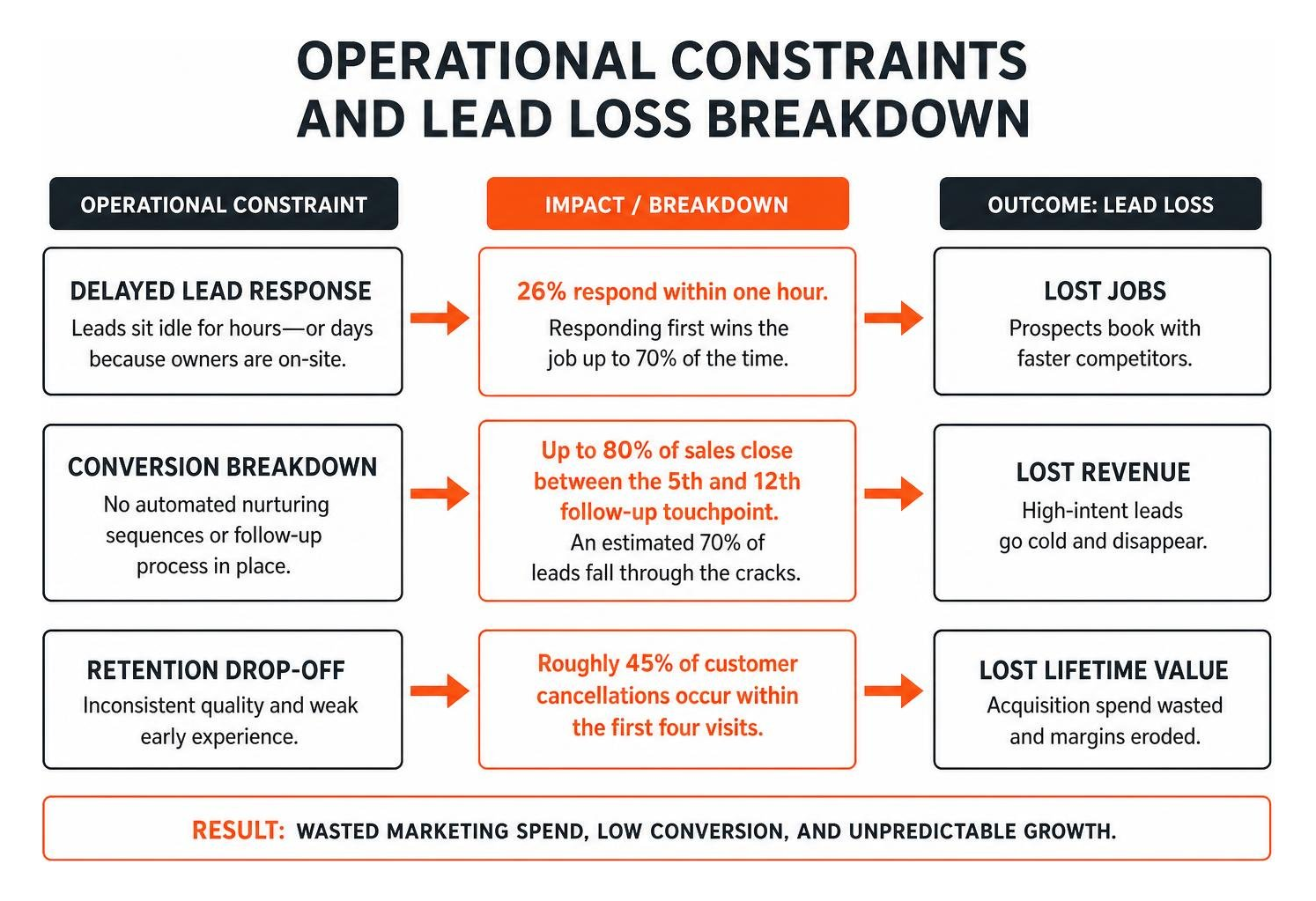
A cleaning business growth framework helps you grow in the right order: first build trust and lead capture, then improve follow-up and delivery, then add marketing channels only when your team can handle the work.
Use this simple sequence:
- Create a strong foundation: Build a clear website, optimize your Google Business Profile, define service areas, and make booking or quote requests easy.
- Stop lead leakage: Respond quickly, use automated text and email follow-up, track every estimate, and make it simple to book recurring service.
- Standardize fulfillment: Document cleaning checklists, train crews consistently, inspect quality, and know your real labor and supply costs.
- Scale what works: Add Google Ads, local SEO, review systems, retargeting, and new service areas after conversion, capacity, and retention are stable.
Marketing can create demand, but it cannot fix slow responses, inconsistent quality, poor scheduling, or a team with no room for more work. That matters in 2026, when customers increasingly expect online booking and recurring service. More leads are not useful if they turn into missed calls, unquoted jobs, rushed crews, and preventable cancellations.
The goal is not simply higher revenue. It is predictable revenue with healthy margins, loyal clients, and an operation that does not depend on the owner handling every quote, schedule change, and customer issue.
I am Ginger Whitson, founder and CEO of Cleaning Business Growth. After building and growing my own cleaning company and spending more than two decades in organizational change and consulting, I developed this cleaning business growth framework to help owners connect marketing with the systems required to sustain it.
The Core Bottlenecks: Why Marketing Alone Cannot Scale a Cleaning Business
The global cleaning industry is expanding rapidly, projected to reach roughly $482 billion in 2026 and surge to $859 billion by 2030. In the United States alone, cleaning sector employment is growing at 10%—significantly outpacing the national cross-industry average. Despite this rising tide, 64% of cleaning businesses earn under $100K annually, while only 18% generate $500K or more per year.
Why do so many cleaning operators stall out?
When business owners experience a plateau, their immediate reaction is almost always: “I need more leads.” They pour capital into paid ads, SEO campaigns, or lead aggregators. What happens next is rarely sustainable growth; instead, it is operational exhaustion. Marketing creates demand, but without robust operations, increased ad spend simply exposes deeper delivery bottlenecks.
| Growth Metric | Transactional Lead Generation | Systemised Operational Growth |
|---|---|---|
| Primary Goal | Maximising raw lead volume | Maximising customer lifetime value (LTV) |
| Conversion Focus | Manual, ad-hoc phone calls | Automated CRM follow-ups within minutes |
| Fulfillment Model | Owner manages schedules and covers call-outs | Standardized SOPs, field checklists, and crew leads |
| Revenue Stability | Spiky, one-off deep cleans | Predictable recurring contracts (65%+ recurring revenue) |
| Owner Role | Chief cleaner, dispatcher, and firefighter | Strategic leader driving asset valuation |
Navigating these friction points requires understanding the distinct stages of growth for cleaning businesses. Transitioning from a solo cleaner to an enterprise operator demands fundamentally different operational mechanics at every milestone.
Why Marketing Alone Fails Without a Cleaning Business Growth Framework
When you pour marketing budget into an un-systematized business, lead slippage happens instantly:
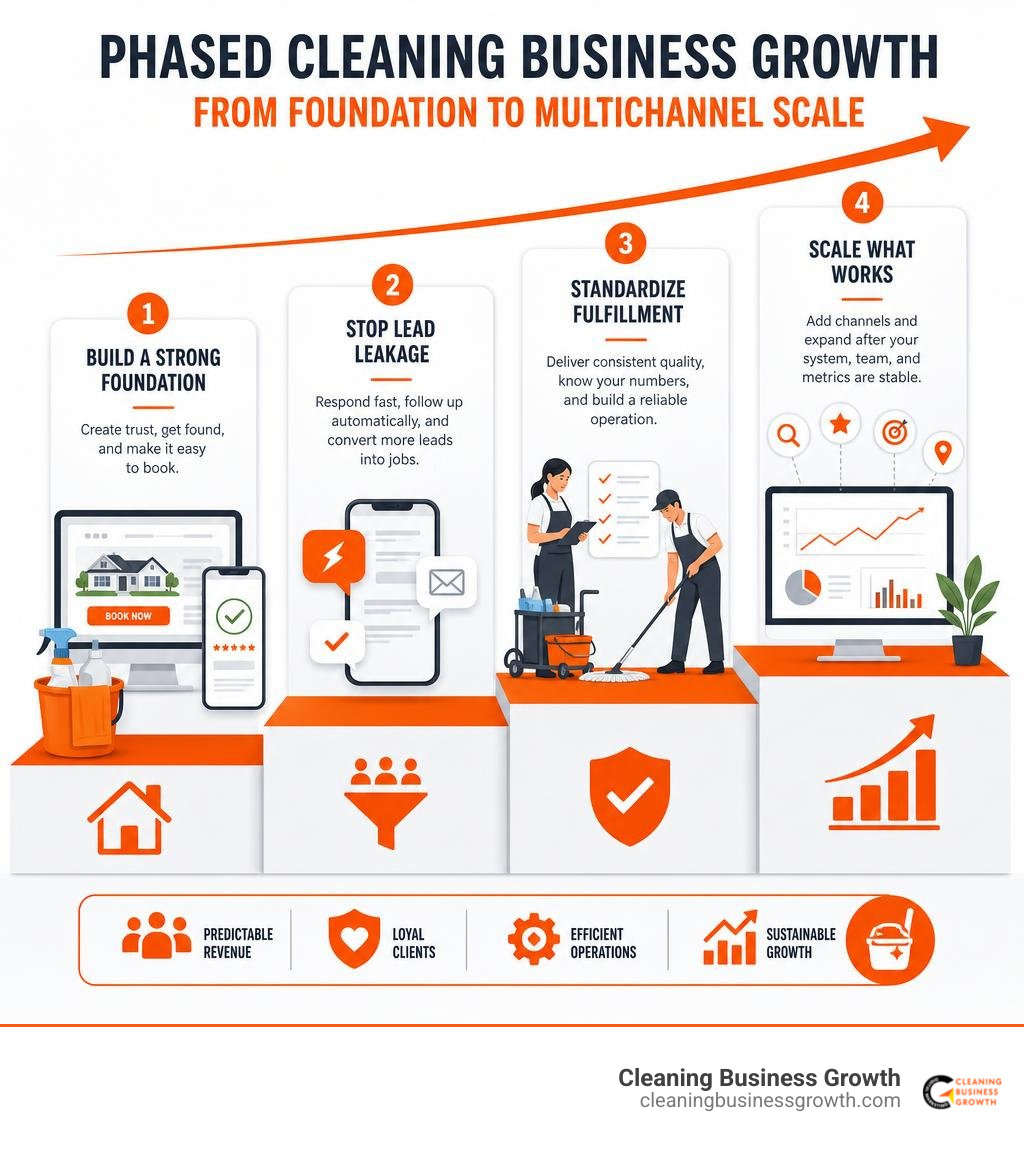
- Delayed Lead Response: 85% of cleaning businesses respond to leads the same day, but the modern buyer demands speed. In fact, 26% of top-performing businesses respond within one hour, and responding first wins the job up to 70% of the time. When an owner is on-site scrubbing floors, leads sit idle for hours—or days.
- Conversion Breakdown: Up to 80% of sales close between the 5th and 12th follow-up touchpoint. Without automated nurturing sequences, an estimated 70% of generated leads fall completely through the cracks.
- Retention Drop-Off: Securing a client via paid channels only to lose them after visit one or two destroys your unit economics. In residential cleaning, roughly 45% of customer cancellations occur within the first four visits due to inconsistent quality. Systemising your cleaning business helps standardize the conversion and delivery process so new demand does not turn into preventable churn.
Deploying structured operational systemisation methods ensures that every dollar spent on client acquisition flows into a conversion funnel and delivery engine built to retain them.
Operational Constraints: Staff Turnover, Scheduling Drag, and Capacity Limits
The cleaning industry faces an average employee turnover rate between 75% and 200%. High turnover creates an endless cycle of recruitment fatigue where owners constantly scramble to backfill cleaners rather than growing the client base.
Furthermore, poor route planning creates scheduling drag—cleaners spend excessive unpaid time driving across town, driving up vehicle wear and burning out crews. A sustainable operation requires dense geographic routing and an ironclad hiring funnel.
The Clean Growth Model: A Phased Cleaning Business Growth Framework
To prevent wasted marketing spend and operational collapse, we structure cleaning company expansion into four sequential phases. By unlocking new channels only when backend operations are mature enough to support them, you protect your margins and scale with predictability.
Implementing a complete system for digital marketing for cleaning businesses is not about doing everything at once; it is about doing the right things in the right order.
Phase 1: Launch – Establishing Trust and High-Intent Inbound Capture
The Launch phase is about establishing baseline market legitimacy, local presence, and immediate conversion mechanics.
- High-Converting Website: A modern, mobile-friendly website designed around conversion. With 62% of bookings occurring via mobile apps and online platforms, your site must feature clear calls-to-action, instant quote request forms, and transparent service scopes.
- Google Business Profile (GBP) Optimization: Claim, verify, and fully optimize your profile with accurate primary categories, service sub-categories, high-resolution photos, and defined service zones.
- Google Local Services Ads (LSA): Launch Google LSA to secure the Google Guaranteed badge. In major metropolitan markets, LSAs capture 45% to 60% of high-intent search leads at a lower cost-per-lead than standard search ads.
- Business Strategy Alignment: Build your foundational business model using a foundational business plan template to establish pricing benchmarks, target demographics, and initial equipment overhead.
Phase 2: Grow – Paid Search Dominance and Automated Lead Conversion
Once your conversion assets are live, Phase 2 focuses on capturing high-intent search traffic and automating follow-up so zero leads slip away.
- Targeted Search Advertising: Deploy dedicated Google Ads PPC campaigns targeting high-value transactional keywords (e.g., “recurring maid service,” “commercial office cleaning near me”).
- CRM Automation and Speed to Lead: Connect inbound lead forms to an automated CRM. Incoming inquiries instantly trigger a two-way SMS and email sequence within 60 seconds, allowing prospects to self-schedule an estimate.
- Local Maps SEO: Build consistent local citations and optimize geo-relevance to rank organically in the Google 3-Pack.
- Lead Nurture Campaigns: Deploy structured email campaigns to educate unconverted leads, share customer testimonials, and offer time-sensitive promotions. You can see how automated email campaign strategies re-engage cold leads and convert them into recurring revenue.
Phase 3: Accelerate – Organic Authority, Reviews, and Geo-Targeted Pages
With steady paid acquisition and lead management active, Phase 3 builds compounding organic assets that decrease your blended customer acquisition cost over time.
- Local Organic SEO: Follow our practical guide to cleaning company SEO to construct dedicated city and neighborhood landing pages that capture search traffic across surrounding suburbs.
- Systematic Review Generation: Automated SMS requests trigger 2 hours post-service, directing satisfied customers to leave 5-star Google reviews. Maintaining a steady flow of at least 5 new positive reviews every month keeps your profile ranking high in local search results.
- Double-Sided Referral Engines: 64% of leads in the cleaning industry originate from repeat customers and direct referrals. Launch an automated referral engine offering mutual value (such as $25 off the next clean for both the referrer and new client), triggered automatically after a customer’s 6th completed service.
Phase 4: Scale – Multichannel Expansion and AI Search Optimization
The final phase expands brand reach across top-of-funnel channels, captures non-active searchers, and dominates modern AI answer engines.
- Social Advertising and Retargeting: Deploy targeted Facebook Meta ads to build brand awareness in target zip codes and retarget visitors who visited your website but did not book.
- AI Search Optimization (AIO): Structure your website content, schema markups, and business data so AI-driven search models and voice assistants recommend your company as the premier local service.
- Enterprise Scaling: Expand into multiple crews, territory branches, and commercial contracts, replicating the playbook validated in our proven marketing case studies.
Systems, Unit Economics, and High-Yield Niches in 2026
Scaling a cleaning company requires strict financial controls. Revenue without profit is merely exhausting. In 2026, top-performing operators maintain a target net profit margin between 18% and 25%, anchoring their pricing on flat-rate job costing rather than arbitrary hourly rates.

To maintain healthy margins, ensure that your fully-loaded cleaner labor cost (including base pay, payroll taxes, workers’ compensation, and mileage) remains capped under 38% to 44% of gross revenue per job.
Top High-Yield Cleaning Niches in 2026
Expanding into specialized, high-barrier service lines allows you to command premium rates and insulate cash flow:
- Short-Term Rental / Airbnb Turnover Cleaning: Vacation rentals require up to 8 to 12 turns per month per property, generating rapid recurring cash flow at higher effective hourly yields.
- Medical & Healthcare Facility Sanitation: Commercial medical clinics require strict sanitation protocols, specialized terminal cleaning, and biohazard standards, commanding stable, multi-year commercial contracts.
- Move-In / Move-Out Deep Cleans: The highest-margin residential service type, billing at $75–$95 per cleaner-hour due to empty spaces, lack of furniture obstruction, and urgency.
- Post-Construction Cleanup: Contractors pay premium rates for multi-phase cleans (rough, final, touch-up) to meet tight occupancy deadlines.
- Eco-Friendly / Green Cleaning: Utilizing certified low-toxin, EPA Safer Choice formulations allows businesses to capture health-conscious, dual-income households and commercial wellness centers at a 15–20% price premium.
Standardizing Execution: Checklists, Video SOPs, and Rapid Onboarding
To make your business run smoothly without the owner physically inspecting every clean, standardize the Critical Client Flow:
- Video SOPs over Binders: Text manuals rarely get read. Have your top cleaner demonstrate optimal room-by-room techniques on short video recordings, capturing the exact motions for baseboards, bathrooms, and kitchens.
- Photo-Required Digital Checklists: Crews complete mobile checklists on their phones, uploading mandatory completion photos of high-touch zones before marking a job closed.
- Appoint a Systems Champion: Task a senior cleaner with maintaining standard operating procedures and onboarding new staff. This provides them with a clear career progression while freeing the owner from repetitive training.
- Paid Ride-Along Screening: Implement a 4-hour paid on-site ride-along as the final interview stage. This practical assessment quickly filters out candidates who cannot handle the physical demands of the job before they are formally hired.
Leveraging Automation and AI for Estimates, Billing, and Retention
50% of cleaning business owners actively use AI and software automation to streamline administrative overhead. Adopting modern operations software allows you to automate essential workflows:
- Instant Online Quoting: Allow prospects to input their square footage, number of bedrooms/bathrooms, and cleaning frequency to generate an instant, accurate estimate.
- Automated Card-on-File Billing: Auto-charge customer credit cards 24 hours prior to service or immediately upon job completion to maintain accounts receivable below 3% of total revenue.
- Automated Reactivation & Pause Sequences: When a client attempts to cancel, offer an automated 90-day service pause. At day 60, trigger an automated text offering a $30 reactivation credit. This simple workflow successfully recovers up to 40% to 55% of pausing clients.
Implementation Roadmap: Measuring Metrics and Diagnosing Your Stage
Predictable scaling requires tracking the numbers that drive performance. Implement a weekly Metrics, Analysis, Action (MAA) review to monitor your core key performance indicators:
- Customer Acquisition Cost (CAC) vs. Lifetime Value (LTV): Compare how much it costs to win a new recurring client against how long that client typically stays with your company.
- Recurring Client Mix: Track what percentage of your schedule is filled by weekly and bi-weekly recurring cleaning clients instead of one-time jobs.
- Labor Efficiency: Monitor how much crew time, drive time, and supply usage each job requires so pricing and scheduling stay sustainable.
- Inspection and Quality Scores: Track client satisfaction via automated 1-to-5 post-service rating texts, requiring a manager call for any rating under 4 within 4 hours.
Diagnostic Audit: Assessing Your Stage in the Cleaning Business Growth Framework
To identify where to focus your resources next, evaluate your company against this diagnostic benchmark:
| Stage / Milestone | Primary Operational Bottleneck | Prescribed Growth Focus |
|---|---|---|
| Launch Stage | Lack of consistent lead flow and local visibility | Launch a conversion-focused website, optimize Google Business Profile, and set up Google Local Services Ads. Establish clear service packages and pricing processes internally without making the table about dollar targets. |
| Growth Stage | Lead follow-up lag; owner trapped in day-to-day cleaning | Deploy Google Ads PPC, implement CRM automated follow-up, hire the first core cleaning team, and standardize video SOPs. |
| Accelerate Stage | Management bandwidth, quality control, and route density | Implement localized SEO city pages, automated review capture, double-sided referral programs, and appoint field crew leads. |
| Scale Stage | Channel saturation and regional expansion limits | Deploy Meta Ads retargeting, AIO optimization, expand into specialized residential cleaning service lines, or launch new branch locations. |
Frequently Asked Questions About Cleaning Business Expansion
How do I know which growth phase my cleaning business is currently in?
Determine your phase by looking at your current binding operational constraint rather than revenue alone. If you do not have consistent inbound inquiries, you are in Launch. If you have inquiries but lose them due to slow manual follow-ups, or if the owner is still cleaning homes daily, you are in Grow. If lead capture is automated and crews handle delivery, but you need higher route density and lower blended acquisition costs, you are in Accelerate. If your local market is saturated and you are expanding across multiple territories, you are in Scale.
Why should I prioritize Local Services Ads and Google Search over social media ads?
Google Search and Local Services Ads capture active high-intent demand—homeowners actively searching for “house cleaning service near me” need cleaning immediately and convert rapidly. Social media ads (like Meta Ads) target passive interruption audiences. Until you have captured the existing high-intent search demand in your service area, spending budget on broad awareness channels is far less cost-effective.
What is the most effective way to reduce cleaner turnover while scaling?
The most reliable way to cut cleaner turnover is to create a stronger employee experience: clear expectations, paid drive time policies where applicable, per-visit quality recognition, and visible paths for advancement. Pair this with a 4-hour paid ride-along interview during hiring to ensure realistic expectations, and use video-based SOP checklists so cleaners feel confident and supported from day one.
Conclusion: Building an Absentee-Ready, Highly Valued Cleaning Enterprise
Scaling a cleaning business from a demanding owner-operator job into a scalable, high-margin enterprise requires aligning your marketing engine with back-end operational systems. When marketing creates demand, automated CRM systems capture that demand, and standardized field checklists deliver consistent quality, your business becomes a durable, predictable asset.
An owner-dependent cleaning service often struggles to sell for more than 1x to 2x EBITDA. A systemized cleaning company powered by recurring subscription contracts, multi-channel customer acquisition, and standardized crews commands valuations of 3x to 5x EBITDA or more.
If you are ready to stop guessing and build a predictable pipeline of recurring clients, explore the complete Clean Growth Framework and discover how our specialized marketing and growth systems can scale your cleaning business sustainably.