Choosing the Right Campaign Objectives and Budgeting Models
To master Facebook ad targeting for cleaning services, select the Leads objective with native Instant Forms, restrict geographic targeting to “People living in this location” within a 10-to-15-mile radius, and filter for homeowners aged 30 to 55+. Excluding non-serviceable zip codes and combining these parameters with scroll-stopping before-and-after visuals delivers consistent, high-margin cleaning appointments.
When you log into Meta Ads Manager, the platform prompts you to pick a campaign objective. This single choice tells Facebook’s delivery algorithm exactly what kind of user behavior to seek out in your territory. If you choose “Brand Awareness” or “Traffic,” Meta finds people who love to mindlessly scroll or click on links without ever taking action. As home service operators, we do not want cheap clicks; we want booked jobs.
To build a sustainable pipeline through digital marketing for cleaning businesses, your primary focus should center on direct response. That means structuring your campaigns around tangible inquiries using either native Instant Forms or dedicated landing pages.
| Feature / Metric | Native Facebook Instant Forms | Dedicated Website Landing Page |
|---|---|---|
| Primary Goal | High-volume quote generation | Highly qualified, pre-vetted bookings |
| User Friction | Very Low (pre-filled user profile data) | Moderate to High (multi-step form fill) |
| Average Cost Per Lead (CPL) | Lower ($15 – $30 average) | Moderate to High ($30 – $60+ average) |
| Data Capture Speed | Instant within the Facebook application | Requires full page load and manual entry |
| Technical Requirement | Zero web development needed | Meta Pixel, Conversion API, and fast hosting |
| Best Used For | Fast cash flow, recurring maid service, seasonal specials | High-ticket commercial contracts, exact quoting flows |
Campaign Objectives That Drive Booked Jobs
For 90% of residential cleaning companies, the Leads objective is the undisputed winner. When you select Leads, you can set the conversion destination to Instant Forms. These forms load inside the app and automatically populate the user’s name, phone number, and email from their Facebook account profile. This approach removes mobile friction and captures inquiries before the user gets distracted by another notification.
The Messages objective (directing prospects into Facebook Messenger or WhatsApp) serves as an alternative for residential owner-operators. If you enjoy chatting directly with prospects, a conversation-focused campaign allows prospective clients to ask informal pricing questions. You can clarify square footage, provide a quick estimate range, and secure the booking right inside the chat window.
If you already have a smooth, mobile-optimized online booking system on your website, you can select the Leads objective with “Website” as your conversion destination. For this to work smoothly, your site must feature clear pricing forms and lightning-fast loading speeds, supported by proven website design for cleaning services.
Budget Allocation and Dayparting Schedules
How much should you spend? You do not need a corporate budget to see meaningful traction. A practical testing budget is $15 to $30 per day per ad set in standard suburban markets, and $30 to $50 per day in dense, competitive metropolitan areas.
Rather than spreading a tiny budget across seven different campaigns, consolidate your spend into one or two targeted ad sets. Let each ad set run uninterrupted for at least 7 to 14 days so the Meta algorithm can exit the learning phase and stabilize your cost per lead.
Dayparting—controlling the exact hours your ads are shown—protects your budget from going to waste. For commercial cleaning campaigns, restrict your schedule to standard business operating hours (Monday through Friday, 8 AM to 5 PM) when facility managers and office administrators sit at their desks.
For residential house cleaning, consumer browsing spikes during weekday evenings and weekend mornings when messy kitchens, piled laundry, and chores cause household stress.
Step-by-Step Facebook Ad Targeting for Cleaning Services
The fastest way to burn through marketing capital is targeting everyone within a 50-mile radius of your city. Cleaning is an operationally constrained business; driving 45 minutes for a two-hour bi-weekly clean destroys your profit margins through technician fuel and travel time.
When establishing your geographic baseline inside Meta Ads Manager, use tight pin-drops or specific postal codes that reflect your high-density routes. If you want to scale profitable routes, integrate your ad targeting with a broader strategy for maid service marketing designed to build route density.
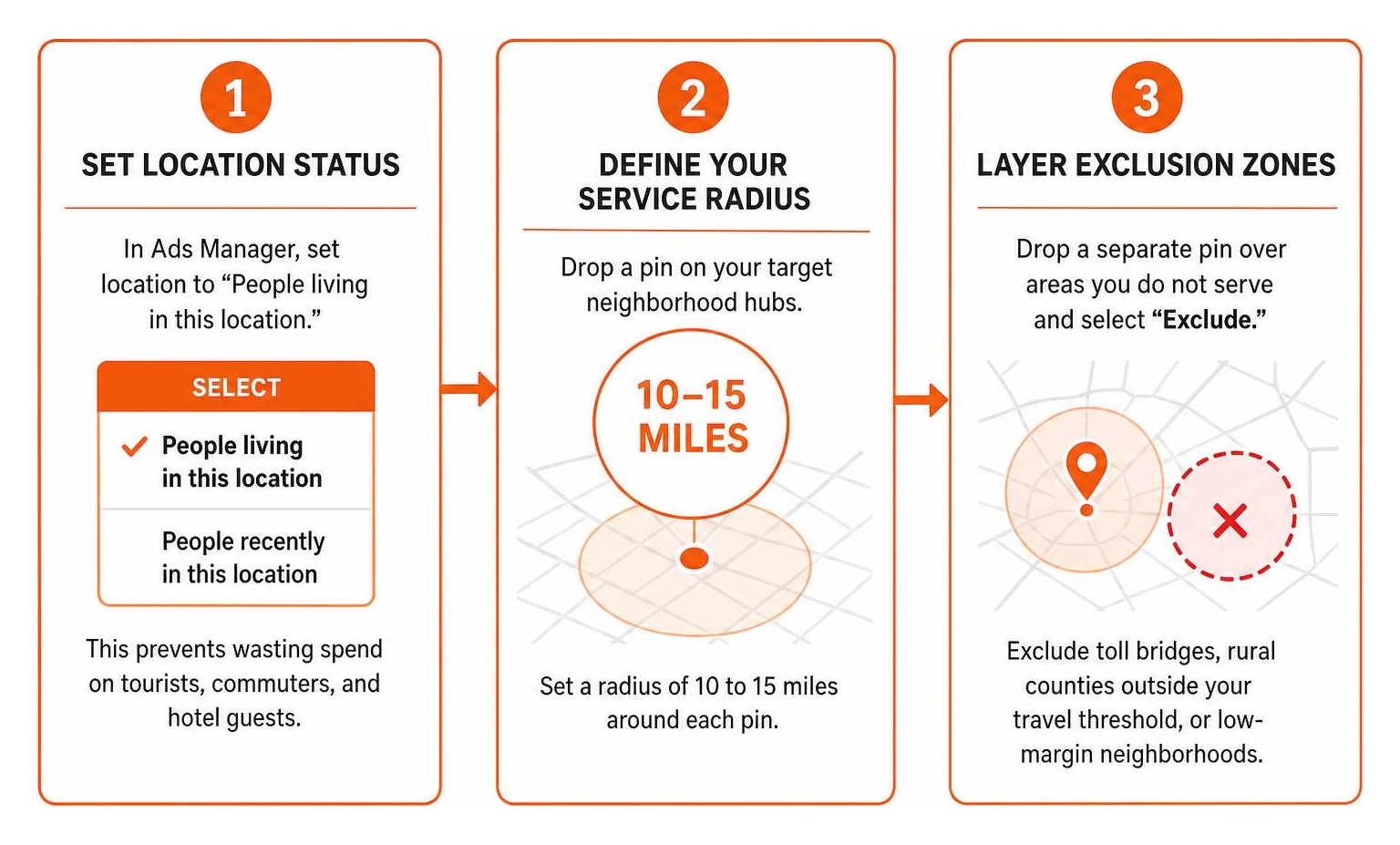
Here is the exact step-by-step process to set up your geographic boundaries:
- Set Location Status: In Ads Manager, ensure your location setting is toggled to “People living in this location” rather than “People recently in this location.” This simple switch prevents you from wasting money showing house cleaning ads to tourists, commuters, and hotel guests.
- Define Your Service Radius: Drop a pin directly over your target neighborhood hubs and set a radius of 10 to 15 miles.
- Layer Exclusion Zones: If there is a nearby city across a toll bridge, a rural county outside your travel threshold, or a neighborhood with historically poor margins, drop a separate pin over that area and select “Exclude.”
Demographic Filters in Facebook Ad Targeting for Cleaning Services
Once your geographic boundary is secure, refine your audience using demographic and behavioral signals without narrowing the pool so much that delivery stalls.
- Age Brackets: Set your age range to 30 to 55+. Younger audiences rent apartments with high turnover and lower cleaning budgets, while individuals aged 30 and older are more likely to own single-family homes, manage active families, and possess the disposable income required for recurring services.
- Homeownership Signals: While Meta has adjusted detailed targeting options over the years, you can still reach likely property owners by targeting interests like Home improvement, Interior design, Single-family detached home, or Home renovation.
- Life-Event Triggers: Life transitions trigger an immediate need for professional cleaning services. Layering targeting options such as Newly engaged, New parents, or Likely to move allows you to present move-in/move-out cleans and nursery deep cleans right when demand spikes.
Retargeting Funnels for Facebook Ad Targeting for Cleaning Services
The harsh truth of online lead generation is that roughly 95% of people will not book a cleaning on their first interaction with your brand. They get interrupted by phone calls, work emails, or their kids. Setting up a retargeting audience recovers these lost opportunities at a fraction of cold acquisition costs.
To build a reliable retargeting machine:
- Install the Meta Pixel across your entire website, especially on your contact and quote pages.
- Navigate to the Audiences tab in Ads Manager and create a Custom Audience.
- Select Website Traffic and isolate visitors who viewed your service pages in the past 30, 60, or 90 days but did not hit your “Thank You” confirmation page.
- Upload your existing customer and past-lead email database into a Custom Audience list to periodically pitch seasonal deep cleans and reactivate inactive clients.
- Launch a dedicated retargeting ad set offering a high-value incentive—such as a “Free inside-the-oven deep clean with your first recurring booking”—to turn fence-sitters into scheduled clients.
High-Converting Ad Creative and Copywriting Frameworks
Targeting gets your ad in front of the right screen, but your creative asset is what actually earns the click. Facebook users do not open the app looking to hire a house cleaner; they are looking at photos of friends and family. Your ad creative must disrupt that scroll with authentic, local visuals.
Many cleaning business owners make the mistake of using generic, sterile stock photos of models holding spray bottles. These look like generic corporate ads and get ignored immediately. Authentic, unpolished photos of your real team in uniform or dramatic transformations always win. For businesses expanding their organic and paid social presence, our dedicated social media services focus on this exact brand of authentic content.
Scroll-Stopping Visuals and Video Demonstrations
- Split Before-and-After Images: High-contrast photos of grimy oven doors turned sparkling, restored grout lines, or messy playrooms returned to order perform well. Ensure both photos share identical lighting, angles, and framing.
- Short-Form Time-Lapses: A 15-to-30-second sped-up video of a cleaner transforming an entire kitchen or living room holds attention. These visual time-lapses hook viewers within the first 3 seconds.
- Satisfying Cleaning Clips: Window squeegeeing, carpet extraction lines, or pressure washing clips leverage the “oddly satisfying” video trend, earning higher engagement signals from Meta’s delivery algorithm.
- Aspect Ratios: Always format your primary feed creatives in a 1:1 square (1080×1080 px) and your story/reel placements in 9:16 vertical (1080×1920 px) to maximize mobile screen real estate.
Ad Copy Formulas and Social Proof Integration
Your ad copy does not need to be poetry. It needs to address customer pain points, introduce your cleaning company as the dependable solution, provide trust signals, and instruct the reader on what to do next.
Use this 4-part ad copywriting framework:
- The Hook: Call out the emotional frustration or geographic location directly.
(e.g., “Tired of spending your entire Saturday scrubbing baseboards instead of relaxing with your family in Naperville?”) - The Offer: Introduce your service clearly and present a straightforward incentive.
(e.g., “Let our professional, background-checked team handle the chores. Claim $30 off your initial deep clean when you set up bi-weekly service this month.”) - Trust & Social Proof: Remove the risk associated with letting strangers into a home. Mention your insurance, bonding, and local reputation. Highlighting your positive client feedback and understanding the importance of reviews to cleaning business growth provides the reassurance prospects need to convert.
- Call to Action (CTA): Tell them exactly how to proceed.
(e.g., “Tap the ‘Get Quote’ button below to get your instant, customized home estimate in under 60 seconds!”)
Lead Intake Workflows and Performance Optimization
Generating leads is only half the battle. A lead that sits inside Facebook Ads Manager for six hours without a response is essentially money thrown away. In home services, speed to lead dictates your ultimate return on investment.
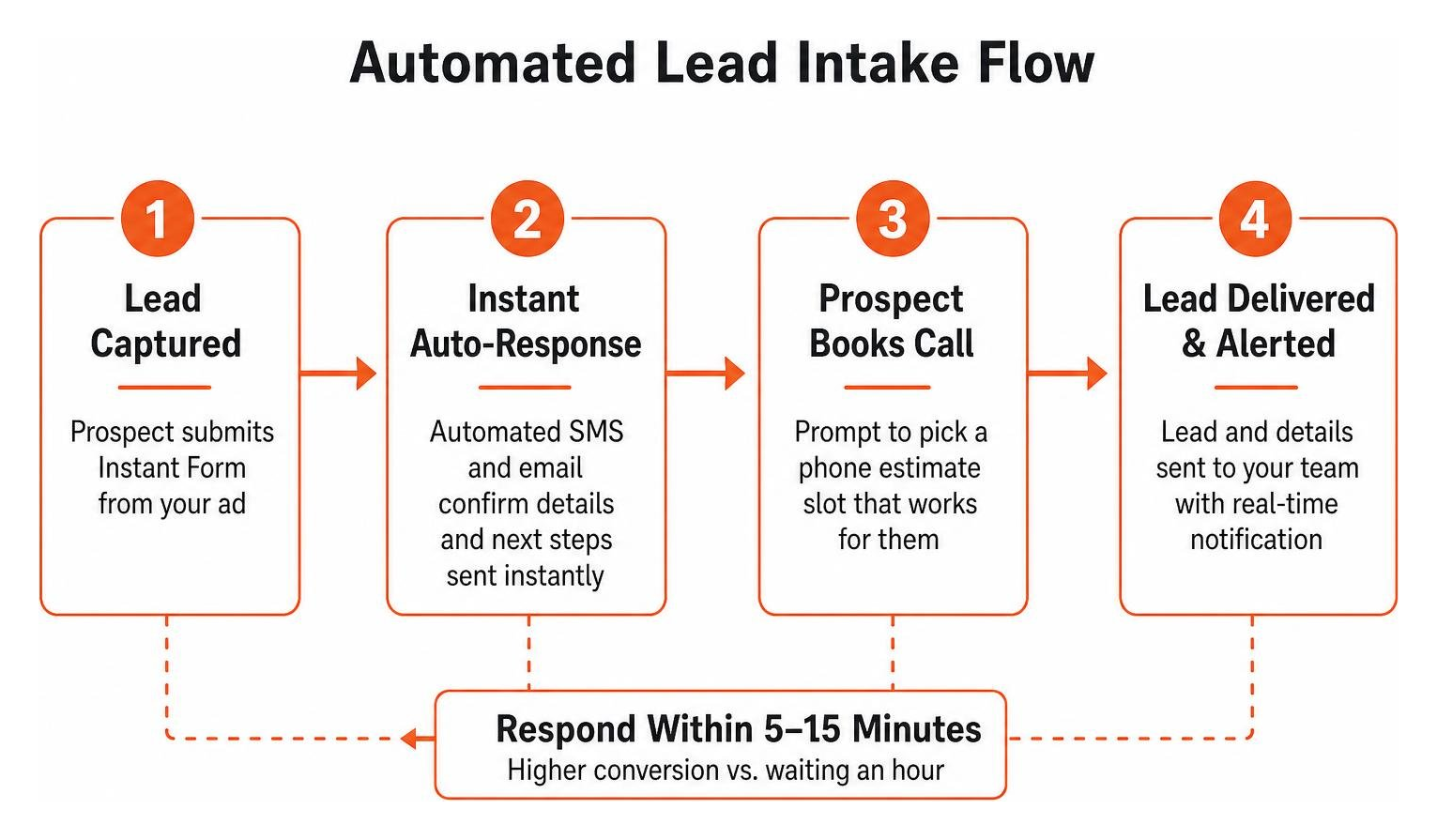
Research shows that contacting a newly submitted lead within 5 to 15 minutes increases conversion rates compared to waiting even an hour. If a homeowner fills out your form on their lunch break, they want a quote right then. If you wait until the evening, they may have already booked with the first competitor who called them back.
Using automated follow-up software like our Market Smart CRM ensures that the second a prospect submits an Instant Form, an automated SMS and email dispatch instantly confirms their details and prompts them to pick a phone estimate slot.
Pre-Qualifying Leads to Filter Tire-Kickers
To keep your sales pipeline clean and avoid spending hours on unqualified bids, include 3 to 4 qualifying questions inside your Facebook Instant Form.
Do not settle for just name and phone number; ask the specific property questions necessary to construct an accurate estimate:
- How many bedrooms and bathrooms is your home?
- What type of cleaning are you looking for? (Recurring Maid Service / One-Time Deep Clean / Move-In or Move-Out)
- What is your full street address and ZIP code?
- Do you have any pets? (Dogs / Cats / None)
Collecting the street address allows you to quickly check the home’s square footage on real estate websites before making your follow-up call, giving you all the context you need to deliver an accurate price.
Tracking Metrics and Iterating with A/B Split Testing
To consistently scale your customer base, keep a close eye on the core metrics inside Ads Manager.
- Cost Per Click (CPC): Aim for a link CPC under $1.50 to $2.00.
- Cost Per Lead (CPL): A healthy CPL for residential cleaning ranges between $15 and $35 depending on market density.
- Click-Through Rate (CTR – Link): Strive for a link CTR above 1.5%. If your CTR dips below 1%, your ad image or hook is failing to stop the scroll.
- Lead-to-Booked Ratio: Track how many submitted leads actually convert into paid jobs. Aim for a 25% to 40% close rate on qualified inquiries.
Never guess what works—test your way to clarity. Run controlled A/B split tests where you keep your ad copy, headlines, and audience targeting identical, while testing 3 to 5 distinct visual creatives against one another. Let the data show you which image delivers the lowest cost per booked clean.
As your brand expands, combining paid social campaigns with search-intent channels like Google Ads PPC helps lower your overall blended customer acquisition costs.
Frequently Asked Questions About Facebook Ad Targeting for Cleaning Services
How much should a cleaning company spend on Facebook ads per day?
A recommended starting budget for testing Facebook ads is $15 to $30 per day per ad set in standard markets, and $30 to $50 per day in highly competitive metropolitan regions. This budget gives Meta’s algorithm enough conversion data to optimize delivery. Once you identify a winning creative and audience combination that produces consistent leads below your target cost per acquisition, you can gradually scale the daily budget by 15% to 20% every few days.
Should cleaning businesses use Instant Forms or send traffic to a website?
For most residential cleaning companies, Facebook Instant Forms outperform website landing pages in raw volume and cost per lead. Instant forms keep users inside the Facebook mobile app and automatically pre-fill contact details, reducing form abandonment.
Sending traffic to an external website works best when you have an advanced, mobile-optimized instant booking system that allows prospects to select a date and pay a deposit directly online.
How do I prevent Facebook from showing ads outside my cleaning service area?
To stop Facebook from showing ads to users outside your operational territory, navigate to the Location targeting settings in Ads Manager and change the default dropdown from “People living in or recently in this location” to “People living in this location.”
Additionally, set precise radius boundaries around your core ZIP codes and drop manual “Exclude” pins over neighboring suburbs, adjacent counties, or regions across natural travel barriers (such as rivers or toll bridges) that your technicians do not service.
Conclusion
Building a predictable customer acquisition channel does not require wasting money on boosted posts or hoping for word-of-mouth referrals. By applying granular geographic boundaries, demographic parameters, high-contrast visual creatives, and rapid lead intake automation, you turn Meta’s platform into a dependable growth engine for your company.
Take control of your service routes, target your ideal local neighborhoods, and structure your campaigns to book high-margin jobs. If you are ready to scale your recurring customer base without the trial-and-error headaches, explore our dedicated Facebook Meta Ads management systems at Cleaning Business Growth. We build, manage, and optimize custom acquisition funnels designed exclusively for cleaning business owners looking for long-term growth.