Email Marketing for Cleaning Businesses Can Fill Your Schedule
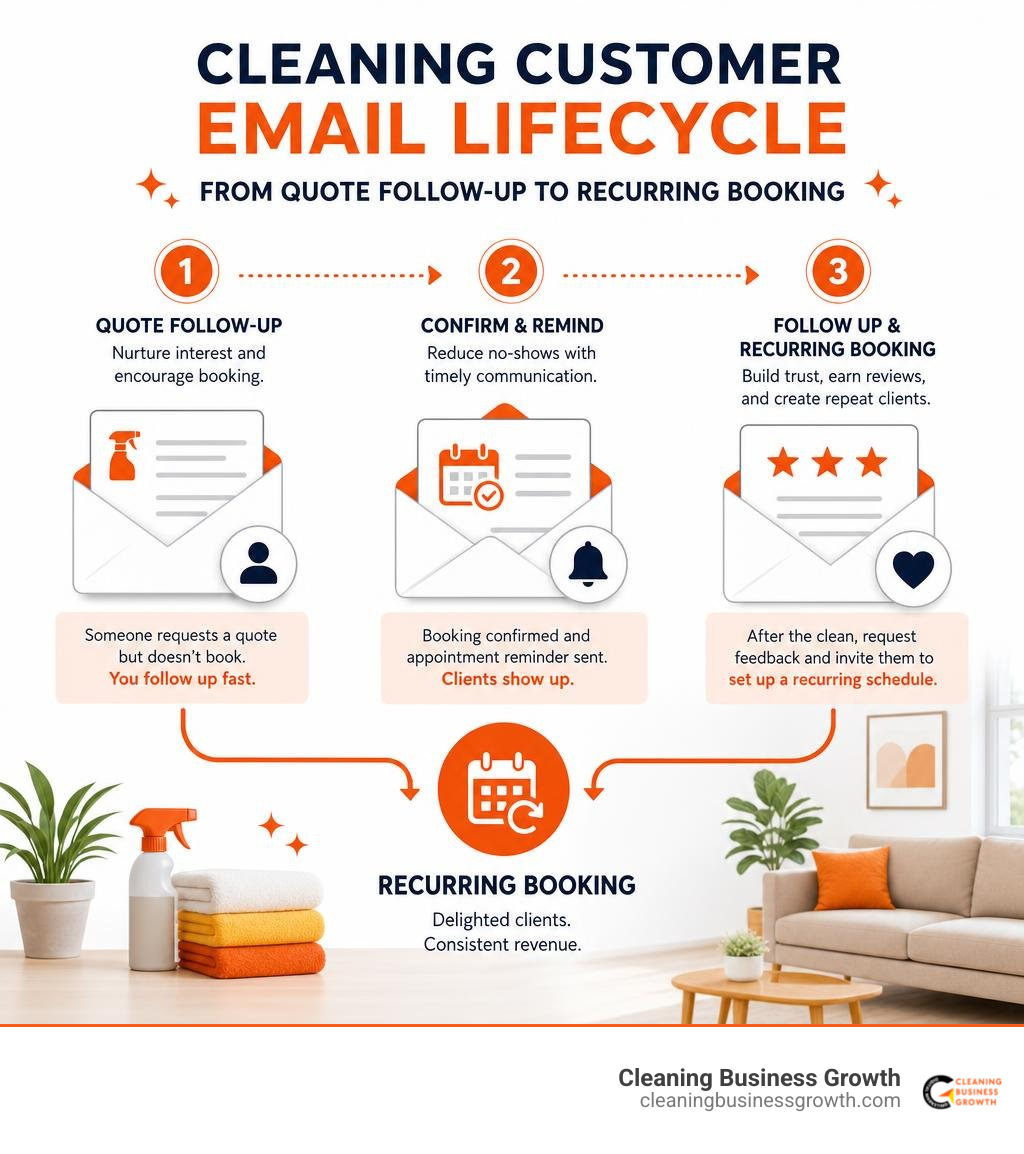
Email marketing for cleaning businesses works best when it runs on customer actions, not when you send random promotions. Start by collecting permission-based email addresses at every quote and booking, then automate these three messages:
- Follow up quickly when someone requests a quote but does not book.
- Send booking confirmations and service reminders to reduce no-shows.
- After the clean, request feedback and invite one-time clients to choose a recurring schedule.
This approach turns your contact list into an owned source of repeat bookings. Automated emails can outperform bulk campaigns because they arrive when the message is most useful: after an inquiry, before an appointment, or when a past client is due for another clean.
For a cleaning company facing high ad costs and an unpredictable calendar, that matters. Keeping an existing customer generally costs far less than winning a new one, and even a small lift in retention can have a major effect on profit. Email helps you stay visible without constantly paying to chase the next lead.
I am Ginger Whitson, founder and CEO of Cleaning Business Growth. After building and growing my own cleaning business and helping cleaning companies scale, I have seen how practical email marketing for cleaning businesses can create steadier bookings, stronger client trust, and more recurring revenue.
Why Email Marketing for Cleaning Businesses Outperforms Paid Ads in 2026
As we navigate the competitive landscape of 2026, relying solely on paid ads has become an expensive habit. Pay-per-click costs continue to rise, and social media algorithms change constantly. In contrast, industry benchmarks show that email marketing consistently delivers an average return of $36 to $42 for every dollar spent.
When you capture a prospect’s email, you secure an owned media channel that no third-party platform can take away. Combining high-converting organic channels with a complete approach to digital marketing for cleaning businesses allows you to stop renting attention and start building predictable client lifetime value. Residential maid services and commercial janitorial companies operate on natural repeat service cycles—making email the ideal vehicle to capture recurring demand.
Shifting from Acquisition Costs to Recurring Retention
The math behind home service profitability is clear: keeping an existing customer costs between 5 to 25 times less than acquiring a new one. Furthermore, research demonstrates that a modest 5% increase in customer retention can boost overall company profits by 25% to 95%.
Instead of pouring thousands of dollars every month into raw top-of-funnel lead generation, modern operators turn to a smart marketing playbook for ambitious cleaning business owners. We use strategic email automation to lock in bi-weekly recurring residential cleans and stable multi-year commercial contracts, effectively protecting your customer acquisition costs from leaking out of your funnel.
The 22x Revenue Advantage of Automated Triggers
Traditional email blasts—such as random monthly newsletters broadcasting generic holiday discounts—often fail because they arrive without context. Data highlights that automated, behavioral event-triggered emails earn roughly $3.41 per message sent, compared to just $0.15 per send for bulk campaigns. That represents an astonishing 22-fold revenue advantage.
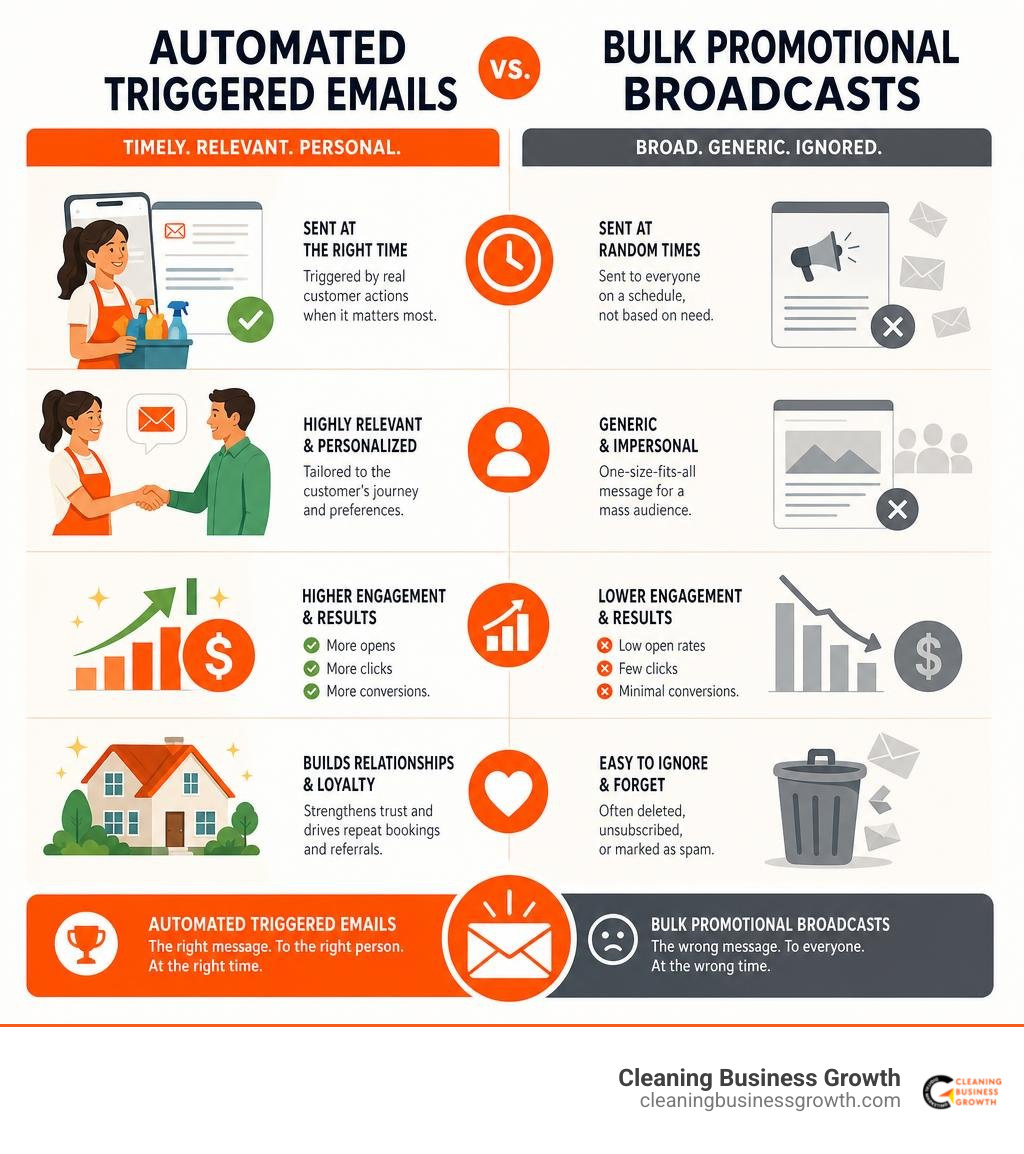
Automated triggered emails achieve a conversion rate of roughly 1.49% compared to 0.08% for bulk broadcasts. Why? Because they trigger based on real customer actions: requesting a quote, completing a first-time deep clean, or hitting a 60-day period of inactivity.
Essential Infrastructure: Tools, List Building, and Segmentation
A successful email program relies on solid infrastructure. Without smooth lead capture workflows, mobile-optimized templates, and organized database tagging, even the best copywriting will miss the mark.
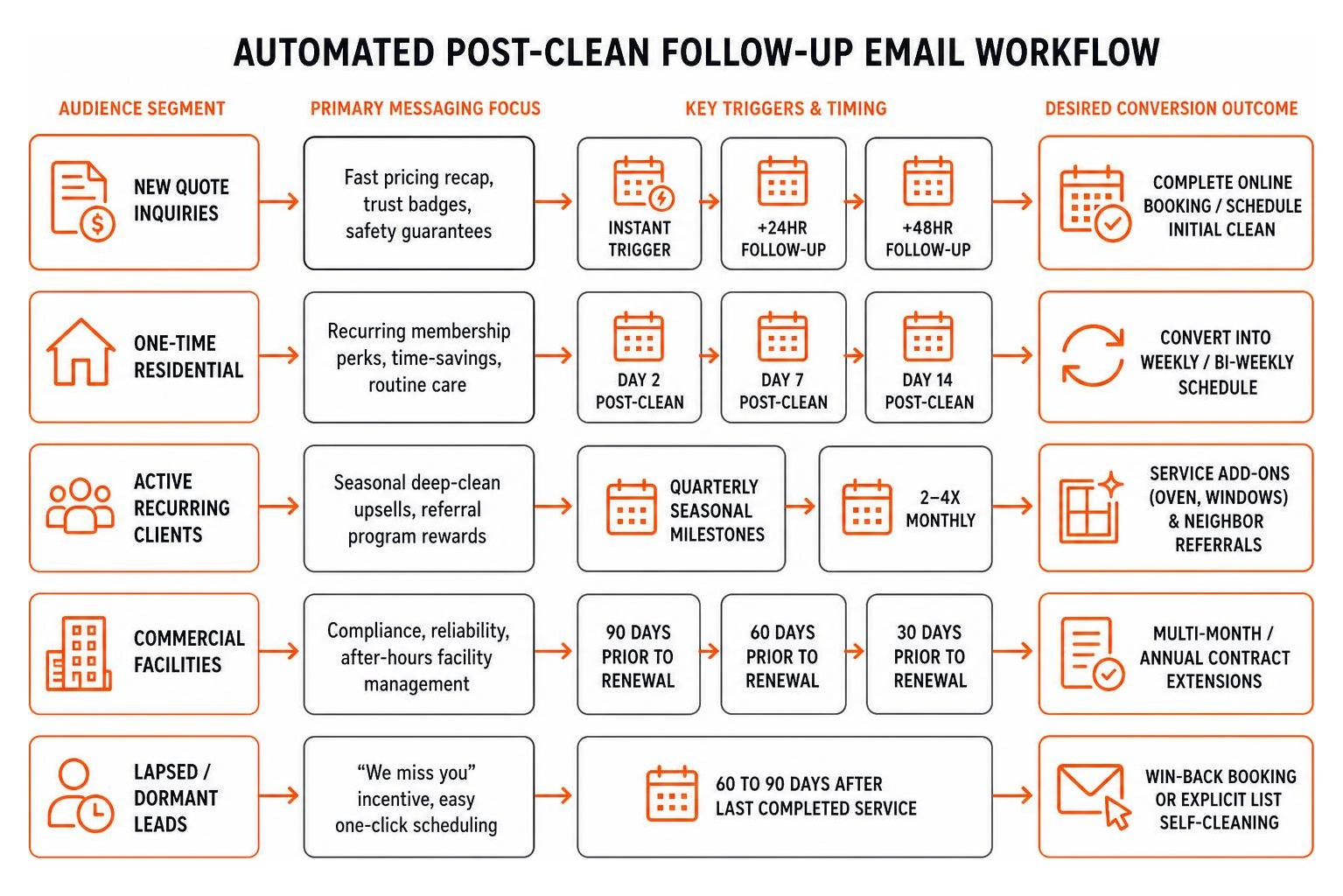
| Audience Segment | Primary Messaging Focus | Key Triggers & Timing | Desired Conversion Outcome |
|---|---|---|---|
| New Quote Inquiries | Fast pricing recap, trust badges, safety guarantees | Instant trigger; +24hr and +48hr follow-ups | Complete online booking / schedule initial clean |
| One-Time Residential | Recurring membership perks, time-savings, routine care | Day 2, Day 7, and Day 14 post-cleaning | Convert into weekly / bi-weekly schedule |
| Active Recurring Clients | Seasonal deep-clean upsells, referral program rewards | Quarterly seasonal milestones, 2-4x monthly | Service add-ons (oven, windows) & neighbor referrals |
| Commercial Facilities | Compliance, reliability, after-hours facility management | 90, 60, and 30 days prior to contract renewal | Multi-month / annual contract extensions |
| Lapsed / Dormant Leads | “We miss you” incentive, easy one-click scheduling | 60 to 90 days after last completed service | Win-back booking or explicit list self-cleaning |
Core Tools Powering Email Marketing for Cleaning Businesses
Cleaning operations require marketing platforms that integrate directly with operational scheduling. Your technology stack should support dynamic proposal generation, automated dispatch webhooks, field management syncing, and integrated SMS follow-ups. Whether using industry-specific tools or unified customer relationship managers, the platform must allow behavioral triggers so an operational status update (such as a technician marking a job “Complete” in the field) instantly activates marketing automations.
Ethical List-Building Strategies and Lead Magnets
Building a responsive list requires permission-based opt-ins rather than scraped or bought contact sheets. Practical lead magnets that generate quality residential and commercial leads include:
- Interactive Quote Estimators: Allowing prospects to calculate instant pricing in exchange for their name and email.
- Room-by-Room Cleaning Checklists: Downloadable PDF guides for spring turnover or move-out preparation.
- Vehicle Wrap QR Codes: Placing clear QR codes on fleet vehicles that drive local traffic to seasonal booking offers.
- On-Site Digital Collection: Field estimators collecting contact details and marketing consent during in-person property walkthroughs.
Smart Segmentation: Residential vs. Commercial and Lifecycle Stages
Sending the same generic message to every contact ruins deliverability and drives unsubscribes. Residential homeowners care about convenience, trust, vetted cleaners, and spending more free time with their families. Conversely, commercial facility managers prioritize insurance coverage, scope-of-work reliability, flexible off-hours scheduling, and consistent invoicing. Tag your database properly by customer type, service frequency, and lifecycle stage to keep your content relevant.
The 7 Automated Campaigns That Turn One-Off Cleans into Recurring Contracts
Implementing targeted lifecycle sequences helps turn one-time cleans into dependable recurring revenue. The real-world impact of disciplined execution is evident in how an email campaign helps Tulsa cleaning company grow by removing manual follow-up friction.
Instant Quote Follow-Up and Booking Confirmation Sequences
Nearly half of all cleaning quote requests drop off simply because the business takes too long to follow up. When a prospect requests a quote, an automated sequence should trigger immediately:
- Immediate Response: Email and SMS delivery of the requested estimate with a single direct link to select an available time slot.
- 24 Hours Post-Inquiry: A short follow-up answering common objections regarding supplies, insurance, and satisfaction guarantees.
- 48 Hours Post-Inquiry: A final gentle check-in offering to answer questions before the spot on the schedule is released.
Once booked, confirmation sequences provide value by sending 48-hour preparation checklists (such as pet containment and entry instructions) and day-of arrival notifications to eliminate cancellations and no-shows.
Post-Clean Review Requests and Rebooking Triggers
Welcome and onboarding emails consistently achieve open rates around 83.6%, demonstrating that clients pay the closest attention right around their service date. Use this momentum:
- 24 Hours After Service: Send an automated satisfaction check featuring a direct one-click link to your Google Business Profile. If they had a great experience, capture that 5-star review immediately.
- Days 2, 7, and 14 (The Recurring Conversion Flow): For one-time clients, send automated follow-ups highlighting the health and time-saving benefits of setting up a regular bi-weekly or monthly maintenance clean, complete with a recurring schedule incentive.
Win-Back Flows and Commercial Outreach Sequences
When a past customer has not scheduled a visit in 60 to 90 days, an automated re-engagement campaign should step in. Send a friendly “We miss your home” note paired with a limited-time reactivation perk.
For commercial accounts, set up automated renewal flows triggered at 90, 60, and 30 days before contract expiration. This prompts facility walkthroughs and scope updates before property managers look elsewhere.
Copywriting, Deliverability, and Legal Compliance for Cleaning Operators
A great campaign is useless if it lands in the spam folder or violates privacy laws. Keeping your technical setup sharp and your tone approachable ensures reliable inbox placement. Reviewing our guide to email health 2025 provides valuable foundational steps for maintaining domain reputation over the long run.

High-Converting Subject Line Formulas
Subject lines for local service companies should prioritize clarity over cleverness. Keep them under 50 characters so they display cleanly on mobile devices:
- Specific & Timely: “Your quote’s ready — pick a time in 60 seconds”
- Local & Relatable: “Spring cleaning slots now open in Austin”
- Helpful & Curious: “Why your floors still feel dusty after cleaning”
- Direct Rebooking: “Time for your next deep clean, Sarah?”
Clean, conversational copy targeted at specific needs helps maintain healthy open rates between 20% and 30%.
Technical Deliverability and the 70/30 Content Ratio
Ensure your domain has SPF, DKIM, and DMARC records properly configured. When designing emails, stick to the 70/30 rule: approximately 70% text and 30% images.
Overly graphical emails that mimic retail flyers trigger spam filters, take too long to load on mobile devices, and hurt readability. Conversational, text-forward emails feel like a personal note from the business owner, earning higher engagement. That unsubscribes under 0.5% are completely normal—they serve as a healthy, self-cleaning mechanism for your list.
CAN-SPAM, TCPA, and CASL Compliance Rules
Always follow core legal guidelines like the CAN-SPAM Act across all outbound communication:
- Physical Address: Include a valid physical postal address in the footer of every marketing send.
- One-Click Unsubscribe: Provide an easy, immediate mechanism for contacts to opt out.
- TCPA & 10DLC for SMS: If pairing email with SMS reminders, obtain documented express consent with clear “STOP” opt-out language.
- Transparent Headers: Never use misleading “From” names or deceptive subject lines.
Tracking ROI and Performance Benchmarks for Long-Term Growth
To scale predictably, track the metrics that connect directly to your bottom line rather than getting distracted by vanity numbers. Our real-world results are highlighted throughout our marketing case studies.
Essential KPIs Beyond Vanity Open Rates
With Apple’s Mail Privacy Protection and modern inbox filtering masking true opens, focus your attention on bottom-line engagement:
- Click-Through Rate (CTR): Aim for a benchmark of 2% to 5%.
- Quote-to-Booking Velocity: How many hours or days it takes for an abandoned quote lead to convert.
- Recurring Conversion Rate: The percentage of one-time deep clean customers who transition to recurring schedules within 30 days.
- Revenue Per Subscriber: The net dollar value generated per active contact in your CRM.
Continuous A/B Testing and Database Hygiene
Consistently test subject lines, send times, and call-to-action buttons. Conduct list hygiene every six months to remove subscribers who haven’t opened an email in over 120 days. A responsive list of 300 active local homeowners will consistently drive more bookings than a cold list of 3,000 unengaged contacts.
Frequently Asked Questions About Cleaning Business Email Marketing
How often should a cleaning business email its subscriber list?
Automated behavioral emails should deploy immediately in response to user actions (such as quotes or completed jobs). For general audience updates, sending 2 to 4 valuable, educational, and seasonal emails per month strikes the right balance without overwhelming subscribers.
What is the fastest way to turn a one-time deep clean into recurring service via email?
Deploy an automated 3-part sequence on Days 2, 7, and 14 following their service. Remind the homeowner how great their clean home feels, show how regular maintenance saves time, and provide an exclusive recurring membership rate if they lock in a regular schedule within two weeks.
Is cold emailing legal for commercial cleaning contracts?
Yes, under CAN-SPAM regulations, B2B cold emailing to commercial property managers and office administrators is permissible as long as you identify yourself accurately, include a physical address, provide a working opt-out link, and avoid misleading subject lines.
Conclusion
Filling your schedule doesn’t require spending more money on cold ads every week. By putting intelligent, automated lifecycle emails in place, you build a dependable system that recovers lost quotes, reduces no-shows, generates five-star reviews, and converts one-off cleans into reliable monthly recurring revenue.
At Cleaning Business Growth, we help cleaning business owners install proven marketing workflows designed to scale without extra manual busywork. If you are ready to automate your client follow-ups and build a full schedule, see how you can streamline operations and scale your revenue with Market Smart CRM.