Case Study
How Top Cleaners Book Out Their Schedules in Record Time

Fill Your Cleaning Schedule Faster With a Repeatable Client Engine
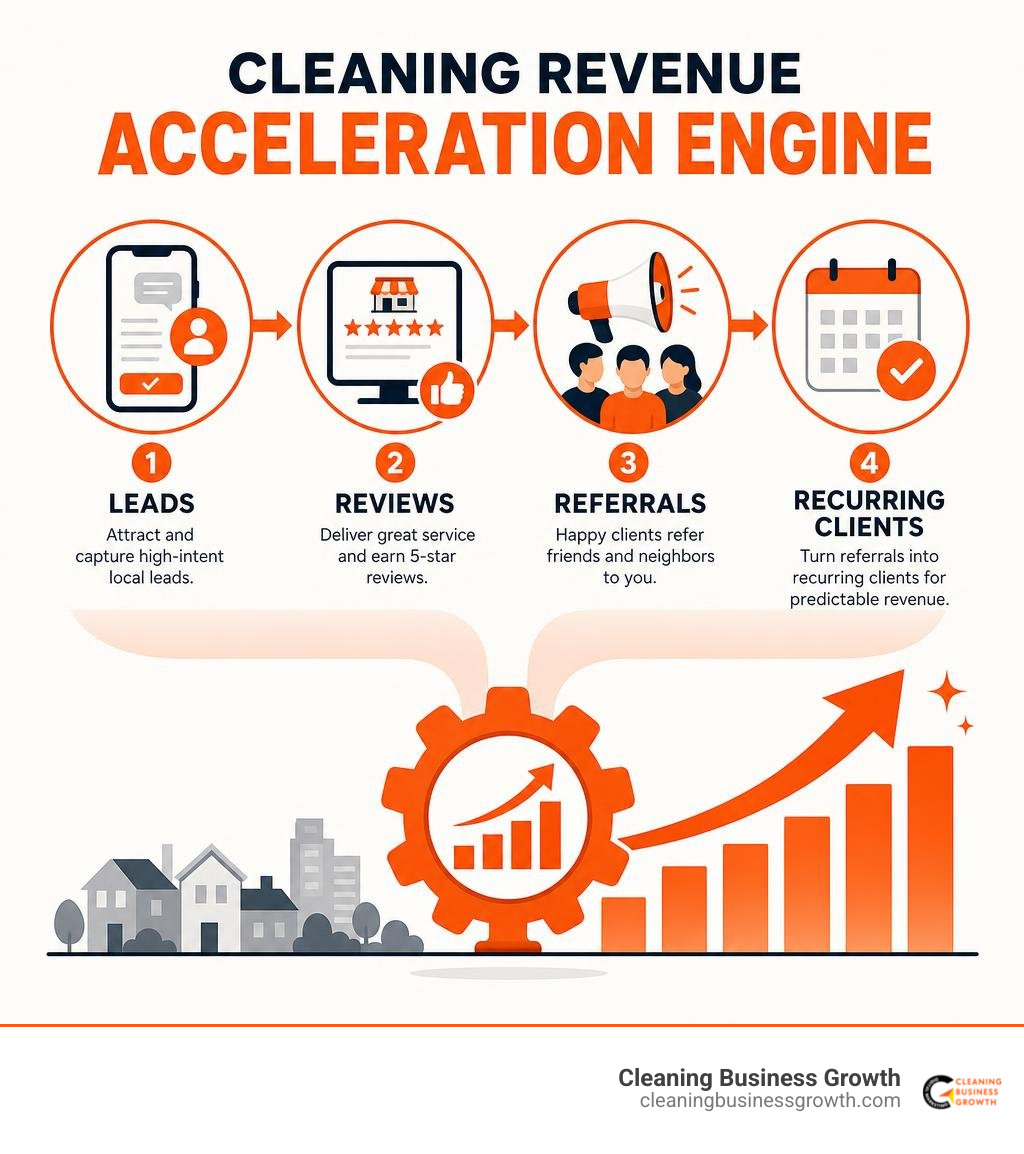
To learn how to grow a cleaning business fast, focus on four actions: respond to every lead quickly, make your Google Business Profile easy to find and trust, turn each completed job into a review and referral request, and sell recurring service instead of one-time cleans.
- Reply to calls, forms, and messages within minutes, not hours.
- Target a tight local area so reviews, referrals, and nearby jobs build momentum.
- Offer clear flat-rate packages and make biweekly or weekly cleaning the default choice.
- Use checklists, follow-up texts, and simple scheduling systems before adding more jobs.
Fast growth is not about being the lowest-priced cleaner or posting everywhere online. It comes from creating a reliable system that brings in high-intent local leads, converts them fast, and keeps them long enough to make marketing pay off. Referrals can convert 3-5 times better than cold leads, while a well-served recurring client can be worth far more than the first appointment alone.
I’m Ginger Whitson, founder and CEO of Cleaning Business Growth, and I have built and grown a cleaning company while helping service businesses create practical marketing systems for expansion. In this guide on how to grow a cleaning business fast, I’ll show you the client acquisition and operational moves that help a full schedule become predictable, profitable revenue.
7 High-Impact Strategies on How to Grow a Cleaning Business Fast
Scaling a cleaning company requires balancing lead generation with rock-solid fulfillment. If you bring in 30 new clients this month but lose 25 due to missed appointments, poor communication, or sloppy mopping, you are running on an exhausting hamster wheel.

Speed to lead is your single greatest operational weapon. The first business to respond gets the job roughly 70% of the time, and when you contact a lead within 5 minutes, your conversion rates skyrocket compared to waiting even an hour. In home and commercial services, 80% of sales require between 5 and 12 touchpoints before closing. If your booking flow is frictionless, you capture market share before competitors even check their voicemails.
Below is a breakdown comparing organic versus paid acquisition channels to help you balance your customer acquisition costs (CAC) against speed:
| Client Acquisition Channel | Upfront Cash Cost | Time to First Lead | Conversion Rate | Long-Term Scalability |
|---|---|---|---|---|
| Warm Outreach & Direct Messaging | $0 | 1–3 Days | High (40–60%) | Low (Capped by network size) |
| Nextdoor & Local Facebook Groups | $0 | 3–7 Days | Moderate (20–35%) | Moderate (Requires daily posting) |
| Google Business Profile (Local SEO) | $0–Low | 14–45 Days | Very High (50%+) | Extremely High (Compounds over time) |
| Google Local Services Ads (LSAs) | Moderate | 1–3 Days | High (35–50%) | High (Directly scales with budget) |
| Google Search Ads (PPC) | Moderate to High | 24–48 Hours | Moderate (15–25%) | High (Captures active searchers) |
| B2B Real Estate & Property Alliances | $0–Low | 14–30 Days | Very High (45–65%) | High (Generates repeat monthly volume) |
1. Master Local Outreach: How to Grow a Cleaning Business Fast on Zero Budget
When starting out or filling sudden calendar gaps, you do not need a massive ad budget to generate immediate cash flow. You can gain initial traction using grassroots, zero-ad-spend strategies outlined in our smart marketing playbook for ambitious cleaning business owners.
Start with direct outreach to your warm personal network. Reach out directly via text message to 50–60 personal contacts—friends, past coworkers, gym buddies, or family members. An authentic message like, “Hey Sarah! I just launched my professional cleaning service in town. I’m offering 20% off initial cleanings for our first 10 neighbors this month to build up our portfolio. Let me know if you’d like a spot!” consistently yields immediate bookings.
Next, dive into neighborhood-centric channels like Nextdoor and local Facebook community groups. On Nextdoor, 79% of users report being influenced by neighbor recommendations. Use the search bar to search keywords like “cleaner recommendation” or “house cleaning needed” to reply to existing posts—even ones that are a few months old, as cleaners frequently cancel or stop showing up.
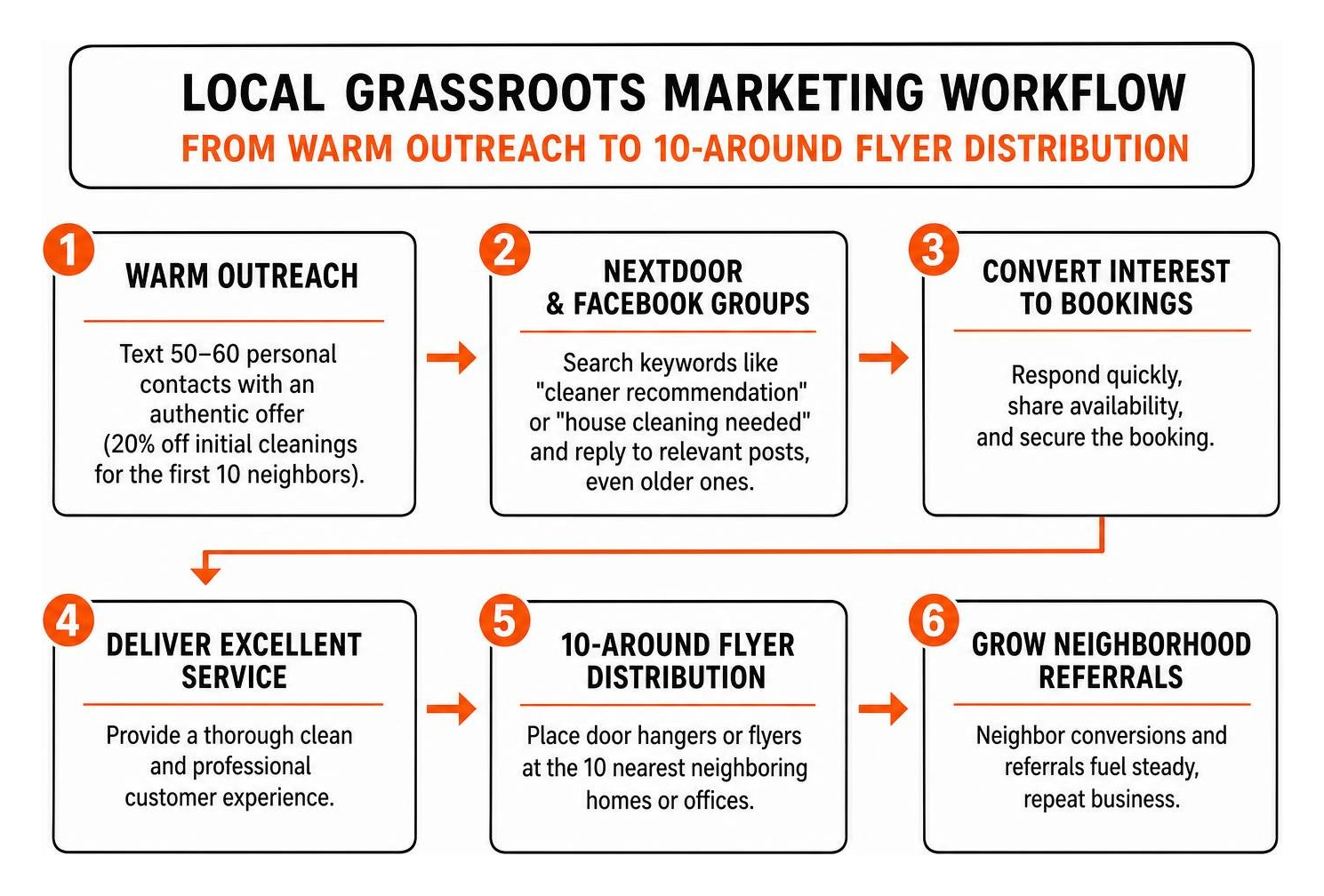
Complement online outreach with the “10-Around” strategy: every time you service a home or office, place professional door hangers or flyers at the 10 closest neighboring properties. Highlight that you are already servicing their neighbor on Tuesdays and can offer them a neighborhood route discount.
2. Dominate Local Search and Automated Review Systems
Over 80% of consumers hire a cleaner after a quick online search, and 98% read online reviews before picking a local provider. If your business is invisible on Google Maps, you are giving away thousands in monthly recurring revenue to competing services.
To build sustainable visibility, implement dedicated SEO for cleaning services starting with an optimized Google Business Profile (GBP):
- Keep your primary service category precise (e.g., House Cleaning Service or Janitorial Service).
- Define a compact, dense service radius (15–20 miles maximum) to maximize proximity ranking signals.
- Upload at least 10–15 high-resolution before-and-after photos of actual jobs, updating them weekly.
- Fill out all service descriptions with clear, transparent pricing guidelines and localized keywords.
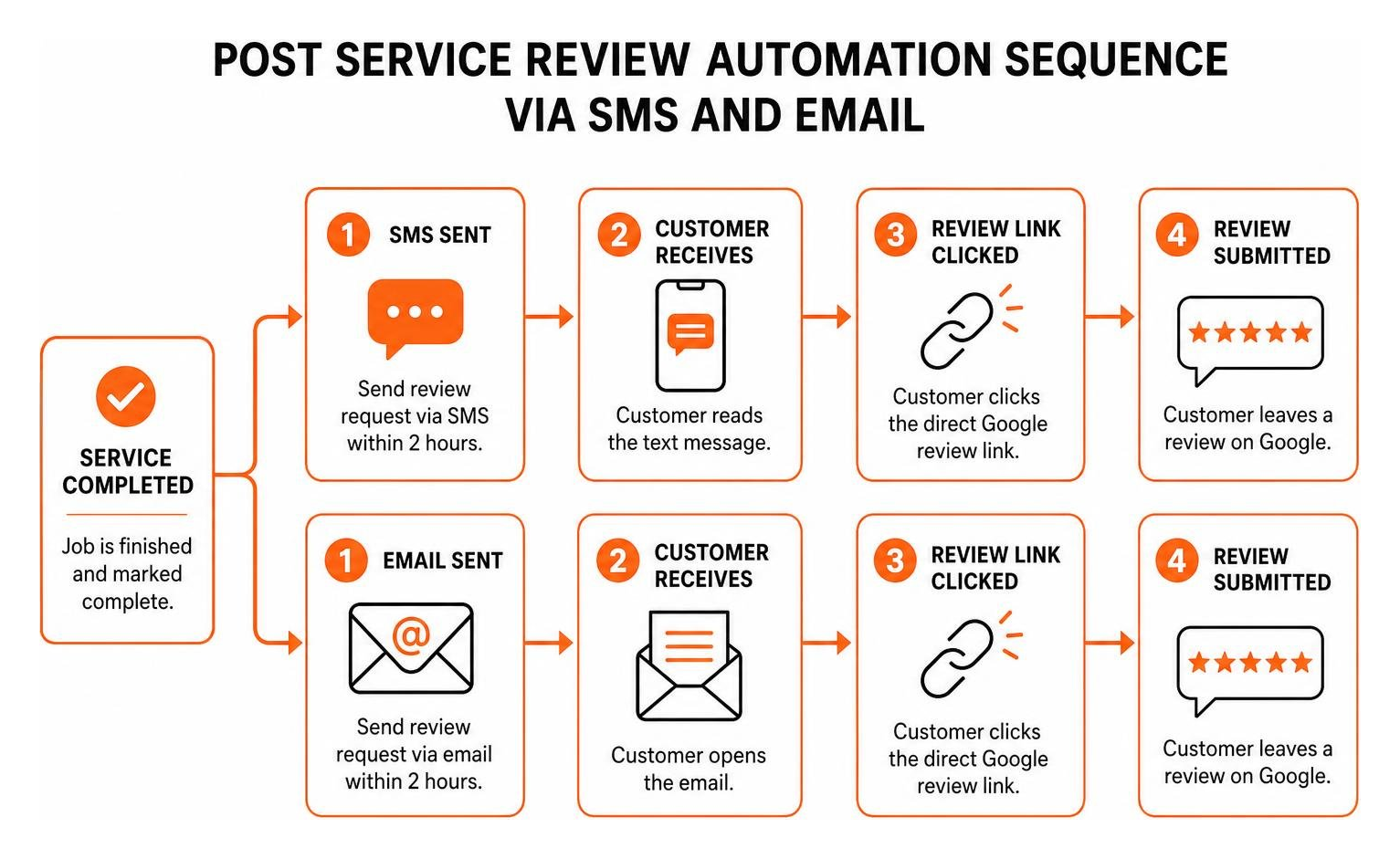
Reviews act as conversion rocket fuel. 68% of consumers will not use a local business rated below 4 stars. To build proof rapidly, automate your review collection. Send a text message containing a direct review link within 2 hours of completing a job:
“Hi Mark, thanks for trusting us with your home today! If you’re thrilled with how fresh everything looks, could you take 30 seconds to drop us a quick Google review? It helps our local team immensely: [Direct Google Review Link]”
Securing 10 to 20 positive reviews establishes trust in most mid-sized markets and pushes your profile into the local map pack.
3. Launch Targeted Paid Advertising Campaigns
Once your organic foundation is established, paid advertising provides immediate, scalable lead volume. The key is deploying channels that capture high-intent prospects who are ready to book immediately.
Start with Google Local Services Ads (LSAs). LSAs sit at the absolute top of search results, above traditional paid ads and map listings. By passing a background check and submitting your business insurance, you earn the Google Guaranteed badge. This badge instills immediate confidence, and you only pay per valid phone inquiry rather than per click.
Complement LSAs with high-intent Google Ads PPC campaigns targeting phrases like “move out cleaning near me” or “office janitorial services [City]”. Use negative keywords aggressively to eliminate non-commercial or budget DIY searches (such as “cheap cleaning hacks” or “cleaning jobs hiring”).
Combine your search ads with Facebook Meta Ads for retargeting. When a prospect visits your website but fails to request a quote, retarget them on Facebook and Instagram with client transformation photos, 5-star review highlights, and a limited-time free deep-clean add-on.
4. Build a High-Converting Referral and B2B Network
Referrals convert at 3 to 5 times the rate of cold leads because trust is established before the first conversation. Instead of hoping for referrals passively, build a formal, dual-sided incentive system.
Offer a “$25 for You, $25 for Them” referral structure. When an existing client refers a neighbor or colleague, the new client gets $25 off their initial cleaning, and the referrer receives a $25 credit toward their next clean.
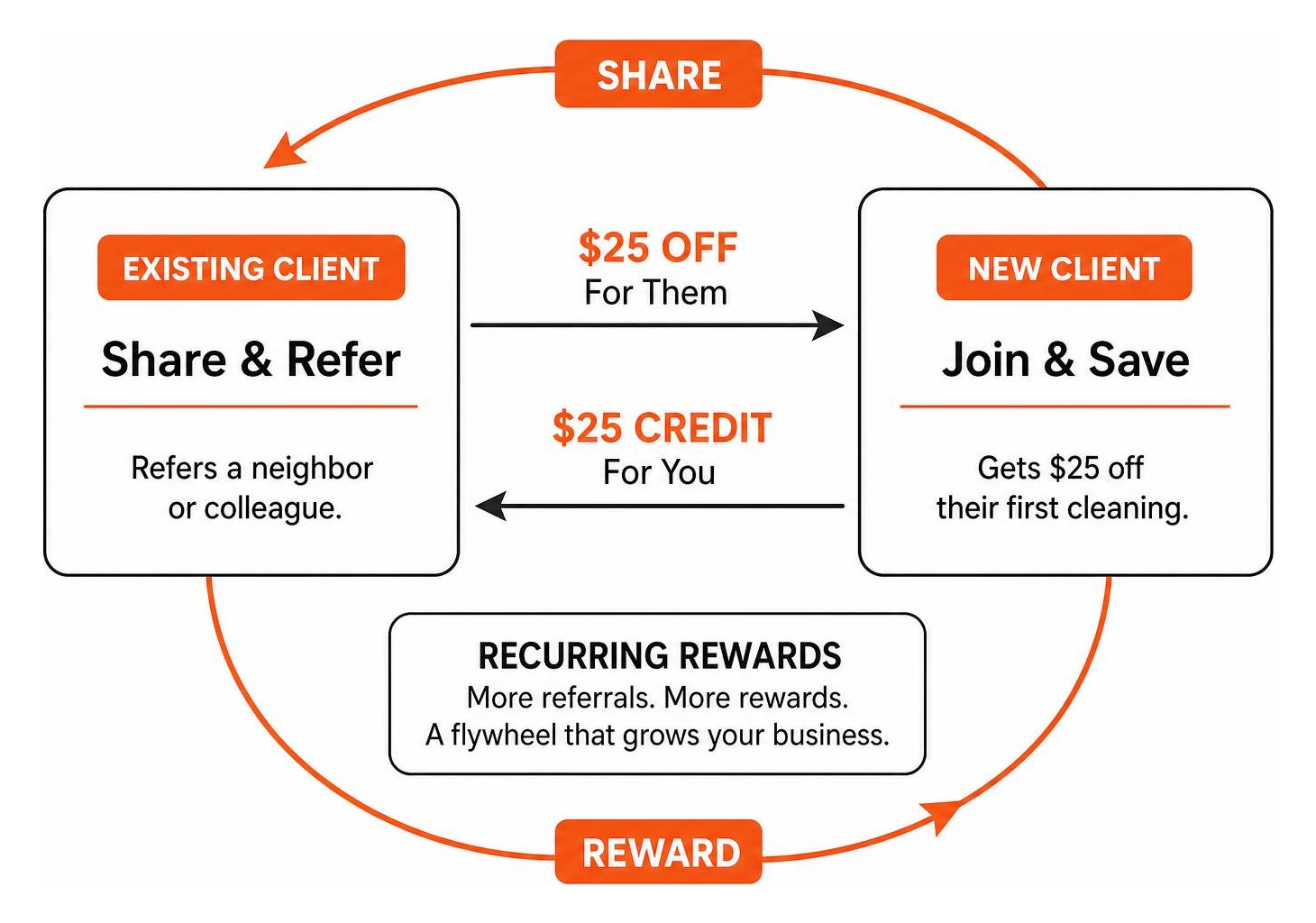
Simultaneously, establish strategic B2B referral partnerships:
- Real Estate Agents: Agents need reliable move-in and move-out cleaners who can work around tight closing dates. A small group of active agents can bring in valuable turnover-clean opportunities on a consistent basis.
- Property Managers and Short-Term Rental Hosts: These partners often need dependable turnovers with short notice and consistent quality.
- Complementary Residential Home-Service Providers: Build referral relationships with businesses that serve the same homeowners, such as organizers, movers, and home-staging professionals.
A residential cleaning client can deliver meaningful long-term value, making referral credits a practical investment in recurring revenue and stronger client relationships.
5. Build Scalable Operations: How to Grow a Cleaning Business Fast With Proven Systems
If your operational foundation is disorganized, fast marketing will only break your business sooner. Scaling requires standardized workflows that keep service delivery consistent as client count rises.
Deploy a modern field service management CRM to handle your schedule, track customer profiles, and automate recurring billing. Implement automated credit card processing so you are paid immediately upon job completion, avoiding cash flow bottlenecks.
Establish detailed Standard Operating Procedures (SOPs) for every job type:
- The “Top-to-Bottom, Left-to-Right” Rule: Train cleaners to move methodically around every room to avoid missing ceiling fan blades, baseboards, or cabinet corners.
- Color-Coded Microfiber Systems: Use red cloths for bathrooms, blue for glass/mirrors, and yellow for living areas to eliminate cross-contamination risks.
- Safety & Hazard Compliance: Keep updated Safety Data Sheets (SDS) organized in digital and vehicle binders.
Consolidate your client base to maximize route density. Keeping your team within tightly grouped neighborhoods cuts non-billable drive time, lowers fuel expenses, and increases daily job capacity. For complete implementation roadmaps, explore our approach to digital marketing for cleaning businesses to align your backend capacity with incoming lead flow.
6. Package Profitable Flat-Rate Pricing and High-Margin Niche Upsells
One of the fastest ways to stall growth is underpricing your labor. Hourly pricing penalizes your team for working efficiently. In contrast, 75% of consumers prefer flat-rate pricing because it eliminates cost uncertainty.
Calculate your pricing by identifying direct labor costs, supply expenses, and operational overhead, then apply a 2.5x to 3x multiplier to achieve a healthy 50% to 60% gross profit margin. For instance, if a 3-bedroom home requires $60 in cleaner wages, $10 in supplies, and $20 in overhead ($90 total cost), price the job between $225 and $270.
Offer modest discounts for recurring service (e.g., 10% off for weekly service, 5% for biweekly) to secure consistent monthly cash flow.
You can also boost average ticket values by adding high-margin niche services:
- Move-In / Move-Out Cleans: Higher ticket prices ($250–$450+) with empty rooms that allow faster turnaround.
- Post-Construction Cleans: Demands dust-removal equipment and commands premium commercial rates.
- Eco-Friendly / Green Cleaning: Using EPA Safer Choice or Green Seal-certified products attracts health-conscious families and corporate offices willing to pay a 15–20% premium.
For specialized residential conversion strategies, see our guide to maid service marketing.
7. Hire, Train, and Retain High-Performing Cleaning Crews
You cannot scale a cleaning business past solo capacity without stepping out of the field and into the operator role. Businesses are 17% more productive and 21% more profitable when they provide structured training to engaged employees.
To build a dependable cleaning team without compromising quality:
- Screen for Character and Reliability: Conduct thorough background checks, verify driving records, and run reference checks.
- Execute Paid Trial Cleanings: Have candidates complete a 2-hour paid working interview alongside your top team lead to evaluate their eye for detail, speed, and coachability.
- Use 10-Item Quality Inspection Checklists: Provide digital checklists that require photo confirmation for high-touch areas (under cushions, inside microwaves, polished fixtures).
Critical Milestones Across the Stages of Expansion
Scaling a cleaning enterprise happens in stages. Navigating these transitions smoothly requires aligning your financial targets, hiring cadence, and operational systems with the distinct stages of growth for cleaning businesses.
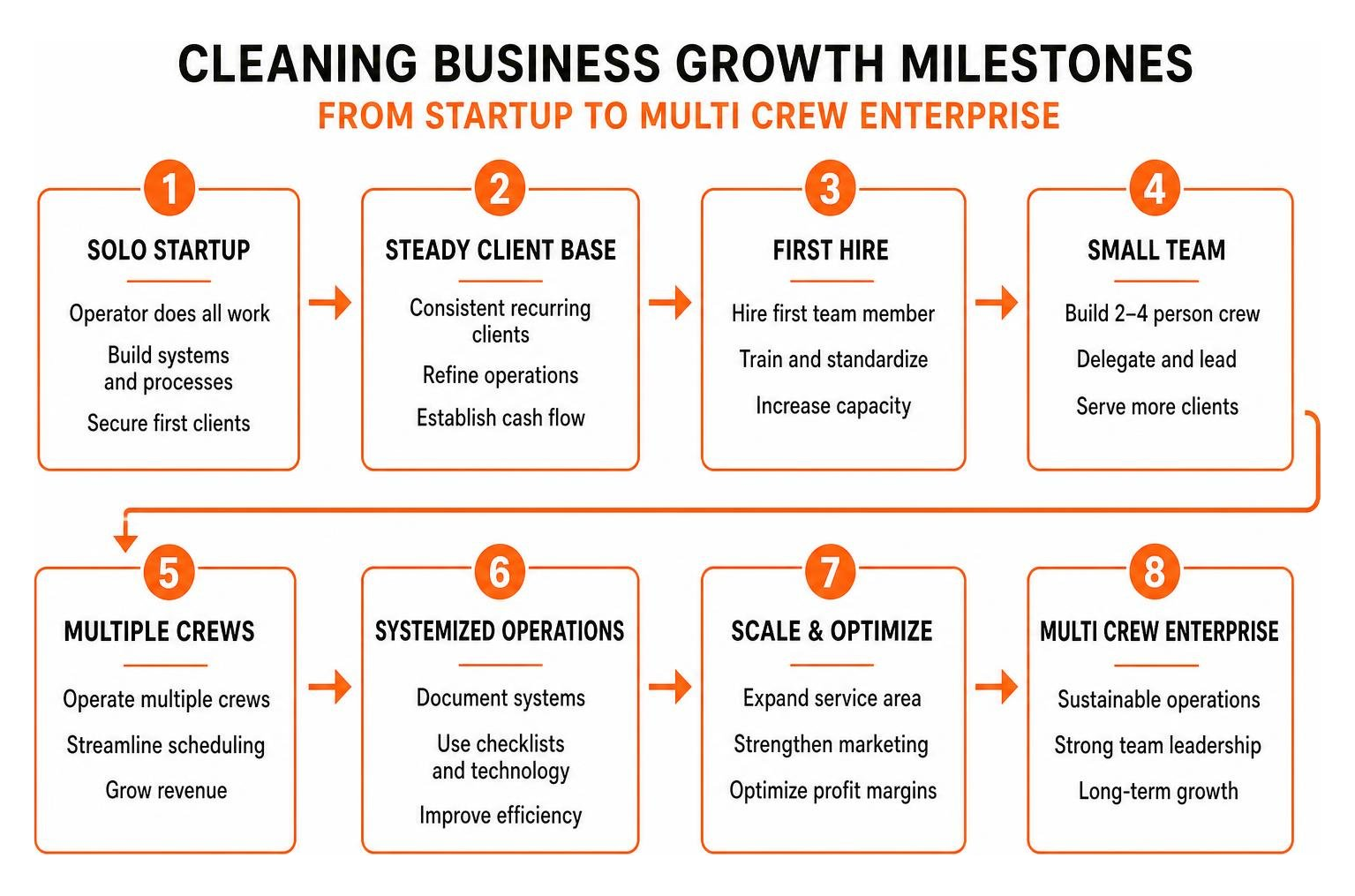
The 90-Day Setup and Client Ramp Trajectory
When launching or formalizing your cleaning business, running administrative setup and marketing outreach in parallel cuts your ramp time in half. As shown in operational benchmark data from Opora’s 90-day cleaning operations field guide, operators who execute setup tasks sequentially average 47 days to service their first paying account, whereas those running parallel execution book their first paid clean by Day 23.
- Foundation: Complete essential business setup, secure insurance, create your Google Business Profile, and begin reaching out to warm contacts.
- First Accounts: Serve initial clients, capture transformation photos, and request genuine Google reviews.
- Systemization: Put your referral process in place and adopt scheduling and invoicing software.
- Acceleration: Build a dependable base of recurring clients and focus on steadily increasing monthly recurring revenue.
Transitioning from Solo Cleaner to Multi-Crew Fleet
A solo cleaner eventually reaches an operational ceiling. At that point, fatigue can build, customer service may slip, and administrative work can fall behind unless the business has dependable systems and support in place.
To break past this plateau, transition into running 2-person independent crews:
- Crew 1 handles morning residential maintenance routes.
- Crew 2 tackles move-outs, deep cleans, and light commercial facilities.
- The owner transitions 100% of their time to sales, marketing, quality control audits, and customer retention.
Pairing structured operational delegation with professional website design for cleaning services and studying real-world marketing case studies will help you move from a solo cleaner to a multi-crew operation doing six figures. For an in-depth breakdown of scaling milestones, read the Bizzby six-figure cleaning growth playbook.
Costly Mistakes That Sabotage Rapid Cleaning Growth
Avoiding operational pitfalls is just as important as generating leads. Here are the common errors that derail cleaning business owners:
- Competing Purely on Price: Low prices attract price-sensitive clients who switch providers over small price differences. Compete on reliability, communication, and quality guarantees instead.
- Pausing Marketing When Schedules Are Full: Client churn is inevitable due to moves, budget changes, or life transitions. If you pause marketing, you will face empty calendar slots 60 days later. Maintain continuous baseline marketing.
- Ignoring Perceived Indifference: 68% of clients leave a service business because of perceived indifference. A quick post-service text checking on cleaning quality keeps clients engaged and loyal over time. For more retention insights, review Tofu’s cleaning marketing and retention guide.
- Scaling Without Documented SOPs: Adding cleaners without written checklists leads to inconsistent service quality, negative reviews, and lost accounts.
Frequently Asked Questions About Rapid Cleaning Growth
What is the fastest way to get new cleaning clients with no budget?
The quickest zero-cost strategy is direct messaging your personal contacts alongside active outreach on Nextdoor and local Facebook community groups. Offer an introductory discount or a free deep-clean add-on in exchange for an immediate 5-star Google review and photos. For a detailed step-by-step roadmap, check out CleanKit HQ’s 30-day client acquisition playbook.
How do I price cleaning jobs to stay profitable while scaling?
Avoid low hourly rates. Instead, calculate your total job cost (labor + supplies + overhead) and use a 2.5x to 3x multiplier to maintain a 50% to 60% gross profit margin. Provide flat-rate quotes based on home square footage and room count.
How many Google reviews do I need to rank locally?
In most local markets, securing 10 to 20 detailed 5-star reviews provides enough authority to rank in the Google Maps 3-pack. Consistency matters: aim to gain 3 to 5 new verified reviews every month using automated SMS requests.
Conclusion: Build a Sustainable, High-Profit Cleaning Machine
Learning how to grow your cleaning business rapidly is not about working 14-hour physical cleaning shifts. It comes down to shifting from a solo cleaner mindset to an operational business builder. By pairing rapid lead response with automated review collection, flat-rate recurring packages, and structured training checklists, you build a cleaning company that scales reliably.
If you are ready to remove the guesswork, fill your calendar, and scale recurring revenue with proven digital acquisition systems, explore our full Clean Growth Framework and partner with our growth team today.

Let’s Build the Right Marketing Plan for Your Cleaning Business
In one conversation, we’ll review what is working, identify the biggest gaps and discuss the marketing services that make sense for your goals, market and budget. You’ll leave with clearer priorities and practical next steps—whether or not you decide to work with us.
Honest guidance. No pressure. No long-term commitment.
Review your current marketing
Identify gaps & missed opportunities
Prioritize next steps
Discuss a realistic budget
Start marketing
The leads flow
Your Business Grows