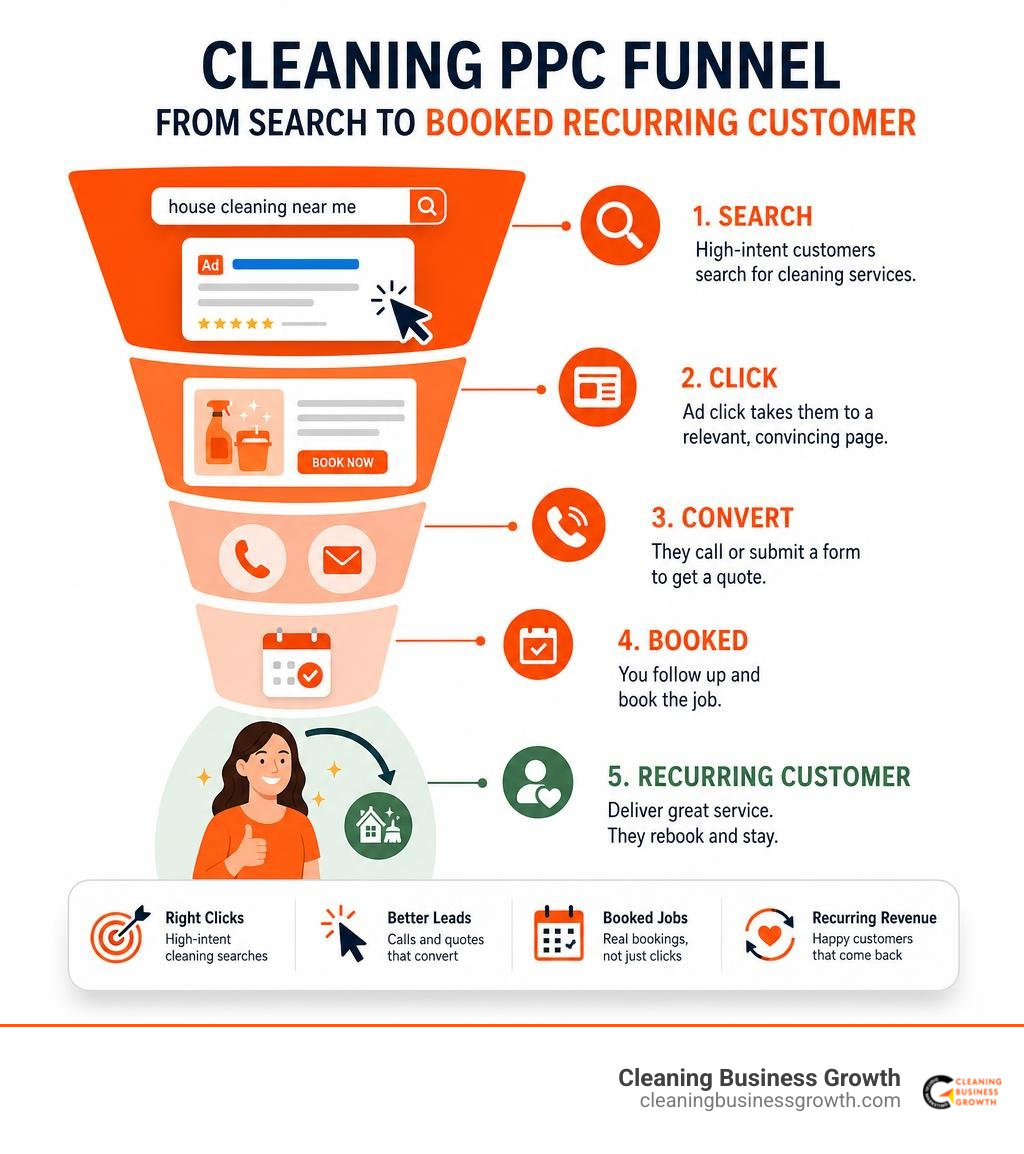
Turn Cleaning Ad Clicks Into Booked Jobs
Effective ppc for cleaning services starts with a simple system: advertise only the services you want to book, send each click to a matching page, and track every call and quote request through to a real job.
- Run high-intent Google Search campaigns for services such as recurring house cleaning, deep cleaning, and move-out cleaning.
- Use Local Services Ads where available to earn trust with Google Guaranteed eligibility and generate direct leads.
- Block wasteful searches, including jobs, DIY advice, and cleaning supplies.
- Measure booked jobs – not just clicks or form fills – then put more budget toward recurring customers with stronger lifetime value.
Most local cleaning companies begin with roughly $1,000 to $5,000 per month in ad spend, while cleaning clicks commonly cost about $1.50 to $8 depending on the market and service. The goal is not more traffic. It is a dependable flow of profitable bookings at a cost your business can sustain.
I’m Ginger Whitson, founder of Cleaning Business Growth and a former cleaning business owner who has built growth systems for cleaning companies. I use hands-on experience in ppc for cleaning services to help owners turn ad spend into measurable leads, booked jobs, and recurring revenue.
Campaign Types and Account Structure in PPC for Cleaning Services
Setting up a pay-per-click account without clear organization is like tossing all your cleaning chemicals, rags, and mop heads into a single bucket and hoping for the best. To drive real bookings, your account architecture must be structured cleanly from day one. Understanding why Google Ads campaigns are crucial for growing your residential cleaning service allows us to build campaigns that systematically turn local searches into revenue.
We organize Google Ads accounts by service families rather than bundling everything into one generic campaign. For a typical residential cleaner, this means building dedicated campaigns for:
- Recurring maid service / routine house cleaning
- Deep cleaning / seasonal spring cleaning
- Move-in and move-out cleaning
- Commercial and office cleaning (if offered)
- Post-construction cleaning (if offered)
Each campaign contains tight, single-theme ad groups (STAGs). This separation ensures that when a frantic tenant searches for “end of tenancy cleaner,” they see an ad specifically promising prompt move-out inspections, not a generic headline about weekly dusting.
Geographic targeting requires equal discipline. Set your location targeting strictly to “People in or regularly in your targeted locations” rather than people showing interest in your area. Use tight radius exclusions around neighborhoods outside your practical service radius to prevent paying for clicks from homeowners you cannot legally or logistically service.

Structuring High-Intent Search Campaigns and Ad Groups
High-intent Search campaigns require precise message match across three stages: the search term, the ad copy, and the landing page headline.
When grouping your keywords, create dedicated ad groups based on intent:
- Recurring House Cleaning Group: Keywords focused on weekly, bi-weekly, or monthly domestic cleaning. These clients deliver the highest customer lifetime value (LTV).
- Deep Cleaning Group: High-margin, one-off projects where homeowners want a thorough refresh before holidays or family visits.
- Move-Out Cleaning Group: Urgent, time-sensitive searches where conversion rates are high because tenants need their security deposits returned.
Maintaining this segmentation maximizes your Google Quality Score, keeps your cost per click lower, and drives higher conversion rates because the user finds exactly what they requested immediately.
Leveraging Google Local Services Ads and Google Guaranteed
In addition to traditional Search campaigns, Google Local Services Ads (LSA) provides an alternative pay-per-lead channel. Sitting at the absolute top of the search engine results page, LSA displays your business name, star rating, phone number, and the green Google Guaranteed badge.
To launch LSAs, cleaning companies must pass business verification, provide proof of general liability insurance, and complete background checks for technicians.
Once approved, you only pay when a potential customer calls or messages you directly through the ad unit. If a lead turns out to be outside your designated zip codes or looking for a service you do not offer (like window washing or carpet dyeing), you can dispute the charge inside the dashboard to protect your ad budget.
Keyword Selection, Match Types, and Negative Keyword Management
Keyword selection determines whether your ad budget produces booked appointments or evaporates on unqualified traffic. Industry data and best practices from Google Ads Help show that targeting generic queries like “cleaning” results in high bounce rates and inflated acquisition costs. We need commercial-intent queries where the searcher is holding a credit card and ready to hire.
| Feature / Metric | Google Search Ads | Google Local Services Ads (LSA) |
|---|---|---|
| Pricing Model | Pay-Per-Click (CPC: $1.50 – $8.00) | Pay-Per-Lead ($15.00 – $45.00+) |
| Placement | Top & bottom of search results | Very top of Google results |
| Trust Badge | Optional review extensions | Google Guaranteed Badge |
| Landing Page Needed | Yes (Custom, dedicated page) | No (Direct Google profile) |
| Lead Disputing | Not available for invalid clicks | Available for invalid/out-of-area calls |
| Targeting Control | High (Keywords, match types, schedules) | Moderate (Job categories & zip codes) |
Best Keyword Match Strategies in PPC for Cleaning Services
Google Ads offers three match types: Exact Match, Phrase Match, and Broad Match.
- Exact Match (
[house cleaning services near me]): Gives you maximum control. The ad triggers only when the query matches the meaning precisely. Use this for your most profitable, highest-converting core terms. - Phrase Match (
"move out cleaning cost"): Triggers your ad when the search includes the core meaning of your phrase. This is the workhorse of local cleaning campaigns, allowing you to capture relevant long-tail variations. - Broad Match (
maid service pricing): Casts a wide net using Google’s machine learning. While useful in large enterprise accounts, broad match can waste budget in local campaigns unless paired with extensive negative keyword lists and strong automated conversion data.
Begin with a curated blend of Phrase and Exact match keywords centered around high-intent residential queries:
[house cleaning service]"maid service near me""deep cleaning services for home"[move out cleaning services]"cost of bi weekly house cleaning"
Audit your Search Terms Report weekly to discover new profitable phrases and identify irrelevant terms to block.
Building Comprehensive Negative Keyword Lists to Stop Waste
Negative keywords prevent your ads from showing on irrelevant queries. Without them, your budget will drain on people looking for job openings, DIY tutorials, or mop refills. If you need to troubleshoot and fix underperforming cleaning company Google Ads, the negative keyword list is always the first place to look.
Create account-level negative keyword lists covering these categories:
- Employment & Careers: jobs, careers, salary, hiring, resume, employment, application, wage, hourly pay
- DIY & Informational: how to, DIY, homemade, recipes, tips, steps, tutorial, clean it yourself
- Supplies & Equipment: products, chemicals, vacuum repair, supplies, store, rental, wholesale, depot
- Irrelevant Services: dry cleaning, car detailing, crime scene, biohazard, pool cleaning, duct cleaning
- Discount Seekers: free, cheap, cheapest, craigslist, coupons, bartering
Adding these negative keywords ensures your dollars are spent solely on homeowners seeking professional maid services.
High-Converting Ad Copy, Trust Signals, and Dedicated Landing Pages
Clicks do not generate revenue—confirmed jobs on your schedule do. If you want an improved cost per lead with Google Ads, your ads must earn the click with compelling trust signals, and your landing page must make booking effortless.

Crafting Click-Worthy Ads with Trust Signals
Homeowners are letting strangers into their personal living spaces. Because of this, trust is the primary conversion factor in domestic cleaning.
Build Responsive Search Ads (RSAs) that combine localized hooks with verified trust signals:
- Headline 1 (Keyword Focus): Top-Rated Maid Service in [City]
- Headline 2 (Offer / Value): Instant Online Estimates & Booking
- Headline 3 (Trust Anchor): Background-Checked & Insured Staff
- Descriptions: Include details like “100% Satisfaction Guarantee,” “Eco-Friendly & Pet-Safe Products Used,” and “Reliable recurring cleaning tailored to your schedule.”
Equip every ad with comprehensive Ad Assets (formerly extensions):
- Call Assets: Allow mobile searchers to click to call immediately.
- Sitelink Assets: Link directly to Move-Out, Deep Clean, and Recurring plans.
- Callout Assets: Highlight “No Long-Term Contracts,” “Bonded & Insured,” and “Locally Owned.”
- Structured Snippets: Detail your service offerings (Kitchens, Bathrooms, Deep Scrubbing, Baseboards).
Landing Page Optimization and Conversion Tracking Setup
Never send paid traffic to your website’s generic homepage. A homepage contains too many distractions: navigation links, company history, blog posts, and multiple service menus.
Send ad clicks to a dedicated, distraction-free landing page designed for a single goal: capturing a booking or quote request. When applied systematically, specialized page funnels help Google Ads leads jump 2x compared to standard web pages.
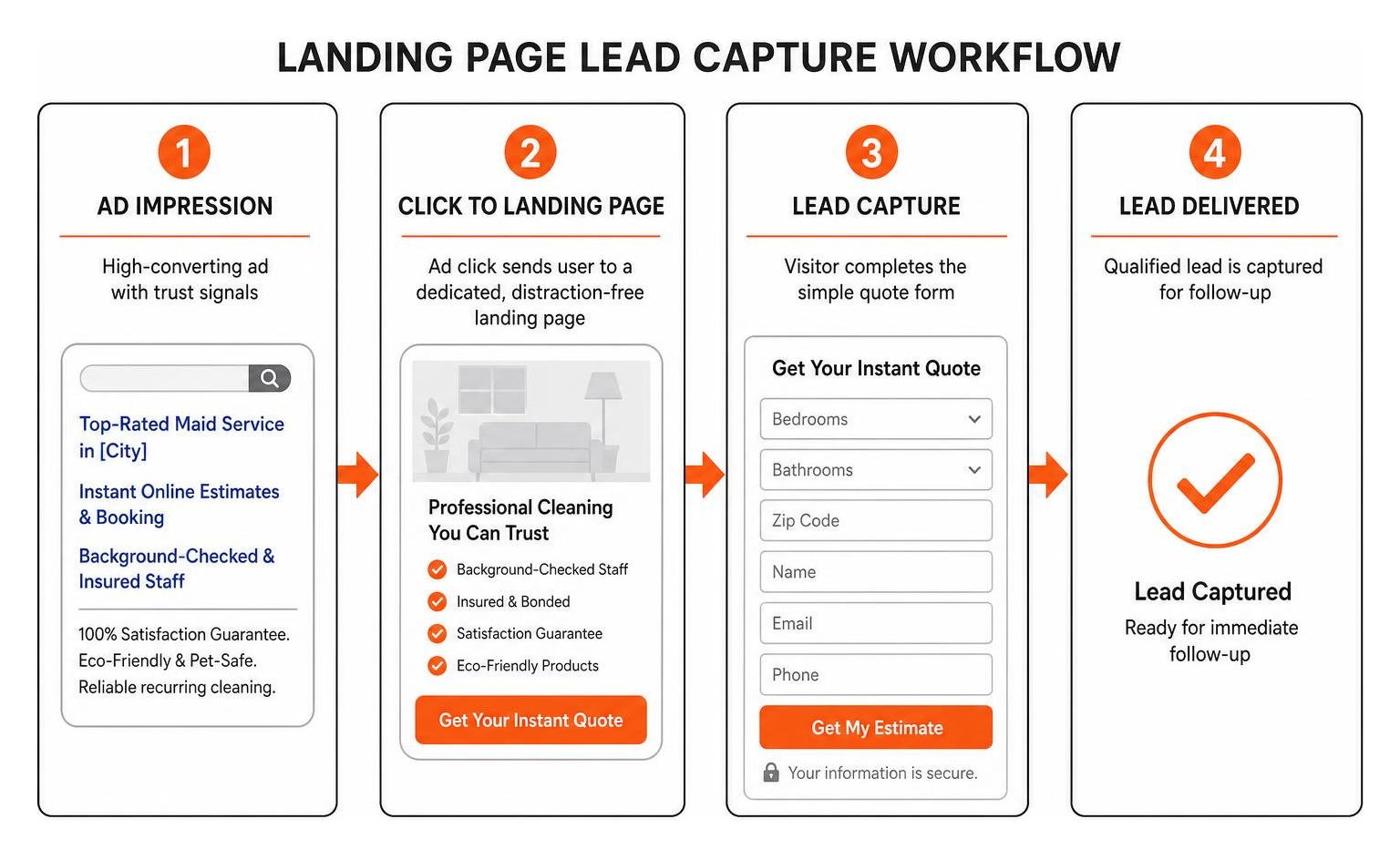
Essential landing page elements include:
- Above-the-Fold Form: A simple quote form asking for bedrooms, bathrooms, zip code, and contact information.
- Sticky Click-to-Call Button: Highly visible on mobile screens for users needing immediate assistance.
- Real Social Proof: Google review badges, before-and-after photos, and verified customer testimonials.
- Clear Guarantees: Explicit statements regarding background checks, insurance coverage, and re-clean guarantees.
For conversion tracking, configure dynamic call tracking software with unique numbers for PPC traffic. Establish a minimum duration threshold (such as 60 or 90 seconds) so that wrong numbers or brief inquiries do not register as qualified conversions. Connect your CRM to Google Ads using offline conversion tracking to feed completed jobs and recurring contract values back into the platform.
Bidding Strategies, Budgeting, and Seasonal Scaling
Maximizing your return on ad spend requires balancing short-term cash flow against customer lifetime value (LTV). While deep cleans yield higher one-time ticket prices, recurring bi-weekly clients generate thousands of dollars in revenue over their lifespan. A well-rounded approach to digital marketing for cleaning businesses factors this customer lifetime value into its bidding models.
Scaling Budgets and Maximizing ROI with PPC for Cleaning Services
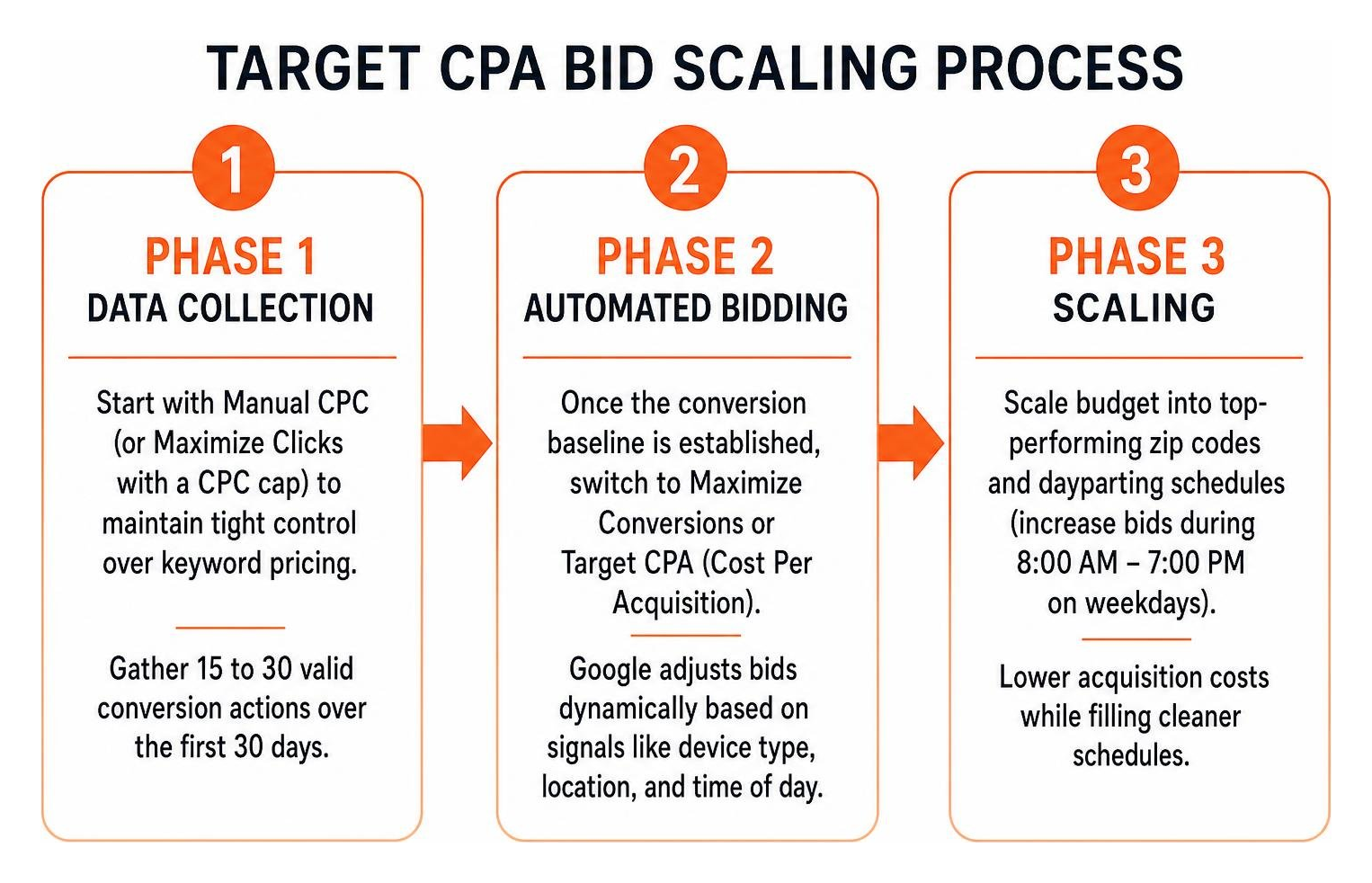
When launching a new campaign, do not jump immediately to automated Smart Bidding. Google’s algorithms require historical data to optimize bids accurately.
- Phase 1 (Data Collection): Start with Manual CPC (or Maximize Clicks with a CPC cap) to maintain tight control over keyword pricing. Gather 15 to 30 valid conversion actions over the first 30 days.
- Phase 2 (Automated Bidding): Once the conversion baseline is established, switch to Maximize Conversions or Target CPA (Cost Per Acquisition). This allows Google to adjust bids dynamically based on signals like device type, location, and time of day.
- Phase 3 (Scaling): Examine our marketing case studies to see how scaling budget into top-performing zip codes and dayparting schedules (increasing bids during 8:00 AM – 7:00 PM on weekdays) drops acquisition costs while filling cleaner schedules.
Capturing Seasonal Surges Across Move-Out and Holiday Periods
Cleaning service demand follows distinct seasonal waves throughout the calendar year:
- Spring Cleaning Surge (March – May): Residential demand spikes for deep cleans, window washing, and decluttering. Increase budgets by 20–30% on deep clean ad groups and introduce spring-themed promotional copy.
- Summer Moving Wave (June – August): College leases turn over, and home sales peak. Scale move-out cleaning ad budgets, highlight guaranteed deposit-back cleans, and use ad schedules that cover evenings and weekends.
- Holiday Prep Spike (October – December): Homeowners prepare for Thanksgiving, holiday parties, and family visits. Emphasize fast turnaround times, guest-ready deep cleans, and recurring holiday prep packages.
Ramp up ad spend two weeks prior to the historical surge in your market to capture searchers planning in advance.
Frequently Asked Questions About Cleaning PPC
How much should a cleaning company budget for Google Ads each month?
Most independent cleaning companies start with an ad budget between $1,000 and $3,000 per month, while multi-crew operations in competitive metros often invest $3,000 to $5,000+ monthly. With average clicks ranging from $1.50 to $8.00, this budget delivers enough traffic volume to secure consistent leads, train Google’s bidding algorithms, and keep technician schedules full.
How long does it take to see positive ROI from cleaning service PPC?
You can start generating calls and quote requests within the first 48 to 72 hours after launching a campaign. However, dialling in optimal profitability typically takes 4 to 6 weeks. This ramp-up window allows you to build negative keyword lists, refine ad copy, adjust geographic boundaries, and collect the 15 to 30 conversions needed for automated bidding to stabilize.
What is the most common mistake cleaning businesses make in Google Ads?
The most common and expensive mistake is sending paid ad traffic to a generic website homepage while running broad match keywords without a negative keyword list. This drains budgets on unqualified searches (like job seekers and DIY instructions) while presenting visitors with an unfocused page that fails to convert them into booked appointments.
Conclusion
PPC advertising is one of the fastest, most scalable channels available for acquiring residential and commercial cleaning clients. By structuring campaigns around distinct service families, utilizing targeted match types, aggressively blocking negative keywords, and directing clicks to dedicated conversion landing pages, you transform pay-per-click from an unpredictable expense into a profitable booking engine.
At Cleaning Business Growth, we provide a proven growth-partner system built by an owner who scaled her own cleaning company from the ground up. We deliver no-contract, budget-friendly, results-focused systems designed to generate qualified leads and recurring revenue. Ready to stop burning ad spend and fill your schedule with profitable clients? Scale your revenue with dedicated Google Ads PPC management today.