Why Facebook Ads for Cleaning Business Growth Deliver High ROI
To generate consistent, high-ROI leads with Facebook ads for cleaning business growth, focus on four foundational pillars: establish a tight 10 to 15-mile geographic boundary targeting homeowners aged 30 to 55+, deploy high-contrast before-and-after visual creatives, capture contact details through frictionless native Instant Forms with qualifying questions, and execute rapid automated follow-up within minutes.
Cleaning is an inherently visual trade. When a homeowner scrolls past a dull kitchen sink that suddenly transforms into sparkling stainless steel, they immediately grasp the value of the service. Meta advertising allows you to showcase this direct transformation to the exact homeowners residing within your service territory.
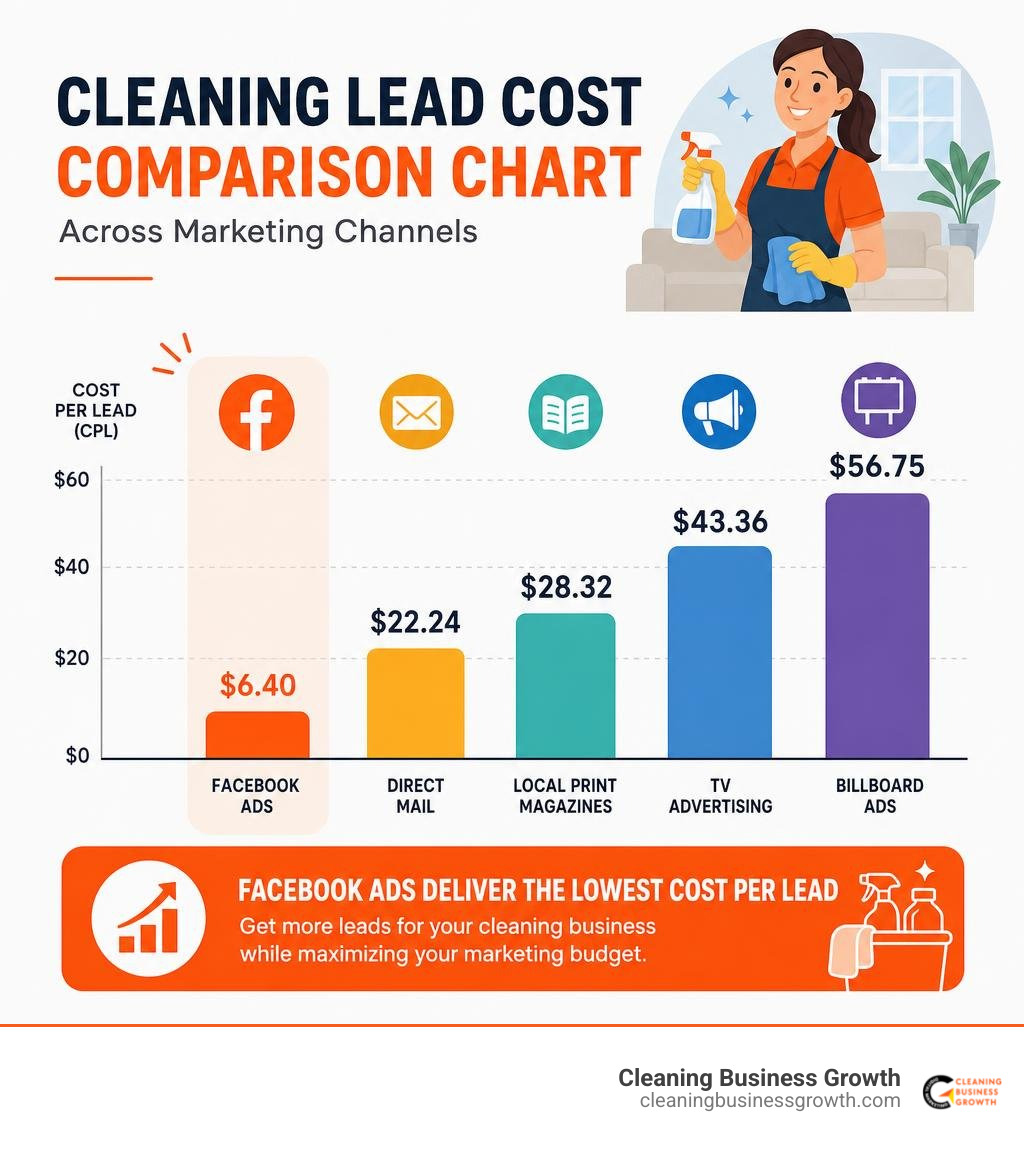
From an economic perspective, paid social delivers exceptional capital efficiency compared to legacy channels. Across the cleaning industry, Facebook ads average $14.23 per thousand impressions (CPM) and roughly $6.40 per lead (CPL). With roughly 50% of cleaning businesses ramping up their digital marketing efforts, running targeted social campaigns ensures you capture market share before competitors saturate your neighborhoods.
When executed through a proven maid service marketing framework, social ads do not simply generate vanity metrics; they build sustainable local brand equity that keeps your recurring schedule booked solid.
Instant Lead Capture vs. Traditional Media
Traditional local advertising channels such as direct mail, local print magazines, or regional cable TV spots can easily cost between $10,000 and $50,000 monthly, with virtually zero real-time attribution. If a billboard fails to generate calls, you cannot tweak the headline or pause the spend mid-month.
Facebook Lead Ads solve this issue entirely through native Instant Forms. When an interested user clicks your ad, Meta auto-populates their name, email address, and phone number directly from their profile data. This removes the friction of loading an external website on a slow mobile connection and typing out personal details manually.
As highlighted in our marketing case studies, removing this barrier to entry dramatically cuts cost per acquisition while providing immediate contact data for your sales pipeline.
Turning Organic Group Engagement into Paid Retargeting Audiences
Many cleaning operators attempt to drum up business by joining local community and neighborhood groups. However, dropping blatant promotional links often violates community guidelines and gets accounts banned.
A far more sustainable approach bridges organic community value with paid targeting:
- Search for hyper-local groups (such as neighborhood associations, parent groups, or local real estate investor groups).
- Share helpful, non-promotional video content directly from your business page, such as a 30-second technique for removing hard water spots or tackling dirty oven glass.
- Answer homeowner cleaning questions in the comment sections with genuine professional guidance.
- Open Meta Ads Manager and build a Custom Audience comprised of everyone who viewed at least 50% of your shared video posts.

By turning organic video viewers into a warm retargeting pool, you avoid being perceived as a spammer while creating a hyper-responsive audience for your paid service promotions.
Strategic Setup and Campaign Objectives in Meta Ads Manager
One of the most common mistakes cleaning owners make is clicking the blue “Boost Post” button on their Facebook page. While boosting creates surface-level post engagement, it bypasses the powerful optimization algorithms, lead form configurations, and granular bidding controls available inside Meta Ads Manager.
To build a sustainable client acquisition engine, campaigns must be constructed within Ads Manager around distinct conversion objectives.
| Campaign Objective | Primary Use Case | Conversion Mechanism | Best For |
|---|---|---|---|
| Leads | High-volume quote requests | Native Instant Forms | Recurring residential and deep cleaning inquiries |
| Messages | Direct client conversations | Messenger, Instagram DM, WhatsApp | Real-time quote negotiation during business hours |
| Traffic / Sales | Instant online scheduling | External booking software / Landing page | Fixed-price packages and automated checkout funnels |
Setting Up Facebook Ads for Cleaning Business Lead Generation
When launching a lead campaign, select the Leads objective and choose Instant Forms as your conversion location. To ensure lead quality without introducing excessive friction:
- Incorporate 1–2 Custom Qualifying Questions: Add simple dropdown choices such as “Number of bedrooms/bathrooms” or “Type of service needed (Recurring, Deep Clean, Move-Out).” This filters out casual tire-kickers while preparing your team for an accurate quote.
- Add Your Privacy Policy Link: Meta requires a valid privacy policy URL on every lead form before publication.
- Connect Automated CRM Syncing: Connect your lead form to your customer management software so your office staff receives instant notifications the moment a lead submits their details.
For step-by-step guidance on setting up campaigns, see How to Advertise Cleaning Services on Facebook for additional campaign structure tips.
Direct Messaging and Traffic Objectives for Instant Bookings
The Messages objective directs ad traffic straight into Facebook Messenger, Instagram DMs, or WhatsApp. This format converts exceptionally well for operators who maintain rapid response times, as modern consumers appreciate quick answers without picking up the phone.
When using Messages campaigns, implement Dayparting (ad scheduling) inside Meta Ads Manager. Schedule your ads to display exclusively during your active office hours so inquiries are answered within minutes.
If your website features a live booking engine where clients can select a date, calculate square footage, and pay online, test the Sales objective directed at your booking page. Ensure your Meta Pixel and Conversions API are properly configured to attribute completed transactions.
Pinpoint Local Audience Targeting and Budgeting Strategies
Residential cleaning is a localized service. Marketing to individuals beyond your standard driving radius burns budget on travel time that ruins job profitability.
When establishing your geographic parameters:
- Set your location radius between 10 to 15 miles from your dispatch hub or target specific high-value ZIP codes.
- Change the location setting dropdown from “People living in or recently in this location” to “People living in this location.” This prevents your ads from serving to commuters, delivery drivers, or tourists passing through your zone.
- Actively exclude neighborhoods or adjacent municipalities outside your operational boundary to prevent unprofitable quotes.
Demographic Filtering and Custom Audience Segmentation
Once your geographic boundary is defined, layer demographic filters that align with recurring residential cleaning buyers:
- Age: Filter between ages 30 to 55+. Homeowners in this age bracket possess the discretionary income to outsource housework and value their free time.
- Homeownership & Family Status: Target homeowners, married couples, and working parents with children.
- Behavioral Triggers: Layer behaviors such as “Likely to move” to capture high-ticket move-in and move-out deep clean opportunities.
- Exclusions: Exclude existing clients from top-of-funnel acquisition campaigns by uploading your customer email list into Ads Manager as an exclusion audience.
For smaller businesses testing low-budget strategies, How to Advertise Your Maid Service on Facebook for $35 with ZenMaid CEO Amar Ghose breaks down how to run lean local campaigns without overcomplicating initial setup.
Testing Budgets, Bidding, and Scheduling Best Practices
Start your testing phase with a modest daily budget of $10 to $20 per day distributed across one campaign with 2–3 ad sets.
Allow your campaign to run undisturbed for a minimum of 7 days before modifying budgets or turning off ads. Meta’s algorithm requires sufficient impression volume to navigate the learning phase. Aim for a cost-per-click (CPC) under $1.00 and a steady flow of leads below your target acquisition ceiling.
Integrating Facebook campaigns alongside an omnichannel digital marketing for cleaning businesses framework provides multiple touchpoints across paid search, local SEO, and social feeds.
High-Converting Creative Strategies and Copywriting Frameworks
Great targeting places your ad in front of the right screen, but persuasive creative earns the click. Ad creative for cleaning services must overcome consumer skepticism by proving professionalism, reliability, and transformative results.
To craft ad copy that converts, structure your primary text around a proven 4-part copywriting framework:
- The Hook: Address a specific pain point or emotional desire. (“Tired of spending your entire Saturday scrubbing baseboards and folding laundry?”)
- The Solution & Offer: Introduce your service alongside a clear incentive. (“Let our professional team make your home sparkle. Book your initial deep clean this week and receive $25 off your first recurring service!”)
- The Trust Builder: Eliminate risk with operational credentials. (“Fully licensed, bonded, background-checked, and insured with over 150+ 5-star local reviews.”)
- The Direct Call to Action: Tell the user exactly what to do next. (“Tap ‘Get Quote’ below to check availability in [City Name] in under 60 seconds.”)
Creative Formats for Facebook Ads for Cleaning Business Owners
Test multiple visual formats across your ad sets to determine what captures local attention best:
- Before-and-After Images: High-contrast split images showing grime-covered stovetops or stained tile grout transformed into spotless finishes. Ensure lighting and camera angles remain identical in both shots for authenticity.
- 1:1 Square & 9:16 Vertical Video: Capture 15-second clips of team members working in branded uniforms. Vertical formatting ensures full-screen coverage across mobile feeds and Stories/Reels placements.
- Oddly Satisfying Cleaning Clips: Time-lapse videos of power washing patios, extracting deep carpet stains, or polishing faucets generate high engagement and watch time.
- Carousel Ads: Highlight individual service offerings across multiple cards (Card 1: Recurring Maid Service, Card 2: Deep Cleaning, Card 3: Move-Out Turnovers, Card 4: Window Cleaning).
A/B Split Testing and Ad Creative Rotation
Never launch a campaign with a single ad creative. Set up your ad sets with 4 to 6 ad variations, keeping the audience targeting and ad copy identical while varying the visual asset (e.g., testing two static before-and-after photos, one team photo, and two short cleaning videos).
Monitor your cost per lead weekly. When an ad’s CPL creeps above $8.00 or its click-through rate declines due to creative fatigue, swap the underperforming creative with fresh footage. Businesses scaling their operations frequently leverage dedicated social media services to manage asset creation, split testing, and campaign rotation without pulling the owner away from daily field management.
Retargeting, Conversion Tracking, and Automated Lead Follow-Up
The Meta Pixel and Conversions API (CAPI) are essential for tracking what occurs after a user clicks your ad. Installing tracking codes on your website enables Meta to identify which ad sets drive paying customers rather than non-converting clicks.
Pixel data also powers warm retargeting audiences:
- Retarget visitors who visited your booking page within the past 30 days but did not finalize checkout.
- Retarget past one-time deep cleaning clients with seasonal offers (e.g., spring cleaning or pre-holiday refresh specials) to transition them into recurring bi-weekly schedules.
Multi-Touch Lead Nurturing Cadence
A prospect who submits a Facebook lead form has expressed immediate interest, but residential cleaning decisions often span a longer evaluation cycle. If your team only reaches out once, you leave substantial revenue on the table.
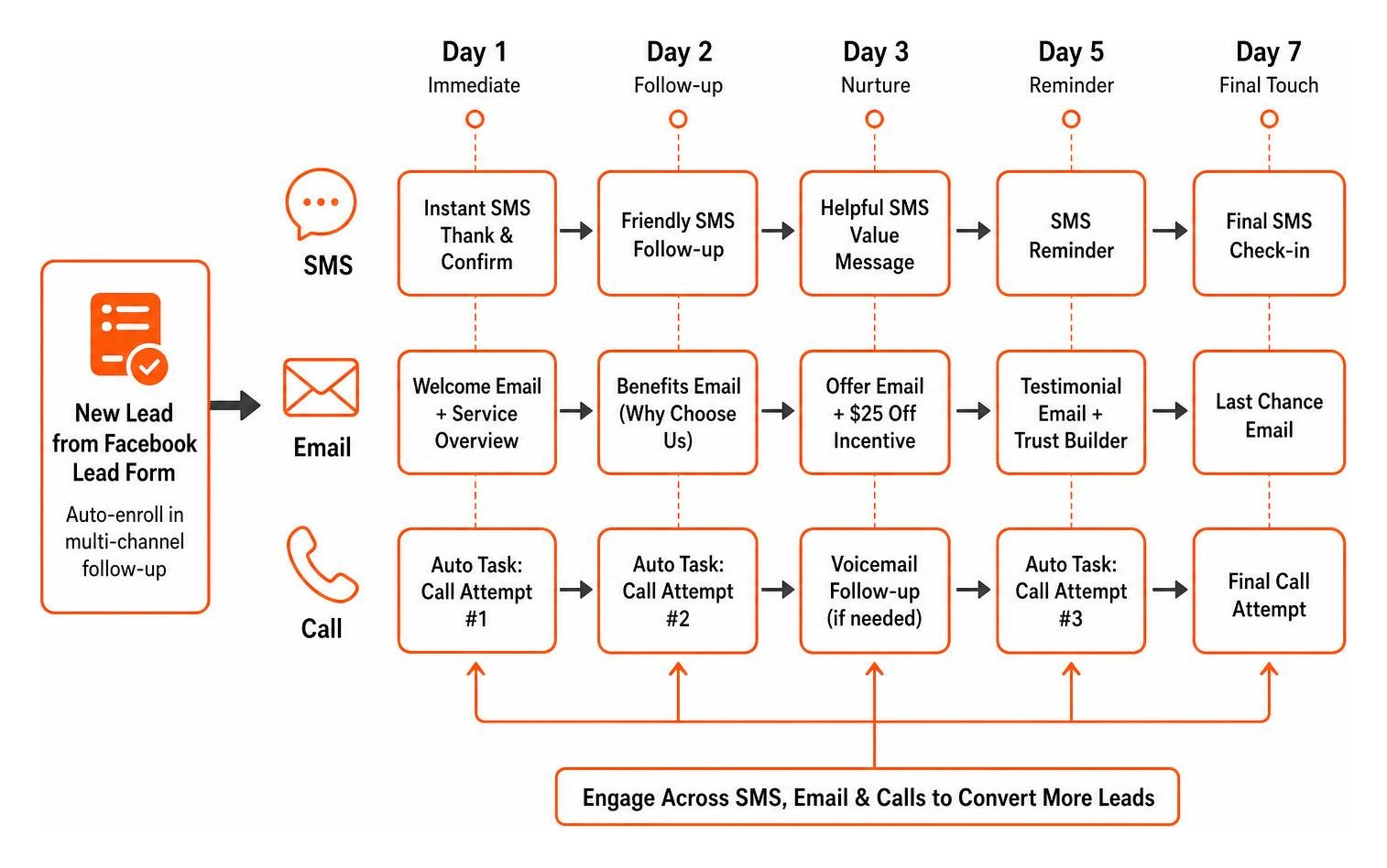
Implement an automated multi-channel follow-up cadence:
- Day 1 (Instant): Automated SMS text and email confirmation sent within 2 minutes of form submission, followed by a phone call from your office team within 15 minutes.
- Day 2: Friendly check-in email answering common service questions (e.g., “What’s included in your initial deep clean?”).
- Day 4: SMS text checking if they have questions regarding their customized quote.
- Day 7: Value-focused email highlighting client reviews and your satisfaction guarantee.
- Day 30+: Monthly promotional check-in delivering seasonal cleaning tips and limited-time booking discounts.
Integrating Meta Campaigns with Search Ads for Maximum Pipeline Velocity
While Facebook ads excel at creating demand by interrupting users with eye-catching transformations, search advertising captures prospects who are actively typing “maid service near me” into Google right now.
Pairing Facebook social campaigns with high-intent Google Ads PPC creates an omnichannel growth engine. Homeowners who see your professional before-and-after transformations on Facebook will recognize your brand name when searching for emergency move-out cleaners on Google, lifting your conversion rates across both channels.
Frequently Asked Questions About Cleaning Business Facebook Ads
How much should a cleaning business spend on Facebook ads per day?
A starting budget of $10 to $20 per day is ideal for testing local audiences and identifying your best-performing ad creatives. A 7-day test costing roughly $70 to $140 provides sufficient data on click-through rates and cost per lead. Once you establish a profitable cost per booked job, scale your daily budget by 15–20% every few days to maintain steady client acquisition.
Why are my Facebook ads generating clicks but no booked cleaning jobs?
High clicks without booked jobs usually indicate friction in the conversion process. Common culprits include directing traffic to an unoptimized, slow-loading website homepage instead of a direct booking page, asking for too much information on initial forms, or taking hours to contact leads. Switching to native Facebook Instant Forms and responding to inquiries within 5 to 15 minutes immediately resolves this drop-off.
What is the ideal cost per lead for residential cleaning services on Meta?
Across residential cleaning campaigns, a healthy cost per lead falls between $6.00 and $10.00. Because recurring residential clients deliver an average lifetime customer value ranging from $1,500 to $3,500+ annually, an acquisition cost under $50–$100 per retained recurring client delivers exceptional return on investment.
Conclusion
Building a profitable client pipeline through social advertising does not require massive corporate budgets or complicated technical funnels. By defining precise local service boundaries, showcasing genuine before-and-after visual proof, leveraging friction-free Instant Lead Forms, and executing an automated multi-touch follow-up sequence, your cleaning company can generate a dependable stream of residential and commercial bookings week after week.
At Cleaning Business Growth, our growth-partner system was built by a cleaning business founder to help independent operators scale profitably without binding contracts or guesswork. If you are ready to stop relying on word-of-mouth and establish a predictable client acquisition engine, connect with our team today to launch high-converting Facebook Meta Ads tailored to your local market. Have questions about setting up your campaign? Feel free to Contact Us to discuss a custom marketing strategy for your service business.