Understanding Performance Max Ads for Cleaning Services and How They Work
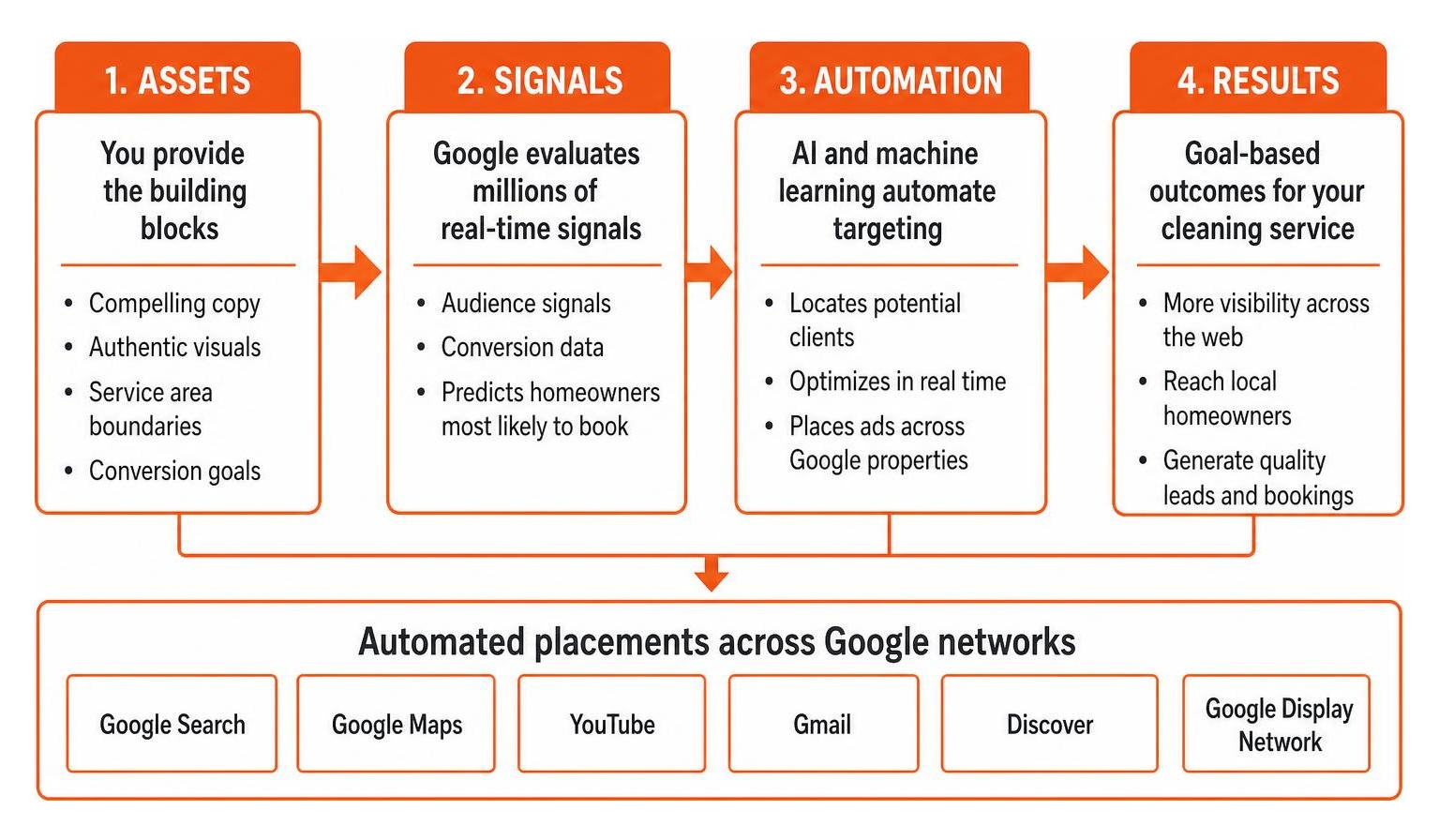
Modern digital marketing requires capturing homeowners across multiple touchpoints as they research, evaluate, and choose a maid service. Performance Max acts as an automated, goal-based campaign system within Google. Instead of creating separate, isolated ads for every individual channel, this format consolidates your marketing efforts across Google Search, Maps, YouTube, Gmail, Discover, and the Google Display Network.
By utilizing artificial intelligence and machine learning, Google evaluates extensive real-time signals to predict which homeowners are most likely to book a residential cleaning. Rather than relying solely on manual keyword bidding, the platform uses audience signals, creative assets, and structured conversion data to locate potential clients.
For house cleaning businesses, this cross-channel capability expands reach into local neighborhoods where families and busy professionals need recurring home upkeep or deep cleaning. Through centralized Google Ads PPC management, you provide the building blocks—compelling copy, authentic visuals, service area boundaries, and precise conversion goals—and the algorithm handles placement across Google properties. Performance Max ads for cleaning services help you stay visible to potential clients without manual oversight of each individual channel.
The evolution of automated campaigns also ties directly into recent platform changes. Google has been transitioning traditional pay-per-lead features into this unified environment, as detailed in the official documentation regarding how Local Services Ads transition to Performance Max campaigns with pay-per-lead goals. Embracing this automated framework enables residential cleaning business owners to streamline local lead generation while maintaining consistent visibility across the entire web.
Performance Max Versus Traditional Search Campaigns
Understanding the structural differences between traditional Search ads and Performance Max helps you decide how to balance your advertising spend. Standard Search campaigns focus primarily on active search intent, displaying text ads when a homeowner types a query like “maid service near me.” Performance Max broadens that scope by engaging users across visual and contextual environments while they browse video content, check email, or explore local maps.
| Feature | Traditional Search Campaigns | Performance Max Campaigns |
|---|---|---|
| Primary Placements | Google Search Results & Search Partners | Search, Maps, YouTube, Gmail, Discover, Display |
| Targeting Method | Specific Keywords & Match Types | Audience Signals, Search Themes & Machine Learning |
| Creative Assets | Text Headlines & Descriptions | Text, High-Resolution Images, Logos & Short Videos |
| Optimization Focus | Keyword Bids & Search Query Match | Full-Funnel Conversions & Goal-Driven Bidding |
| Channel Reach | Intent-Driven Search Capture | Comprehensive Multi-Channel Local Discovery |
Standard Search remains vital for capturing immediate, high-intent searches. However, exploring why Google Ads campaigns are crucial for growing your residential cleaning service shows that relying on an isolated channel can leave local demand untapped. Performance Max supplements traditional search by keeping your brand visible throughout the homeowner’s decision-making process.
Core Conversion Tracking Essentials for Performance Max Ads for Cleaning Services
The automated engine driving Performance Max relies entirely on conversion data to determine where to place ads and which users to target. If your campaign receives flawed or incomplete tracking signals, the algorithm will optimize for meaningless interactions rather than paying residential cleaning clients. Establishing precise tracking is the foundation of any profitable campaign.
To train the algorithm effectively, categorize your tracking actions into primary and secondary goals:
- Primary Conversion Actions: High-value actions that represent real prospective revenue, including completed quote request forms, dynamic call tracking calls lasting over a qualified duration, and confirmed online booking appointments.
- Secondary Conversion Actions: Informational milestones used strictly for reporting and observation, such as newsletter signups, general contact page views, or brief phone inquiries.
Phone calls represent a significant percentage of residential maid bookings. Using dynamic number insertion tools ensures that incoming calls from ad interactions are accurately attributed back to your campaign. Furthermore, ensuring that incoming traffic reaches the anatomy of a high converting maid service landing page keeps bounce rates low, simplifies the estimate request process, and sends clean conversion signals back into your Google Ads dashboard.
Step-by-Step Campaign Setup and Smart Bidding Strategies
Building a campaign designed for sustainable lead generation requires setting clear boundaries so the system spends efficiently within your immediate service territory.
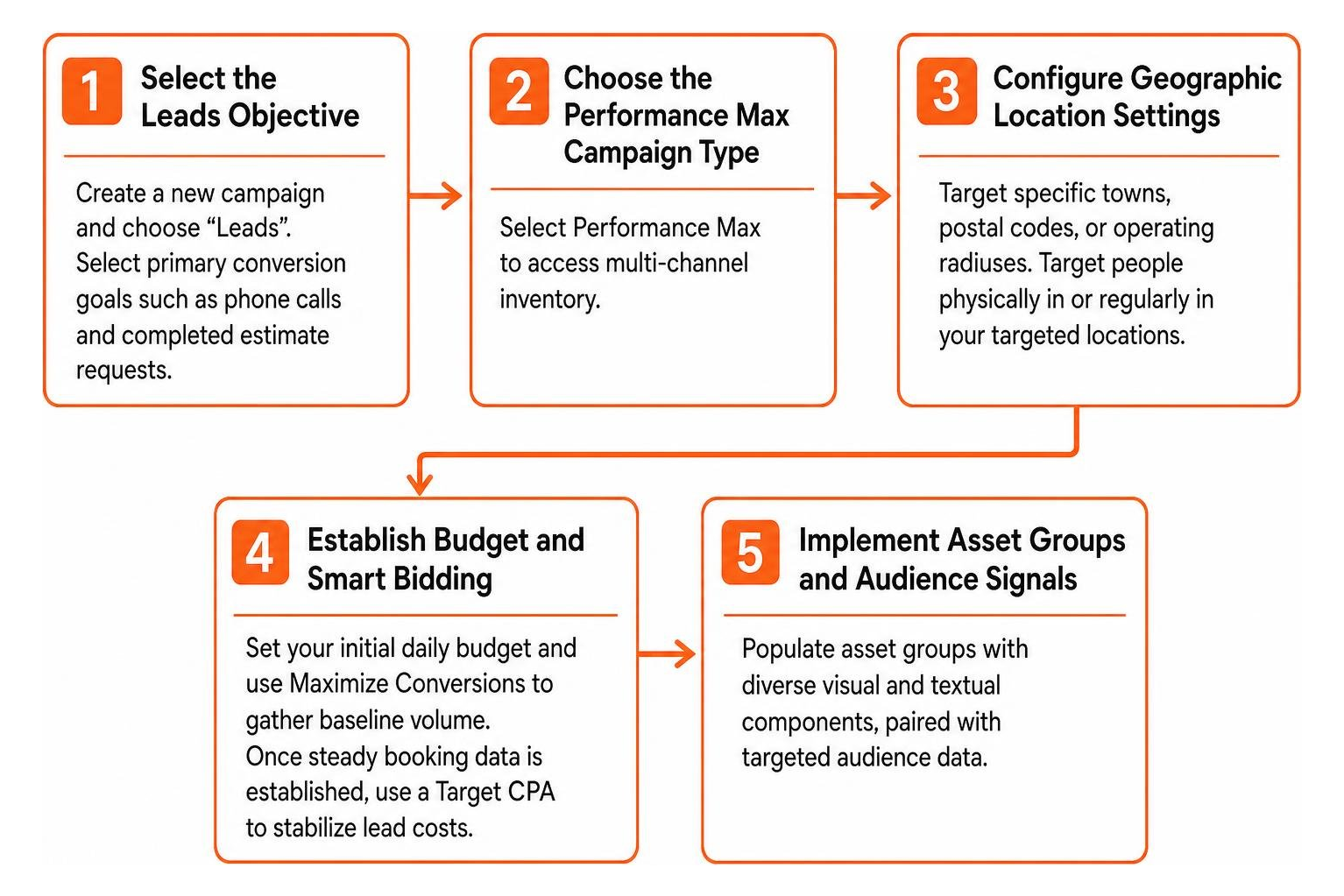
- Select the Leads Objective: Begin by creating a new campaign in Google Ads and choosing “Leads” as your campaign objective. Select your verified primary conversion goals, such as phone calls and completed estimate requests, while excluding secondary metrics.
- Choose the Performance Max Campaign Type: Select Performance Max to access multi-channel inventory.
- Configure Geographic Location Settings: Local service boundaries are critical. Under location options, target your specific towns, postal codes, or operating radiuses. Select the setting to target people physically in or regularly in your targeted locations rather than individuals merely showing interest from outside your service area.
- Establish Budget and Smart Bidding: Set your initial daily budget and begin with an automated bidding strategy focused on maximizing conversions to gather baseline volume. Once steady booking data is established, you can introduce a target cost per acquisition to stabilize lead costs.
- Implement Asset Groups and Audience Signals: Populate your asset groups with diverse visual and textual components, paired with targeted audience data.
Structuring your campaign correctly from the outset helps you stop burning ad spend on cleaning PPC and start driving real bookings by eliminating out-of-market waste and poor optimization cues.
Structuring High-Converting Asset Groups in Performance Max Ads for Cleaning Services
Asset groups house the creative elements that Google automatically arranges into ad formats across Search, Display, YouTube, and Maps. Rather than using generic stock photos, high-performing residential cleaning asset groups rely on authentic visuals and transparent messaging that build trust immediately.
- Short and Long Headlines: Craft headlines emphasizing reliability, background-checked staff, satisfaction guarantees, and easy scheduling.
- Detailed Descriptions: Detail what is included in standard recurring cleans, deep clean packages, and move-in or move-out appointments. Highlight bonded and insured cleaners and pet-safe products.
- High-Resolution Photography: Upload clear, authentic images of your uniformed staff, branded supplies, and genuine before-and-after transformations of living rooms, kitchens, and bathrooms.
- Engaging Video Content: Include short vertical and horizontal video clips showcasing your team at work, equipment setups, or quick customer walk-throughs. If you do not provide videos, Google will generate basic slideshows that often lack brand polish.
- Trust Badges and Callouts: Add structured snippets highlighting business longevity, background-checked cleaners, flat-rate pricing models, and satisfaction guarantees.
Leveraging Audience Signals and First-Party Customer Data
Audience signals provide the algorithm with a strategic head start. Instead of forcing machine learning to guess who needs home cleaning, you supply curated data points indicating the characteristics of your ideal recurring client.
Incorporate first-party data by securely uploading customer match lists comprised of past and present house cleaning clients. Google analyzes these lists to construct predictive profiles of local homeowners who share similar browsing habits and economic profiles.
Combine these lists with in-market audience segments for residential cleaning, alongside custom search intent themes. Adding these themes guides the system toward prospects actively searching for maid services, house cleaners, and recurring home maintenance, demonstrating how top maid services dominate local search using Google Ads.
Optimizing Placements and Eliminating Wasted Budget
While Performance Max provides widespread automation, maintaining active control over where and how your budget is spent prevents wasted spend on unqualified traffic.
To protect your budget, apply account-level negative keyword lists. Residential house cleaning campaigns frequently attract irrelevant searches from individuals seeking cleaning jobs, DIY stain-removal tips, or other non-commercial queries. Adding terms like “jobs,” “employment,” “salary,” “free,” and “how to clean” prevents ads from triggering on non-commercial searches.
Additionally, use brand exclusion lists if you already run a dedicated standard Search campaign targeting your company name. This prevents Performance Max from claiming credit for cheap branded clicks, ensuring its budget is directed toward discovering net-new clients.
Review your landing page settings by evaluating the Final URL expansion feature. Leaving URL expansion unrestricted can cause Google to direct paid traffic to irrelevant pages, such as privacy policies, careers pages, or informational blog posts. Point traffic strictly to your high-converting residential quote request page. If issues arise, you can troubleshoot and fix underperforming cleaning company Google Ads by auditing search category insights and tightening creative assets.
Frequently Asked Questions About Residential Cleaning Performance Max Ads
How long does it take for a campaign to exit the learning phase?
The machine learning system requires time and conversion volume to calibrate bidding algorithms and identify which creative combinations perform best across different placements. During the initial launch, the system tests various channels, creative pairings, and geographic pockets. Making frequent structural adjustments, changing budgets drastically, or altering bid strategies during this ramp-up period resets the learning cycle. Patience is vital while the campaign gathers sufficient primary booking actions to stabilize performance.
Can a house cleaning business run Search and Performance Max campaigns together?
Running a layered advertising strategy where traditional Search and Performance Max operate concurrently is often highly effective. Traditional Search campaigns maintain strict, predictable control over exact search phrases with immediate local intent. Meanwhile, Performance Max expands around that foundation, capturing prospects on Maps, YouTube, and Display who may not have entered a direct search query yet. Applying brand exclusions to Performance Max prevents both campaigns from competing for the same branded searches.
What is the most effective bid strategy for a new house cleaning campaign?
For a brand-new residential campaign without historic conversion history, beginning with a strategy designed to maximize overall conversions is typically best. This allows the algorithm to focus entirely on collecting booking actions within your budget. Once your campaign establishes a steady, predictable volume of recurring quote requests and phone calls, transitioning to a strategy with an established target cost per acquisition helps regulate lead costs while maintaining steady growth.
Conclusion
Implementing an automated, multi-channel approach allows residential house cleaning companies to expand beyond traditional search pages and connect with local homeowners across their entire digital routine. By combining accurate conversion tracking, authentic before-and-after creative assets, targeted service area restrictions, and negative keyword exclusions, you build an efficient pipeline for generating recurring residential bookings.
At Cleaning Business Growth, we provide proven, niche-specific growth partnerships developed by our founder through scaling her own cleaning business. With no contracts and results-focused support, our team handles web design, local visibility, and automated lead generation to keep your cleaning technicians fully booked. Explore how customized Google Ads PPC campaigns can accelerate your residential company’s long-term expansion today.