High-Value Local Cleaning Service SEO Keywords for Maximum Visibility
The most effective local cleaning service SEO keywords combine high-intent service terms with local modifiers, such as “maid service near me,” “[City] house cleaning,” and “commercial office cleaning near me.” While broad national terms generate raw search volume, geo-targeted and transactional phrases capture prospects at the exact moment they need immediate service. With the U.S. janitorial and cleaning services market projected to reach $112 billion in 2026, targeting commercial intent at the neighborhood and municipal level is the key to driving predictable recurring revenue.
Searchers looking for a cleaner usually have a pressing problem: an upcoming lease inspection, a messy office before a corporate visit, or an overwhelming weekly schedule. Targeting terms with clear commercial intent connects your business with high-value prospects immediately.
Here is a look at the monthly global search volume for top cleaning phrases:
- maids: 1,500,000 monthly searches
- carpet cleaning: 673,000 monthly searches
- pressure washing: 550,000 monthly searches
- housekeeping: 301,000 monthly searches
- cleaning service: 246,000 monthly searches
- cleaning services near me: 201,000 monthly searches
- maid service near me: 201,000 monthly searches
- house cleaning services: 165,000 monthly searches
- window cleaning: 135,000 monthly searches
- gutter cleaning: 110,000 monthly searches
- house deep cleaning service: 22,200 monthly searches
- end of tenancy cleaning: 18,100 monthly searches
- house cleaning prices: 12,100 monthly searches
Notice the difference in search behavior. While 1.5 million people search for the broad term “maids,” terms like “cleaning services near me” or “house deep cleaning service” reflect immediate local buying intent. You can discover how these patterns fit into broader digital campaigns by reviewing our guide on seo strategies for cleaning companies.
Core Categories of Local Cleaning Service SEO Keywords
To organize an effective campaign, we divide target terms into four functional categories based on search intent:
- Ready-to-Book Terms: These are urgent, high-intent phrases used by people needing immediate service (e.g., “same day house cleaning near me,” “emergency office cleaners,” “local maid service open now”).
- Residential Cleaning Terms: Phrases tied to regular home maintenance (e.g., “weekly house cleaning services,” “deep cleaning house checklist,” “apartment cleaning services [City]”).
- Commercial & Janitorial Terms: High-contract-value B2B searches (e.g., “commercial janitorial services near me,” “medical office cleaning [City],” “nightly office cleaners”).
- Specialty Service Terms: Niche tasks tied to life events (e.g., “move out cleaning services,” “post construction cleanup [City],” “airbnb turnover cleaning”).
Grouping your terms this way ensures you don’t treat a one-time move-out clean the same as a multi-year commercial contract.
High-Converting “Near Me” and Hyperlocal Modifiers
Search queries containing “near me” are proximity-driven signals that rely heavily on a searcher’s physical location and mobile device data. In fact, roughly 46% of all Google searches carry local intent, and 88% of consumers searching for a local business on a smartphone call or visit within 24 hours.
Targeting broad city names is rarely enough. A homeowner living in a specific neighborhood or suburb rarely wants a company based 30 miles across the metro area. Using hyperlocal modifiers—such as specific suburb names, local districts, and postal codes—lowers keyword competition and connects your business with customers within your primary route density.
For instance, optimizing for “deep carpet cleaning [North Suburb]” is far easier and more profitable than fighting large aggregator directories for “carpet cleaning [Major Metro].”
Transactional vs. Informational Keyword Conversion Rates
Understanding buyer intent is essential when balancing your website’s content. A visitor searching for “how to remove red wine from carpet” is looking for DIY advice, whereas someone searching “professional carpet stain removal service near me” is ready to hand over a credit card.
Understanding these shifts is central to navigating the evolving landscape of seo, where search engines increasingly distinguish between basic research and ready-to-buy inquiries.
| Keyword Type | Example Query | Search Intent | Conversion Likelihood | Recommended Page Destination |
|---|---|---|---|---|
| Transactional | “book move out cleaning near me” | Ready to hire | Very High (15%–30%) | Dedicated Service / Booking Page |
| Commercial | “office cleaning prices [City]” | Evaluating providers | High (10%–20%) | Commercial Quote / Service Page |
| Investigative | “maid service vs independent cleaner” | Comparing options | Moderate (3%–8%) | Comparison Guide / Blog Post |
| Informational | “how long does a deep house clean take” | Gathering facts | Low (1%–3%) | Informational Blog Post |
| DIY / Research | “diy vinegar window cleaning solution” | Solving issue alone | Very Low (<1%) | General Blog / Resource Center |
Focusing the bulk of your on-page optimization on transactional and commercial queries gives you the fastest path to inbound phone calls and estimate requests.
Structuring Your Website Architecture and Keyword Mapping
A common mistake cleaning business owners make is trying to rank their homepage for every service they offer. When a single page tries to target house cleaning, janitorial work, window washing, and post-construction cleaning all at once, search engines struggle to identify the page’s core focus. This leads to keyword cannibalization, where your own pages compete against one another in search engine results pages (SERPs).

A clear website hierarchy separates distinct services and geographic locations onto dedicated URLs, making it easier for search engines and potential clients to find exactly what they need.
How to Map Local Cleaning Service SEO Keywords to Website Pages
Your keyword mapping blueprint should direct search intent to dedicated, relevant landing pages across your domain:
- Homepage: Target your broadest primary local service term and overarching location (e.g., “Premier House Cleaning Services in [City]”).
- Individual Residential Service Pages: Assign specific service clusters to individual pages (e.g.,
/deep-cleaning/,/move-out-cleaning/,/recurring-maid-services/). - Commercial Cleaning Service Pages: Create dedicated B2B pages tailored to property managers and business owners (e.g.,
/commercial-janitorial/,/medical-office-cleaning/). - Geographic Service Area Pages: Map suburb-level and surrounding city keywords to distinct regional pages (e.g.,
/service-areas/[suburb-name]/). - Blog Posts & FAQs: Assign long-tail informational queries to helpful articles (e.g.,
/blog/post-construction-cleaning-checklist/).
When linking between these pages, use descriptive anchor text that includes target terms naturally (for example, linking from your homepage to your “deep cleaning services” page) to pass topical authority throughout your site.
Building Suburb and Service Area Landing Pages
If your cleaning company serves multiple suburbs or surrounding municipalities, creating dedicated location pages helps capture localized demand. However, you must avoid simply copying the same text and swapping city names. Search engines easily detect thin, duplicated doorway pages and may filter them out of search results.
To make each service area page unique and competitive:
- Write at least 200 to 300 words of unique introductory text highlighting the specific community.
- Mention local landmarks, popular neighborhoods, or common local home styles (e.g., historic properties, high-rise condos, modern suburban estates).
- Embed a customized Google Map focused on that specific service area.
- Feature authentic customer reviews and before-and-after project photos from jobs completed in that neighborhood.
- Add structured LocalBusiness schema markup tailored to that specific location.
This hub-and-spoke model allows you to expand your geographic footprint systematically without risking algorithmic penalties.
Optimizing Google Business Profile and Map Pack Signals
Securing a spot in Google’s local 3-pack is one of the fastest ways to generate inbound phone calls for a cleaning business. Google ranks businesses in the Map Pack based on three primary factors: relevance (how well your business matches what the user is searching for), distance (how close you are to the searcher), and prominence (how well-known and well-reviewed your business is across the web).
Google Business Profile (GBP) signals account for roughly 32% of the local pack algorithm, making an optimized listing essential for local visibility. According to Google’s business ranking guidelines, optimizing for relevance, distance, and prominence directly improves your placement in search results.
Start by getting your categories right:
- Primary Category: Choose the most accurate description of your primary business model, such as “House Cleaning Service” or “Commercial Cleaning Service.”
- Secondary Categories: Add complementary categories like “Janitorial Service,” “Carpet Cleaning Service,” or “Window Cleaning Service” to capture relevant secondary searches.
Fill out every available field in your profile, including your business hours, service areas, and direct booking links, while keeping your business name strictly accurate to avoid listing suspensions.
Leveraging Customer Reviews for Keyword Prominence
Customer reviews account for approximately 20% of Google’s local pack ranking algorithm. However, review count alone is not the only metric search engines evaluate. Review recency (receiving new feedback within the last 30 days) and consistent review velocity are just as critical.
You can learn more about building a dependable review pipeline in our guide on the importance of reviews to cleaning business growth.
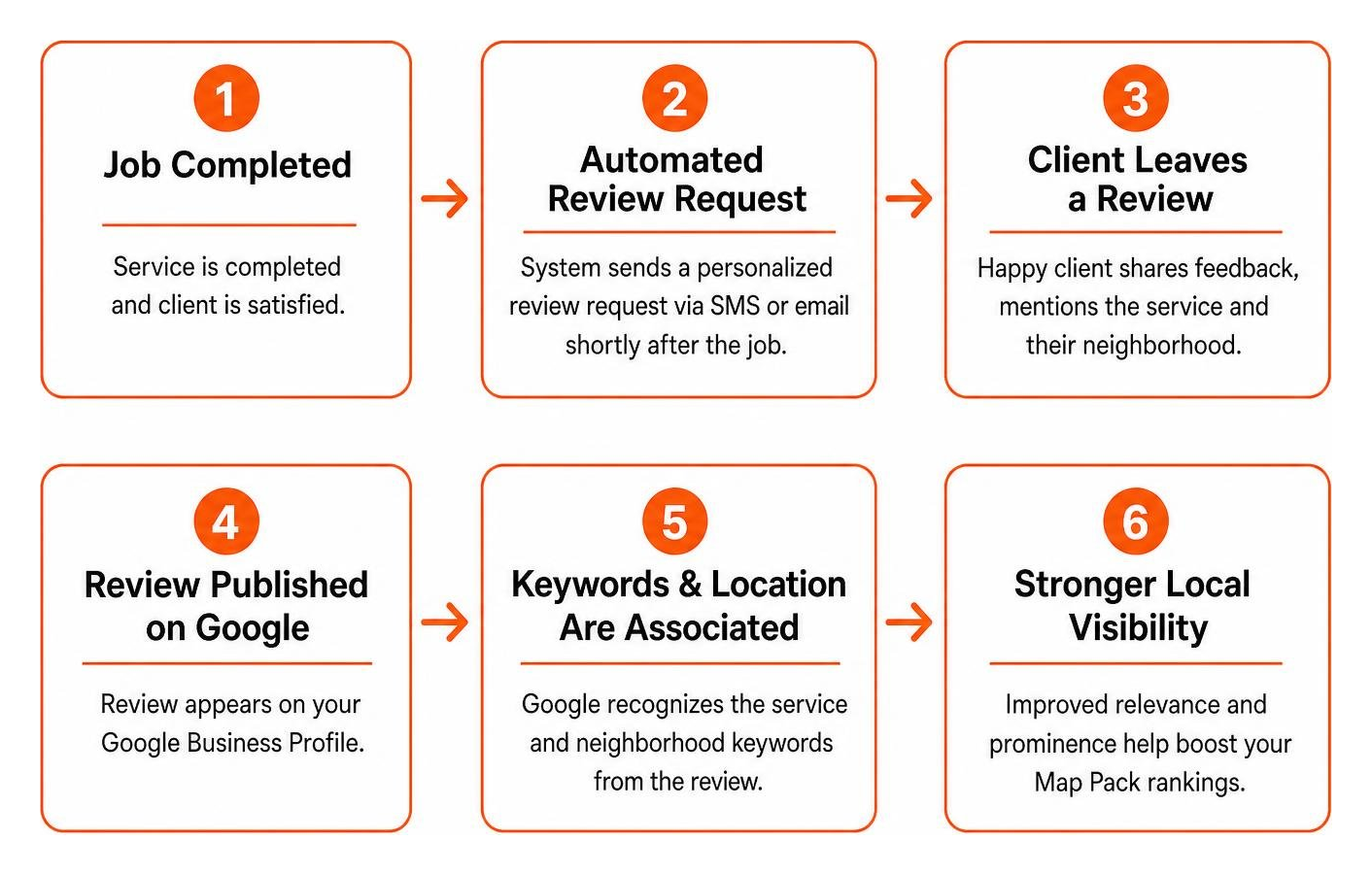
When happy clients naturally mention the service they received and their neighborhood in a review (e.g., “The team did an amazing deep clean on our home in West End!”), Google associates those keywords with your business profile.
When replying to reviews, reinforce those signals naturally:
- Client Review: “Ginger’s crew did a fantastic job cleaning our home before our move!”
- Optimized Business Reply: “Thank you for the review, Sarah! We are thrilled our team could deliver a top-tier move-out cleaning service in [City] to help make your move stress-free.”
Responding to all reviews within a week builds trust with both search algorithms and prospective clients browsing your profile.
Enhancing GBP Posts, Services, and Visual Media
An active Google Business Profile signals to search engines that your business is open, reliable, and engaged with customers. Profiles with regularly updated photos receive 42% more requests for directions and 35% more website clicks than inactive profiles.
To keep your profile active:
- Upload Real Job Photos Weekly: Post 10 to 15 authentic, geotagged before-and-after photos of your crews in action, clean spaces, and branded vehicles.
- Publish Weekly Google Posts: Share seasonal promotions, service highlights, or helpful maintenance tips every seven days to keep your profile active.
- Utilize the Q&A Feature: Proactively ask and answer common questions in the GBP Q&A section, integrating terms like “recurring maid services” or “licensed commercial cleaners.”
- Populate the Services Menu: List every specific service line alongside detailed descriptions and starting rates to give prospective clients clear expectations before they call.
On-Page Optimization and Content Implementation
On-page SEO tells search engine crawlers exactly what your website pages are about. Search engines have evolved from basic keyword matching into sophisticated systems that evaluate user intent, topical relevance, and semantic entities. You can read our analysis of how ai changing local seo is reshaping the way search engines process localized content.
When optimizing on-page elements, place your target phrases in key structural locations:
- Title Tags: Place your primary keyword and city near the front, keeping the total length under 60 characters (e.g., House Cleaning Services in [City] | Top-Rated Cleaners).
- Meta Descriptions: Write a compelling 150-to-160-character summary featuring secondary keywords and a clear call to action (e.g., Looking for reliable maid services in [City]? Get sparkling clean rooms with our bonded and insured cleaners. Book your free quote today!).
- Header Hierarchy (H1, H2, H3): Use a single H1 tag containing your primary page keyword, followed by H2s and H3s that incorporate related service variations and neighborhood terms.
- Image Alt Text: Describe your images naturally using descriptive terms (e.g., Professional cleaner performing deep kitchen cleaning in [City]).
- Structured Data (Schema Markup): Implement
LocalBusinessorHouseCleaningServiceJSON-LD schema markup on your site to explicitly define your business name, operating hours, service area coordinates, and contact details for search engine crawlers.
Avoiding Keyword Stuffing and Technical Errors
Stuffing phrases like “best cleaning service [City] cheap cleaning service [City]” repeatedly into your text creates a poor reading experience and triggers spam filters. Modern search algorithms prioritize natural, helpful language.
Alongside clean copy, your website’s technical health plays a direct role in user experience and rankings:
- Mobile Responsiveness: Most local service searches occur on mobile devices. Your website must feature intuitive navigation, readable text, and tap-to-call buttons.
- Page Load Speed: Prospective clients will leave a slow website. Compress all images using modern WebP formats and remove unnecessary scripts to ensure pages load in under two seconds.
- Clean NAP Integration: Display your canonical Name, Address, and Phone Number (NAP) clearly in your website’s footer across every page, matching your Google Business Profile details exactly.
Informational Blog Content and Topical Authority
Publishing high-quality blog content establishes topical authority, signaling to search engines that your website is an authoritative resource in the cleaning industry. Despite changing algorithms, search engines still depend heavily on well-structured informational content; our perspective on why seo is not dead explains how high-value articles continue to attract qualified organic traffic.
Target top-of-funnel informational queries with actionable guides:
- “The Ultimate Checklist for Deep Cleaning Your Home Before Moving”
- “How Often Should Commercial Carpets Be Professionally Cleaned?”
- “Standard Cleaning vs. Deep Cleaning: What Is the Difference?”
Include direct Q&A formats, bulleted checklists, and clear pricing tables within your articles. This formatting improves readability and increases your chances of earning Google Featured Snippets and AI Overview citations, while strategic internal links guide readers to your primary booking pages.
Research Tools, Performance Tracking, and Strategic Updates
A successful keyword strategy requires routine measurement and adaptation. Tracking how searchers find your business allows you to double down on high-performing queries and fix drop-offs before they impact revenue.
Cleaning companies that regularly track their local search metrics and optimize their profiles often see substantial improvements in lead volume within a few months.
Essential Free and Paid Keyword Research Tools
You do not need a massive budget to conduct effective keyword research. Combining accessible free resources with specialized paid platforms provides comprehensive visibility into local search demand:
- Google Search Console (Free): Shows the exact queries bringing users to your site, along with impressions, clicks, and average ranking positions.
- Google Keyword Planner (Free): Provides historical search volume brackets, regional trends, and advertiser competition levels for cleaning terms.
- Google Autocomplete & People Also Ask (Free): Reveals real-time, conversational questions searchers ask around seed topics like “maid service” or “janitorial costs.”
- Ahrefs / Semrush (Paid): Advanced platforms for tracking Keyword Difficulty (KD), auditing local competitor backlink profiles, and discovering content gaps across your service territory.
- Mangools KWFinder (Paid): An accessible tool for analyzing localized search volumes and SERP competitors at the city and regional level.
Routine Content Audits and Ranking Maintenance
Search engine rankings are dynamic. Competitors update their websites, Google refines its ranking criteria, and consumer search behavior shifts with the seasons.
To keep your rankings strong:
- Monthly Performance Reviews: Use Google Search Console and Google Business Profile Insights to identify pages losing impressions or calls.
- Quarterly Content Refreshes: Update existing service pages with fresh testimonials, updated pricing structures, new project photos, and expanded FAQ sections.
- Citation Audits: Verify that your business listings on platforms like Yelp, Angi, and the Better Business Bureau maintain identical NAP details.
- CTR Optimization: If a page ranks in the top five results but gets few clicks, rewrite the title tag and meta description to make the offer more compelling.
Frequently Asked Questions About Local Cleaning SEO
How do local cleaning keywords differ from generic search terms?
Generic keywords (such as “housekeeping” or “cleaning service”) represent broad informational searches with no geographic context. Local cleaning keywords combine specific services with geographic indicators (e.g., “maid service near me” or “office cleaning in [City]”). These geo-targeted terms carry higher transactional intent, lower search competition, and significantly higher conversion rates from nearby customers.
How long does it take to rank in the Google Map Pack for cleaning terms?
A newly verified and fully optimized Google Business Profile can begin appearing in local search results within 4 to 8 weeks. However, achieving consistent top-3 Map Pack rankings in competitive metropolitan markets typically requires 2 to 4 months of ongoing optimization. This involves gathering steady customer reviews, uploading weekly photos, maintaining citation consistency, and strengthening on-page location signals.
Should my cleaning business target cost and pricing keywords?
Yes, targeting terms like “house cleaning prices” or “commercial cleaning cost per square foot” is effective when handled strategically. While some price-focused searchers are bargain hunters, many are qualified buyers looking for transparent estimates to plan their budgets. Creating dedicated pricing guides or quote calculator pages allows you to capture this search volume, set clear expectations, and filter for serious leads.
Conclusion
Ranking at the top of the Google Map Pack and local search results is one of the most reliable ways to grow a cleaning business. By identifying high-intent keywords, building a clean website structure, optimizing your Google Business Profile, and publishing helpful content, you create a steady source of inbound leads.
At Cleaning Business Growth, we help cleaning business owners put these strategies into practice. As a marketing agency built by someone who grew and operated a cleaning company, we provide web design, paid advertising, automated review systems, and comprehensive seo for cleaning services designed to scale your operations without locking you into rigid contracts.
If you are ready to stop chasing leads and start dominating your local service area, begin by optimizing your core service pages and claiming your Google Business Profile today. Consistent, structured local SEO will keep your schedule full and your crews working season after season.